Living Out the “Do One Thing That Scares You” Advice

Eleanor Roosevelt famously said, “Do one thing each day that scares you.” Last week I did one thing that scared me: I attended an introductory hip-hop dance class.

Who doesn’t want to dance better? Is it possible to watch this flash mob at Ole Miss dancing to Jai Ho without wanting to be teleported to that cafeteria and join in? Or watch my Spanish teachers in Santiago perform their rendition of Shakira’s Waka-Waka without cheering them on? (The official version was watched 70 million times in one month.) Still, the thought of letting it loose on a real dance floor makes many a heart pound — including mine. Heeding Roosevelt’s dictum, though, I added “hip hop dance class” to my June to-do list.

On the appointed night, I put on my Nike Air Max gray sneakers, my gray sweatpants which I’ve owned for 8 years, and my Air Force Academy gray hooded sweatshirt. (Hood up. Obviously.) I made my way over to the Bellavista neighborhood not sure what to expect. I found the building, pre-paid $10 for the one-hour class and waited nervously in the locker room area. Because I was taller than the walls of both the women’s and men’s locker room, I stood in the hallway with my head politely down, and gathered my composure, B-Rabbit style.

The dance room looked like a yoga studio except the speakers were big and blaring and the front mirror stretched wall-to-wall. Each of the 20 students found a place in the room. Without any introductory remarks, the teacher turned on loud dance music and began to lead us in stretches. Five minutes later we began to go step-by-step through a choreographed dance to a generic dance beat.

Almost immediately, I fell behind. Having never taken a dance class or in any way moved my body to a beat, I was lumbering, awkward, inflexible, and incompetent. While I can usually handle myself on a dance floor where there are no rules, keeping up with the (mostly) girls around me who moved briskly through each choreographed stage was impossible. If I wasn’t a step or two behind everyone else, I was instead frozen as I had forgotten the next step in the sequence. I was quite clearly the worst in the class.

As I sat at KFC afterwards reflecting on the class, a few thoughts crossed my mind. First, I knew I’d get a blog post out of the night, which tends to justify most new experiences. Second, there are not many things I do where I am truly the worst. I wouldn’t call it “humbling” — the most cliche of lessons these days, isn’t it? — but hip hop dance did put me out of my comfort zone and generated feelings of frustration I haven’t felt for years. Finally, I’m confident that if I took 5-10 classes I could become halfway decent. There’s a lesson in here about the power of practice.

Bottom Line: As we get older we tend to do stuff we already know we’re good at. Experimenting outside this zone of competence can be fun, mind-expanding, and even a bit scary.

###

One year ago I received an epic, unforgettable Chinese massage in Beijing. The short version of a Chinese massage is you’re thrown into a co-ed room with others, the lights are bright, you lie on a futon naked, an overweight old woman comes in and slaps your ass, stuffs her fingers into your ears, pounds your head with clenched fists, grabs your balls, gives you scalding hot tea halfway through, and then 10 seconds after she finishes she hands you a feedback form to fill in on what you thought of the experience.

Strictly for purposes of comparison, over the weekend I got one-hour massage in Santiago. Not everything in Chile is cheap, but some things like apartments and lunch menus can be had at third world prices. Apparently massages too: USD $14 for an hour! The basic Chilean massage is more dignified than the Chinese. Suave music in the background, a dark room, a gentle masseuse. The only oddity was that the massuse didn’t touch my quads or buttocks — two of the largest muscle groups on the body. Instead, she obsessed with my feet. I happen to have very ticklish toes and feet. When she grabbed them, I left my meditative state, started sweating, and gripped the massage table. My leg convulsed with every touch. None of this dented her enthusiasm. In the face of such stress, all of my usted conjugations escaped me, so I said nothing except curse under my breath. I’m 0-2 with massages the last two years.

Seven Thoughts on the Airline Industry

Airline-experience

Here are seven assorted thoughts on one of my main side interests: the airline industry.

1. Free market needed. Imagine if Americans could only drive cars in America that were designed/made in America. Horrible! The Japanese are the best carmakers. Now imagine if Americans could only fly domestically on airlines run by Americans. Horrible! Yet that's what we have today. The single best way to improve the domestic U.S. flying experience would be to open up the market to competition and allow foreign carriers to service domestic routes. Here's my previous post on making the Open Skies Agreement truly global.

2. Three hour tarmac rule. The new three hour tarmac rule means the government can fine airlines that keep passengers on the tarmac for more than three hours. Generally, when it comes to these kinds of consumer protection laws, I would rather the market determine real need — let consumers vote with their dollars in favor of companies that offer certain protections. Apply this philosophy to airlines: if a certain airline felt consumers would value this "feature" (a guarantee that they would be able to access the gate area after three hours), they would offer it, and consumers would pay a premium for it. But this case is more complicated.

Let's review a typical flight delay situation. Before a plane departs, as passengers wait in the gate area, everybody's priorities are aligned: passengers and airlines want to get to the destination as quickly as possible. Remember, airlines lose money when flights are delayed or canceled. Before boarding, if the consumer wants to go to the bathroom, buy food, meander, or even choose not to board the flight, he can do so.

Once he boards the plane and the plane doors close, he becomes captive to the airline. He has no freedom until he's out at the gate area at his destination. As the plane readies for departure and taxis on the runway, passenger and airline priorities are still aligned: fly to destination as quickly as possible. Now suppose there's a delay on the runway. The plane has pushed back from the gate, but can't take off. The airlines at this point still want to get the plane off the ground as quickly as possible. Some passengers, however, no longer care about making it to their destination. After three stinkin' hours on a cramped plane, they want to stretch their legs, buy food, go to a full-size bathroom, etc. So their priorities have changed but they cannot act on them. This lack of freedom and the discomfort that can result (most recently a full night on a regional jet in Minnesota with no food and a broken bathroom) makes me reluctantly support the three hour tarmac rule.

3. Government subsidizing unprofitable routes. Someone who's keen on stimulating entrepreneurship in Chile told me, "We should lobby airlines to get them to start a San Francisco-Santiago non-stop flight." Make it easier for Silicon Valley folks to go to Chile. I replied, "If the route were profitable, it would already exist." He replied, "What kind of entrepreneur are you? Do you know how many things would never have been built if the attitude was, 'If it were good it would already exist'?"

The difference in the airline industry is that airlines can mine hoards of data around passenger traffic. For example, American Airlines can easily see how many of its passengers who leave SFO are bound for SCL (Santiago). I'm not sure but I presume it's also possible to see aggregated passenger traffic from other airlines. If the airlines saw a tremendous number of passengers departing San Francisco and connecting via Atlanta, Dallas, Los Angeles, or Miami (the four non-stop gateways) to Santiago, they would introduce the route.

By the way, I think this is an easy way for a government to increase possible entrepreneurship: subsidize airlines to service an unprofitable route to the Bay Area.

4. Environmentalists and runways. Efforts to protect the environment ought to be subjected to a cost-benefit test. It's not always easy to do this, of course. (How to calculate the benefit of a pristine national park or clean air?) Generally, I am pro-environment and pro-conservation. I love the outdoors. But I think the environmental movement has gone too far in their effort to protect endangered plants and animals around airports and limit carbon emissions from more planes. A third runway in Heathrow would allow an extra 140 million trips a year by 2050.

5. Why not use the regional airline model in the whole industry? For regional flights, a brand airline like Delta will outsource the operation of the aircraft to a regional carrier like SkyWest. The plane says Delta, the ticket is booked on Delta.com, and the pricing / scheduling is run by Delta. But another company operates the aircraft and hires/fires the ground and flight personnel. It seems bizarre that a single company handles front-end marketing, reservations, customer service, aircraft operation, ground operations, baggage, maintenance, etc. Delta outsources food service to Gate Gourmet, for example. Why doesn't it outsource other aspects of its overall operation?

6. Eight hour workday too long for pilots? I recently spoke with the head of a major pilots union who told me management is trying to force pilots to fly more than eight hours a day and that this constitutes a serious safety risk. The union is lobbying congress. Should lawmakers force airlines to cap pilot workdays at eight hours? How many hours do pilots actually spend flying? My understanding is that 98% of the time the plane runs on auto-pilot. We should let one of the two pilots nap during the flight. Then allow them to fly up to 10-12 hours a day — just like the rest of us — or simply let management and pilots negotiate a fair work day with corresponding compensation.

7. Consolidation such as Delta-Northwest and United-Continental is good for the airlines, bad for consumers (less competition = higher prices), but perhaps long-run good for price insensitive consumers inasmuch as these companies will be able to offer better service, joint facilities / lounges, etc.

The 10 Dollar Rule

Chris G. wrote about how he reduces stress when traveling, and among all the good tips is this:

I often get stressed out spending small amounts of money. Overall, this isn’t always bad — it’s led to a healthy paranoia about debt and a lifelong adherence to frugality. However, it has its downsides too, in that I can spend hours walking around trying to decide what to eat, or hours trying to figure out the public transit system somewhere instead of just flagging down a taxi.

…I finally created a $10 rule for myself that has been rocking my world. The $10 rule is that when I’m traveling, I deliberately avoid worrying about most things that cost $10 or less. As I said, this makes a big difference. I actually eat three meals a day now. If I can’t find free WiFi, I’ll walk into a hotel and pay for the connection. SO MUCH LESS STRESS.

Rules like this reduce stress because they reduce the amount of thought you have to put into each decision (and ultimately reduce the total number of decisions). Evaluating options, weighing pros and cons, and then deciding: this taxes emotional and mental resources.

I should put in place a similar rule when I’m looking at music on iTunes. I will buy a song for $.99 or $1.29 if I know it to be good. But I will never experiment with music because I don’t want to pay a few bucks downloading songs I might not like, yet I will still spend ridiculous amounts of time debating it in my head.

###

Here’s a piece on Salon titled the Art of Choosing: The hidden science of choice. The most interesting point is cultural: in America we glorify choice and teach our kids at a young age to do the same. Japan is different.

The Unbearable Lightness of Travel

Levi is an American traveler and talented writer who's riding his bicycle through Uganda, Rwanda, Burundi, Tanzania, and Kenya. His dispatches from the road are worth following if you read travel blogs.

In a recent post he first covers the liberating freedom of not owning much stuff. Things are a burden: nice and expensive things come with the stress of potentially losing those nice and expensive things. I know more and more people, including non-travelers, who have gone minimalist and report great improvements in psychic calmness.

In the second half of Levi's post he reflects on the flip-side of a life free not only of material stuff but also a regular schedule, regular commitments, regular friends, a regular bed:

at some point, you begin to wonder what you're doing. you begin to feel you don't have a purpose in society, that you are peripheral to the movement of every day life. i think this happens around the time that all the stress you had saved up from whatever you left has sloughed off, and your mind and spirit are a bit free again. the immediate purpose of escape, of release, of experiencing freedom is fulfilled. then if you are still on the road, the question is, why?

there are surely many answers to it: having always wanted to see such-and-such a thing; or doing what you're doing as a challenge (this probably applies a lot to bicyclists); having someone to meet or something specific to do later in the trip, etc. but there are also surely many travellers–like myself–who have no such answer. we are on the road, travelling, without really being able to say why is we are travelling. at least, there's no immediate answer.

and i have more to say about what kind of answers come, and what you can learn from travelling beyond the obvious seeing of sights, tasting of foods, learning of new languages, etc. but what i wanted to mention today was how extended travel can be the needed spoonful of sugar to make regular life go down. when you travel, you are always on the peripheries of regular life: you are a customer but not a worker, a guest but not a regular, a new friend but never an old one.

that life on the periphery–travel–makes you want a place. it makes you want people around you that you've known and will know for some time, some work that you can do every day, a regular bed to sleep at night with a pillow you're used to. it makes you want a home, to go home if you have one, to go make one if–like me–you don't.

and travel that way is a natural end to itself, and support to regular life: it puts you on the outside, free, and after awhile you want again to be inside, confined but comfortable, knowing your place in the world.

This is the classic heaviness/lightness dichotomy that was first popularized in the Czech novel The Unbearable Lightness of Being and more recently in movies like Up in the Air. George Clooney's character gives speeches about emptying your "backpack" of obligations and being totally and completely free. It's a good life, until we see Clooney in the end craving "heavy" commitments like a real, rooted romantic relationship.

The highs and lows of travel follow this all the way: the free spirit in you loves the opportunity to escape and explore and the freedom to live day-by-day, but ultimately the lightness becomes unbearable, and you must find a home, and stay there.

(thanks to Maria Pacana for the pointer)

Exploring Patagonia

Patagonia2
Last week my Mom and I spent several days in Torres del Paine National Park in Chilean Patagonia. The scenery was spectacular. And there is a rush that comes from being very near the Southern tip of the world.

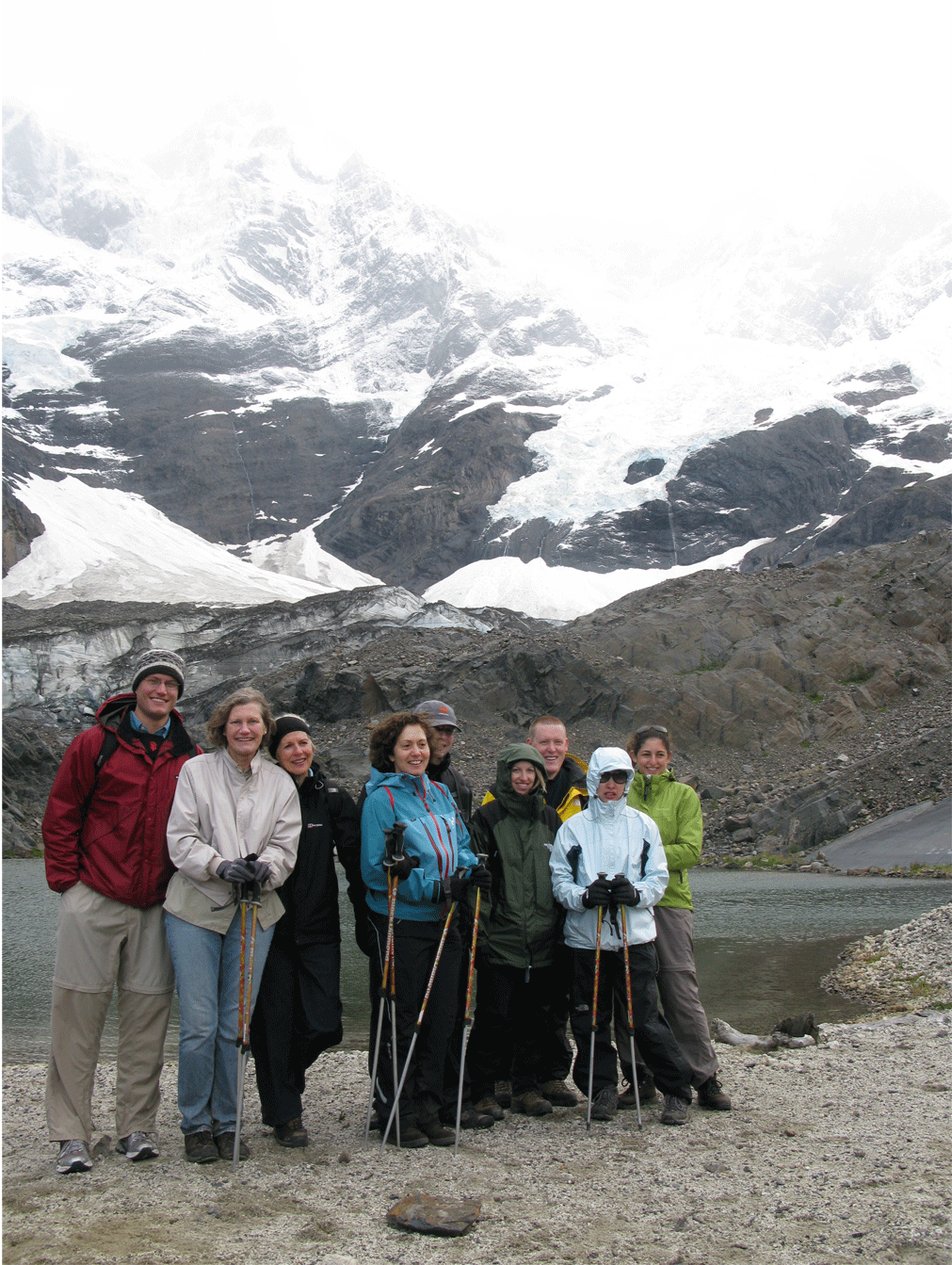
Within the park you can hike in and around glaciers as well as in lush green mountain areas. Here's a pic of my Mom and I (on the far left) during an all-day hike — we stopped for lunch as a small avalanche rumbled behind us. The rain poured, the wind howled, but hey, it's Patagonia.

Group_patagonia
It felt pretty similar to Alaska. Patagonia exists in both Chile and Argentina, though I'm told the Chilean side has more diversity. The National Park is a four hour flight south from Santiago, and I recommend a visit for anyone traveling within the Southern Cone.