Personal Blogs Are So Upbeat – When You're Gonna Blog Something, You Want it to Be Positive

Out of my 200+ RSS feeds, about 20 are close friends of mine, not only for their words but because I know them so it’s more fun. I notice almost all of the personal blogs I read are consistently upbeat.

It’s rare to see a post, “I’ve had a real shitty week. Let me tell you about it” or “Here are all the things I’ve messed up on the past couple days.” Instead, we get only highlights. On my blog, at least, this is defintiely the case. But I don’t think I’m being dishonest; I do think I have a really good life!

My theory is that when you know in advance you’re going to blog something, it changes the actual experience, and you’re inclined to try to make it a positive one so you can write about it positively. For example, I recently had a great solo dinner in Rome. I had a terrific companion (newspaper) and good food. About 1/4 of the way through this thought crossed my mind: “This is an awesome meal. I’m going to blog it.” I did. I was committed in my mind to making it a positive night overall, and it did end up that way. In sum: when I know I’m going to blog an experience, I’m committed to making it a positive experience, and since intention and reaction mostly define the quality of an experience, it usually turns out positive. True, I could always commit to having positive days each day, but knowing I will blog something introduces a weird form of “public accountability.”

This is all related to constructing the preferred narrative of our lives, telling ourselves stories, deluding ourselves to stay happy, crediting our successs to talent instead of luck, so on and so forth. All this is fine by me.

Why live in “reality” when you can live in your own joyous conception of it?

Can Non-Engineers Run Software Companies?

That’s a question I haven’t seen discussed in blogland, even though it’s one many early stage companies grapple with.

I received an anonymous comment on my post Visit to Microsoft in Dublin:

are you one of those non-technical people who think they can manage a software company?

the idea of a non-programmer bossing around programmers is retarded and very common. you’re already spewing bullshit at the tender age of 18!

talk to me about adding closures to C# (do you know what a closure is?) or dynamic vs. strongly typed languages (do you know what that means?) for implementing web applications or something. don’t say "web 2.0 will be all about collaboration in the enterprise" or other meaningless garbage.

Putting aside his assertion that age 18 is tender — ah, what a lovely thought — he does bring up a legitimate point about non-programmers.

One ideal set-up in a start-up software company is to have a few technical guys and one straight shooting business guy. Some guys like Paul Graham like to say every start-up should be employed by "hackers" or "geeks" but I don’t share this view because I don’t think great functional software products is what makes a software company successful. Moreover, hackers tend to share a certain worldview (such as perfectionism, a deadly path for any start-up) which can shut out other perspectives.

The reason why I think there’s a legitimate role for the non-technical person at a software company is that evaluating the quality of the raw code (sort of what Anonymous Commenter is asking me to do) is not, I think, what dooms most software development projects. Communication and management seem royally important, since so much rides on managing and meeting expectations.

The non-engineer must have meaningful expertise and experience in his/her "shallow" area of technology, but doesn’t have to be able to write code. What does this mean?  He could have a reasonably detailed discussion about the application’s architecture and programming methodology. He neither would accept such programmer bullshit as "It will be done when it’s done" nor pull off such business-suit bullshit such as "Hey, add a feature that does X" without detailed specs. He could have conversations about collaboration among programmers, about source control, about deadlines and specs, about cost estimates. And when necessary, he could roll up my sleeves and get dirty (like I tried to do a few months ago when I built a PHP/mySQL simple web app that processed movies).

Likewise, for a technical person to have meaningful expertise in his shallow area, it would mean understanding that it’s not about the software, it’s about the customer problem. It’s not about perfection, it’s about "good enough." It would mean realizing that businesses make promises based on deadlines. Most important, it would mean the technical person could communicate effectively to his co-founders and to other programmers. Since so much of software development seems to be about managing and meeting expectations, the most motivated and effective programmers are often those who communicate the best.

So to answer the question. From my vantage point, non-engineers can indeed run software companies, assuming three things:

1. They have co-founders or colleagues who can assess the raw quality of the code.

2. They have meaningful expertise and experience in their "shallow" area — software development, managing engineers, specing projects, such that they can effectively bring to bear strong communication and management skills in this kind of environment.

3. The company is not selling its wares to programmers or any other highly technical market, in which case an all-coder lineup could work since coders are the customers.

What do you think?
Shai Agassi's Travel Schedule and Thoughts on Hosted Software

Quick comments on this SF Chronicle interview of SAP’s Shai Agassi:

1. He travels 29 weeks a year. How does he have a family? Through his answers his attitude seems to be, "I know I’m not around enough, but they’ll learn the value of hard work through my example." I like this better than people who say, "No, I really am home enough! I go to Johnny’s games!"

I would love to dig in and see how Agassi deals with work-life balance on a day-to-day level…

2. He sees on-demand as "trendy" and the hybrid approach as a nut cracked by SAP. That is, the managed appliance model of customer owning the box but maintained and upgraded by the vendor. I’m more bullish on more pure hosted software: I think we’re just scratching the surface of the internet infrastructure and over the next five years we’ll see the customer be able to customize software extensively even if the base code is shared with lots of people. I also think the reliability issues will resolve themselves as the model becomes the standard; SFDC’s problems of late reminds me of eBay’s IT infrastructure problems when they became huge. If anything, it’s a sign of the critical mass.

Some People Are Better in Email

I like some people better in email than in person. Why is this the case?

One theory: For in-person interactions there is a smorgasbord of interpersonal styles to choose from. Some may be more appealing to me than others. In email, there are less styles. Some people really "get" effective email communications. Others don’t. So, for people who "get" email but have an interpersonal style that I find annoying, they’re more likable electronically.

I am trying to sort my network by people who I like via email more than in-person, and remind myself to send them lots of email instead of requests for coffees.

Separating My RSS Feeds By Priority

I think a lot about productivity, managing energy, time, etc. A big part of this is my information intake of which my RSS reader is a meaty (though not the biggest) portion.

I have a lot of theories around this. One of them has to do with temporality. For example, today on the bike I read The Economist instead of HBR or Harper’s because I know the Economist is relevant this week and may be less relevant in a few weeks. I will be awake for about 11 more hours today (Sunday) and I will be working for probably 9 of them. There are many things I simply need to get done today. If I start to drift into stuff not relevant or necessary for my work today and tomorrow, I will try to re-focus. Of course, this approach needs to be balanced with long-term projects, deep thinking, books, etc.

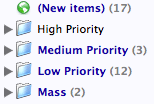
My RSS reader, though, has not until now been structured like this. All my 280 feeds have been in one giant folder and a few times a day I scroll through my New Items folder. Sometimes I would stop and slow down, since a couple dozen warrant close reading of each and every post. Others I skim quickly. Some things I need to read now, others I could read in a week and still be OK. So I reorganized my feeds into four folders:

Rss_pic_blog_copy

"Mass" is for high volume feeds that I must skim to keep up. I will only read Medium and Low feeds once every two days. High Priority I will read several times a day.