The Underrated, No-Stats All-Star

I'm fascinated with people I think of as "underrated" — folks whose contribution is larger than their reputation would suggest. I wonder, why don't more people appreciate this person? What do I see that others do not? (The same thought process of anyone who buys a stock they feel is underpriced.)

I've blogged about why it's better to reach out to underrated people if you're trying to build your network. And I've blogged about how to spot these people by de-emphasizing popular filters.

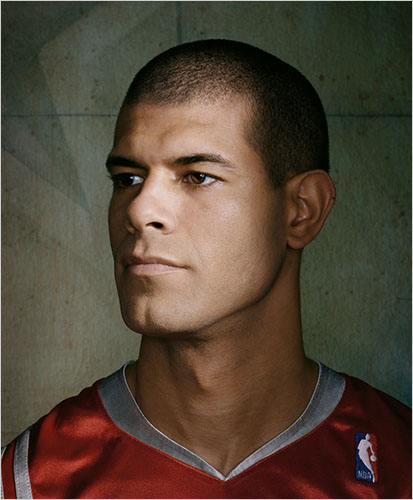
15battier.1-500 Michael Lewis has the cover piece in today's NYT Magazine titled The No-Stats All-Star. Lewis makes the case that Shane Battier of the NBA team Houston Rockets is a seriously underrated player. His contributions are not easily tracked by the conventional statistics, but whenever Battier is on the court the team does better. Why?

It's the philosophy of Moneyball (a book which looked at the Oakland A's use of unusual statistics to size up players) applied to basketball. I recommend reading the whole thing. And then asking yourself, "Who's the Shane Battier on our team?" Every organization has one.

###

There's a throwaway sentence in the piece that touches on a class / race issue that is worthy of an entire separate article:

Is it a coincidence that many of the things a player does in white basketball to prove his character — take a charge, scramble for a loose ball — are more pleasantly done on a polished wooden floor than they are on inner-city asphalt?

The Day Job vs. Side Passions Dilemma via Baron Davis

Every team — corporate or athletic — needs a motherfucker. Baron Davis, a superstar point guard and one of the leading talents in the NBA, is the Los Angeles Clippers’ motherfucker.

Or is he? Sports Illustrated has a great feature on Baron in their latest issue. At 29 years old, Baron probably maintains one of the most active and interesting personal lives of any NBA player — he lectures Congress on health issues and the inner-city obesity crisis, consulted with Barack Obama during the campaign, cites Malcolm Gladwell when explaining social phenomena, produces documentaries, invests in internet start-ups. All good right? Maybe not, if it distracts from his day job:

When you’ve been involved in a successful presidential campaign, produced an Oscar-worthy documentary and include among your goals for 2009 brokering a truce among Bloods, Crips and Latino gangs, it’s easy to see how tossing a ball into a basket against, say, the Milwaukee Bucks could seem somewhat trifling. And while Davis won’t cop to it, there is a sense in some corners that his extracurricular activities have exacted a price on his basketball…

Davis is finding out that the line between being perceived as a Renaissance man or a dilettante can be a fine one. Asked about Davis’s competitive resolve, Hornets coach Byron Scott says tepidly, “My take on him is that he’s a very talented point guard, and I’ll leave it at that.” Recently, Roper, the Crossroads coach who now works for Davis’s foundation, had a heart-to-heart with his former player. “I told him we all get distracted by what’s attainable and obtainable, but first and foremost, you’re a basketball player. Focus on what made you what you are. I want to see you be an All-Star for the next four or five years and turn the Clippers around. Movies and whatnot can wait.”

My buddy Kevin Arnovitz, who writes about the NBA for ESPN.com, has an interesting re-frame:

Here’s a question: Would you take umbrage — both as a parent and as a taxpayer — if you learned that your kid’s fifth grade public school teacher was coming into the classroom a little less prepared this semester because she’s been serving as the chair of a cancer research walk-a-thon, which requires as much as 15 hours a week of her free time, time she’d otherwise spend composing lesson plans? What if her side project wasn’t a charity? What if she were spending those hours starting a business that indulged one of her many passions outside the classroom?

In this scenario, no, I wouldn’t mind. But what if I were CEO of a company with an employee who decided to indulge her many passions outside of work to the tune of 15-20 hours a week? I’d like to think I’d be supportive, if it didn’t prove too distracting, though I can’t be sure. There are no easy answers to the day job vs. side passions dilemma that so many of us face.

Related Post: Are You Your Team’s Motherfucker? In the comments, Chris Yeh says he is a “situational motherfucker” but claims he can “step up to full motherfuckerhood when necessary.”
Success and High Expectations for Happiness Can Feed Depression

Henry Abbott at the ESPN TrueHoop blog writes:

The other day I talked to a guy who is close to several NBA players. I asked him to estimate the percentage of NBA players who are depressed. I guessed 60. He said more like 95.

Why are so many successful people depressed? Theories abound…

One I often think about is that people get depressed when there's an expectation that they're always supposed to be really happy and grateful, as NBA players must feel when interacting with starry-eyed fans. This effect also explains higher-than-normal depression over the holiday season: there's an expectation that you're supposed to be jolly and merry and if you are not something is wrong with you.

Anything with a strong narrative around it (like the holiday season) fosters this dynamic. Take New York City. This article about a couple leaving New York City for Buffalo, NY notes their frustration that the real New York — the one you dream about — always seemed just out of grasp to them but fully accessed by others. Or take college life. Hollywood films frequently portray college as the "best four years of your life." These expectations produce an effect similar to the NYC couple who felt the romantic, exciting New York was always just around the corner: in college, the real party is always somewhere else. Surveys of college students show that the average student perceives his peers as having more fun than him, and he wildly overestimates the drinking and sex habits of his classmates.

Bottom Line: When you're successful, like an NBA player, people expect you to be super happy, grateful, stable, and so forth, most of the time. Or, even if you're not successful, if you're thrust into certain well-mythologized environments, a similar unrealistic expectation can drag you down.

(thanks to Chris Yeh for tagging this)

Quote of the Day

"It's never that I didn't send child support. It's just that I didn't send the amount that was said to be sent by the courts."

Jason Caffey, 35, former player for Chicago Bulls and holder of two world championship rings. Caffey has fathered 10 children with 8 women and they are suing for child support payments.

Hat tip to Andrew Hess, whose sports blog is titled Just Trying to Feed My Family in honor of Latrell Sprewell turning his nose at a $21 million contract offer by insisting "I'm just trying to feed my family."

Of course when I was growing up I knew Sprewell as the player who choke strangled then Golden State Warriors coach P.J. Carlesimo to the ground and threatened to kill him because Carlesimo asked Spree in  practice to "put a little mustard" on his passes.

Welcome to the NBA.

Attack on Every Pitch – AOEP

A friend who works at a division 1 baseball program told me a lot of the staffers sign off emails with "AOEP" which stands for Attack on Every Pitch. It’s a pitcher’s mantra. It doesn’t mean the pitcher has to throw strikes every pitch — a pitcher can still attack a hitter’s weakness by throwing out of the zone. It simply means that each pitch should have a purpose.

This one is easily adapted to business / life. I like it. Attack on every pitch.