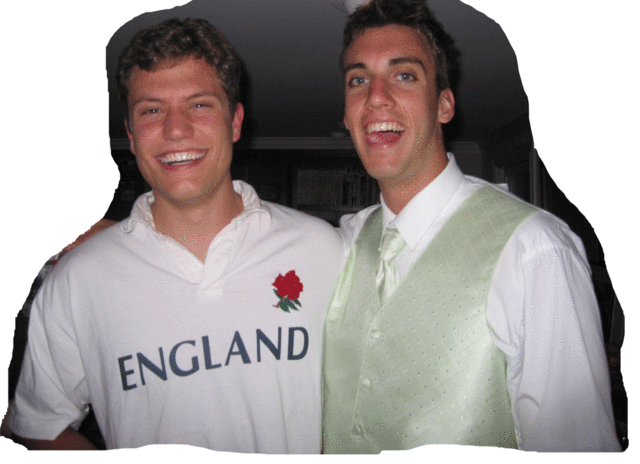
High School Senior Year Prom

It was last night. I didn’t go to the formalities — saved $250 and my sanity — but did hit up the after party.

I arrived at the girl’s house around 11 PM. In a serendipitous moment, after walking in the door I bumped into the girl’s dad who I have been wanting to meet with since he does some cool investing work in China and is a trustee of the World Affairs Council. We exchanged business cards. ("Only Ben Casnocha shows up a high school prom party and ends up trading business cards with a parent," a friend later tells me. I guess.)

A few hours later a couple friends and I crash back at my house. We got back at 3 AM, the latest I’ve been up my whole life (I’m a go-to-sleep-early-get-up-early kind of guy). This morning we rolled out of bed and walked back across town in the beautiful San Francisco sun to pick up our cars, which we had parked near the house.

In one of those only-at-a-high-school-prom-party moments, as we’re walking we bump into a friend of ours walking the other way on the sidewalk. Still in tuxedo, he smiles. "What’s up with you?" I ask. "I haven’t gone to sleep yet, been out all night!" he answers. It was 10:30 AM. Holy christ.

I find my car, turn on the radio, and "It’s a Beautiful Morning" comes on, the perfect song for the cloud-less day. I drove home, tired, humming to the song, and reflecting on the craziness that is high school social life. The most fascinating psychological petri dish I’ve encountered.

Related Post: Prom 2005

Prom_pic_blogFinger2final

Teen Sex Novels…And How to Think About Changing Teen Culture

I feel like I have some obligation to comment on the essay in today’s NYTBR by Naomi Wolf about the young adult fiction teens are gobbling up. They are, to be blunt, sex novels, whose plots center around 15 year old girls sneaking off behind statues at MoMA to have "semi-sex." Oh, how repulsive!

This is, of course, just another adult outraged at the state of pop culture (read: teen culture), though that doesn’t make it any less legitimate. Wolf’s spin is that it’s not just on television screens anymore; it’s intruded our novels. Weren’t books supposed to be an untouched oasis?

I guess my question is what purpose essays like this serve. Awaken parents to the chilling reality? Aren’t parents hit over the head with this stuff all the time? Is it with the hope that a combination of the monthly "tales from the teen trenches" piece (last month it was Caitlin Flanagan and the teen oral sex epidemic) and an expose on college dorms from Tom Wolfe, parents of the 60’s will get off their butt and install internet filters?

Here’s my theory.

There are traditionally thought to be two groups of teens. Both indulge in the ugly: they drink alcohol, smoke pot, hook up with guys/girls indiscriminately, glorify the slutty girl or the dumb jock (Wolf: "Girls…are expected to compete with pornography, but can still be labeled sluts"), watch hours of MTV, and buy pornography. One group engages in such behavior without a cloud of intellectual confliction. It’s just the thing to do. Another group partakes, yet with a deep moral dilemma. Aren’t they going to be instructing their kids to not drink or do drugs?

And yet there’s this little known third category. This is the group of teens who don’t resolve the moral dilemma by saying "Should I do this?" and then light the joint anyway. Instead, they fake their drunkeness, play up their Saturday night at school, exaggerate their sexual experience. When done right, this earns them a place among the hot, popular kids — after all, to completely opt-out would mean social isolation — and concurrently keeps them from breaking every moral fiber.

Wouldn’t it be more useful for writers like Wolf to stop bashing the lifestyle of that one group of teens — the mindlessly hedonistic — and instead lay out a playbook for this third category, which no doubt is the most difficult to pull off?

It is clear that if the ugly teen culture adult critics love to beat up is going to change, it’s not going to be because of essays in high culture media. Instead it will come from infiltrators within, from the quiet warriors fighting to carve a lifestyle that strikes an impossible balance.

They need all the help they can get.

Contexualizing the Summers Fall Out

As a fascinated observer and soon to be consumer of higher education, I have been following Larry Summers’ resignation from Harvard with interest because I think it speaks volumes about the state of academia. Peter Beinart, editor The New Republic and an impressive person, has an excellent contexualization (free username/pass required) of the Summers debacle. Read it and it’s hard not to feel sympathetic for the man.

He wanted top professors to actually teach. What???

He wanted the college to serve the nation, not merely itself. Is he nuts?!?

Higher education needs a reinvention.

Would You Rather Have a UC Berkeley Diploma and No Education, or Education and No Diploma?

There’s a very interesting debate going on among economist bloggers on the "signaling" theory of  education. Would you rather have a [insert prestigious college name here] diploma and no education from there, or the [prestigious college name] education with no diploma? "The signaling theory says that to a significant extent, education does not increase workers’ productivity. Instead, the fact that you obtain an education shows that you were more productive all along, which makes employers want to hire you."

Gary Becker, perhaps the most influential living economist, argues that signaling benefits have tailed off considerably, to the point where it doesn’t matter if someone went to Stanford or the University of Phoenix – after their first job, their overall productivity and success will trump whatever degree they hold. "Pay adjusts to productivity, not education credentials."

Tyler Cowen offers a novel point that education is about "self-acculturation." It’s about surrounding yourself with peers and social attitudes that form a self-image which values intelligence, wealth, etc. "Your identity is shaped by what you are doing, and your peers, between the critical ages of thirteen to your early twenties.  Those are precisely the years covered by our educational system."

Bryan Caplan rebuts these points. "Sure, employers eventually figure out how productive a worker is IF they hire him. But interviewing is expensive, and so is getting rid of disappointing workers. So it still makes sense to use credentials to make interviewing and hiring decisions: You save valuable time, and reduce the chance of hiring unproductive workers."

I will chime in with my own two cents later.

The High School Years: The Worst Four, or Best Four?

I recently exchanged a couple emails with two different adults who recalled two different views on childhood/adolesence. The first was on Amy Batchelor’s post where a book reminded her of "the deep and real sadness of childhood, and how much I really like being an adult." A day later I got an email from a really successful late 30’s entrepreneur/investor: "Are you enjoying still being 17? I’ll trade you."

This is pretty representative. It seems some adults look back at their high school years as utterly wrenching – "the worst four years of my life" – while others recall it more fondly. I have to say, if these have been the worst four years of my life, then I’m going to have a good life, but that’s because I’ve had oodles of good luck.

High school – or, more generally, being a teenager – has been neither one big happy party nor one depressing nightmare. Most days I am extremely happy, excited, engaged in the world of ideas. I wake up and bound out of bed ready to tackle an impossible to-do list. A few days ago I took the Authentic Happiness test run by UPenn and soon stopped after taking the first few quizzes. It was a slam dunk. I’m a happy person – I get it – especially when compared to other people my age.

But on those rare days, I sometimes get that splash of cold water that so many of my peers endure regularly.

Irving Wladawsky-Berger
of IBM who maintains an excellent blog, recently posted on diversity and how certain groups of people need to mask their natural tendencies. He concluded, "The freedom to be who I am.  I can’t remember when I last encountered words that so succinctly captured our deepest aspirations."

I think this is an excellent summation. Only problem: most teenagers’ malaise comes from the fact you can’t just be yourself if you don’t know what "yourself" means. This doesn’t just mean one’s most natural personality. It means deeper things, like one’s sexuality, one’s relationship to the material world and religion, one’s life expectations vs. parental expectations. It is amazing how much angst these questions can cause teens – and it appears the angst has increased, as more and more teens are being diagnosed as depressed.

I’m blessed to be very "grounded" in who I am, what I believe, and the life I’m choosing to live. I, fortunately, haven’t had to struggle with these identity issues as much as my peers may have to. I haven’t had to see shrinks, cry to my friends on the phone, etc etc. This doesn’t mean I have it all figured out, or that I don’t have those random days of depressive introspection (hormonal, of course!).

Among the hundreds of comments I’ve gotten on this blog, one anonymous one has always resonated:

Oh please, Ben.  You’ve got an incredible mind, and most of your blog entries are truly engaging and interesting to read, but this sentence is just a veiled form of self-affirmation.  It has nothing to do with truly asking a question of the reader, and really only makes you come off as seeming insecure about yourself and whether reading so many books is truly a good thing to be doing with your time.  If you truly were comfortable with being told by people to "break out of your shell", you wouldn’t have to constantly keep defending just how "big and worldly" your shell is.  You would just move on, knowing full well who you are, why you’re doing what you’re doing, and why your actions will speak for themselves in the long run.  You don’t need to keep defending who you are.

There is some truth in this.

OK, enough sharing for now. Back to work.