What Is the Knowledge Most Worth Knowing?

This is a great post on Gideon’s Blog about what should comprise a broad liberal arts education. Every pundit has their list of "essential knowledge". I found this list thoughtful, as I’m someone who believes in the liberal arts as the underpinning to an active engagement with the world. Excerpts:

I. Origins of the Western Tradition.

An integrated humanities course with a Great Books focus. Students read Homer, Hesiod, the dramatists, Aristophanes, Thucydides and Herodotus, the pre-Socratic philosophers, Plato and Aristotle, the Hebrew Bible and some ancient Near-Eastern contextual material, Plutarch, Virgil, Horace, Ovid, Lucretius, Greek and Latin lyric poetry, secondary material on Greek, Hellenistic and Roman History, the Christian Scriptures, Augustine and other early Church material. I am very sorely tempted simply to stop there. That is easily enough material for two years; it is certainly enough material for two terms, and this is only part of the curriculum. I think it’s important, moreover, to give a sense of this classical material as living, as still being accessible, and if we race on from here through Dante, Chaucer and Aquinas; Locke, Hobbes and Shakespeare; Goethe, Cervantes and Milton; and on and on through Nietzsche and Joyce and whatever else, then Plato and Euripides will only be cultural signposts, matter to be learned for tests, rather than living presences in students’ lives…

II. English Poetry.

A very traditional course. Beowulf, Chaucer, the Pearl Poet, Spenser, Shakespeare, Jonson, Donne, Marvell, Milton, Pope, Blake, Wordsworth, Coleridge, Shelley, Keats, Browning, Whitman, Tennyson, Poe, Longfellow, Hopkins, Yeats, Kipling, Eliot, Frost, Stevens, Larkin, Bishop. I’ve probably put in poets that some would consider dispensible and left out others that some would consider indispensible; forgive me, and consider this a sketch rather than a definitive list. This is covering a lot of ground, and so necessarily the epic poets are not going to get treated fairly. I’m not too upset about that, because if students learn how to read well, they can return to Spenser either in another course or even later in life; if they don’t learn to read well, then they will not be able to….

III. Aspects of American Civilization.

Not a history course. It presumes a decent familiarity with American history; I imagine a strong basic American history text assigned as a reference and to help students who weren’t paying attention in high school to keep up. This is, rather, an open-ended exploration of the nature of American Civilization with both a historical and a comparative method. So, for example, one key "aspect" of American Civilization that would be explored is the nature of American Constitutionalism. To that end, students would familiarize themselves with the British antecedents to the American system, read the Federalist Papers and some of the anti-Federalist arguments, read some key Supreme Court decisions, the Lincoln-Douglas Debates, and finally some of the best contemporary analyses of the American Constitutional tradition (examples: Democracy and Distrust, The People Themselves, The Bill of Rights: Creation and Reconstruction; pick your favorites). Other topics would include immigration and the origins of the American people (start with Albion’s Seed and move on from there); the American foreign-policy tradition (I’m imagining working within Walter Russell Mead’s framework); slavery, anti-slavery and the problem of race (David Brion Davis, Eugene Genovese, etc.); the American experience of religion; one can go on and on…

IV. Principles of Aesthetics.

Secondary schools around the country have been cutting back on art and music; meanwhile, the tribunes of high culture from the major art museums to schools of architecture are failing utterly to teach humanistic aesthetic principles; and popular culture is almost comically debased. We are surrounded by ugliness, to the point where most people do not even know how to think about the aesthetic. The course will spend a little time reading about theories of the aesthetic (Aristotle, Ruskin, Pater, Nietzsche) but will mostly approach the topic directly, by interacting with works of painting, sculpture, architecture, photography and music. A strong emphasis will be placed on solving aesthetic problems: how to achieve such and such effect in a way that works….

V. Probability and Statistics.

No branch of mathematics is more important to thinking intelligently about the world than statistics…

VI. Concepts in Economics.

Ignorance of economics is nearly comparable to ignorance of statistics. But people need to understand some economics for reasons ranging from their own personal prosperity (understanding the importance of savings and investment, and the function of different forms of debt like mortgages and credit cards, as well as intelligently capitalizing on one’s own skills and talents) to participating intelligently in political life….

VII. Logic and Rhetoric.

…Formal logic as such is an esoteric discipline, but basic logical principles need to be drilled into students, as do different rhetorical strategies, and then they need to use these principles and strategies in real situations….

VIII. Problems in Philosophy.

…I titled the course, "Problems in Philosophy" because I think that’s the best way to approach philosophy for true novices: present problems that philosophers have wrestled with. The emphasis is intended to be on "purer" areas of philosophy: how we can know something, how we can communicate meaningfully, etc., and to avoid aesthetic, moral and political questions that might be dealt with adequately in other classes in the core.

IX. Introduction to Human Biology.

A course in human biology would be valuable for many reasons. First, for reasons of health; people really should know about how their bodies work and how to keep them working. They should also understand their own development; both men and women should have a realistic understanding of fertility, of child development, and of aging, because they will be planning to start or delay starting families, raising children, and taking care of aging parents. Our increasing understanding of human biology also informs all kinds of moral and policy questions that students are engaged with….

X. Colloquium on Ethics, Morals and Values.

Unfortunately, this course will inevitably be a gut course, one you almost can’t possibly fail. But I think it’s appropriate for there to be a course in the core explicitly devoted to exploring questions of ethics, morals and values; questions of how one should live one’s life and what is the good. Students will have learned a great deal about the Western Tradition’s classical approaches to these problems in t he Origins course; they will have learned something about what modern knowledge brings to bear on these questions from the Economics and Human Biology courses; they will have learned something about how to intelligently phrase and answer questions from Logic and Rhetoric. They should have the tools, in other words, to ask and try to answer what are, ultimately, the most important questions….

Ken Robinson on Reforming Education to Nurture Creativity

Ken Robinson speaking at TED is a must-watch video. He hits on so many good points about the need to reform our education system to nurture creative geniuses and the importance of interdisciplinary thinking. I think a lot about how our education system can better encourage entrepreneurial thinking. Unfortunately, I believe we’re heading too far in a testing mania that, as it’s apparently done in some Asia countries for many years, produces too many cogs and too few life entrepreneurs.

Thanks to my friend Dan Grossman for pointing out this winner.

Sexuality Categories and Pornified Culture

The 21 comments appended to my post Girl-on-Girl Hookups and Sexual Categories covers some interesting ground by the same crowd which so thoroughly analyzed the issue of independent bookstores and globalization. I recommend you read through them slowly if you’re interested in issues of sexuality, feminism, or the effects of a pornified culture on young people.

Here’s a summary of the discussion:

  1. My post noted the "new trend" of experimental sexuality among young people, so-called "Lesbian Until Graduation."
  2. The comments conclude that the trend is not exactly new. Experimentation in this respect ebbs and flows over the decades. Sexuality historian Jesse Berrett argues that today’s casual lesbianism at parties, for example, may though be new in its  "publicization and serving of male desires as mediated/invented/augmented by porn. I have to say that this sort of performative sexuality does strike me as new, and not as good."
  3. Steve Silberman argues that human sexuality has always been more fluid than the official view suggests. Perhaps it’s the strict bifurcation — straight or gay — which is the fad, since homosexual behavior has been genetically "conserved" for all these years in both humans and animals.
  4. Fluidity acknowledged, Chris Yeh says, but it’s hard to see any large long-term spike in homosexual behavior in the future given that "Homo Sapiens was designed so that a majority of adults would engage in monogamous heterosexual relationships (this is what is required to promote childbearing and childrearing)."

So I think we can be more precise about the trend we’re currently seeing on high school and college campuses: it’s probably not more sexual experimenting or more lasting experimentation (in that a higher percentage of the population in the future will be gay), but rather it’s a different kind of experimentation, perhaps, than in the past. Whereas in the past 20-30 years it’s been true experimentation, one could argue what we’re seeing today is less mutual and more male-aggressive, even if males aren’t involved in the act such as in girl-on-girl hookups.

Girl-on-Girl Hookups and Sexuality Categories

Salon had an article (free w/ day pass) last week titled "Live girl-on-girl action!" about a new trend of girls making out with other girls to turn guys on at high school and college parties. Is this sexual liberation or regression, it asks?

Like the oral sex epidemic in teenageland, the big question here is whether girls are succuming to guys’ wishes and being dishonest to their own desires.

I can attest to the trend, but my question isn’t whether girls are "on their knees" — I think they are, I think a pornified culture is hurting women — but whether teens’ new sexuality categories will endure after school. For example, in this article we read terms such as "bicurious" or "heteroflexible." I think of the Foreign Policy article I blogged last year which predicted which instituations will be extinct in 20 years (monogamy was one). Clearly polygamy and singles engaging in new shades of bisexual behavior are different, but they’re related. Is "Lesbian Until Graduation" going to become "Lesbian Until I Feel Like It"? Will the terms Gay and Straight slowly become more entangled and thus less relevant?

One note related to the fuck buddy discussion on an earlier post. There’s a quote on this article on the one-off girl-girl hookups: "One of girls’ fantasies of hooking up with a guy you like is that they’ll want to date you, but that’s a tried-and-failed situation. If you go home with a guy [right away], you have a minimal chance of him taking you seriously."

High School Graduation 2006

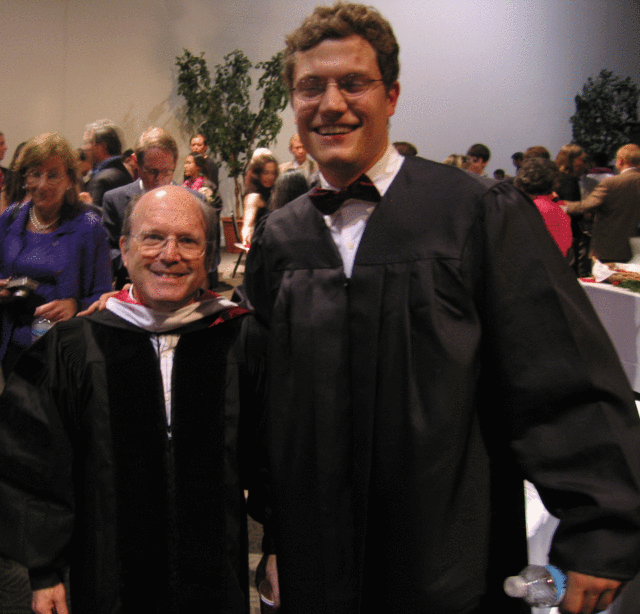
On June 3, 2006 I graduated from San Francisco University High School!

Saturday was The Big Day: commencement. We arrived at the Palace of Fine Arts in San Francisco at 10 AM. As I slipped into my cap and gown it started to dawn on me that my four crazy, generally wonderful years with friends was coming to a close. The services were fine (the Head of School’s speech was all about happiness — as one friend told me, "He’s been reading your blog too much"). I received my diploma and thought warm thoughts of all my friends as their names were read off, too.

In the reception afterwards I greeted close friends and supporters. I tried to thank as many teaches as I could but, on days like these, most thank-yous probably sound too cookie-cutter. My family and extended family had a nice dinner at Fleur de Lys, a fancy restaurant in San Francisco. Although I’m not a big "let’s-eat-fine-food-and-wine" kind of guy (I prefer sweatpants/t-shirt and a cafe), it was fine. Then I rushed home, changed clothes, and headed over to waiting buses for Grad Night.

Grad Night is a traditional parents-sponsored night for the seniors, billed as the last time we are all in one place together (and probably the last time I will ever see some of these people). All 120 of us loaded buses for a secret location (they don’t tell us beforehand). On my bus the music was all San Francisco themed. San Francisco Love has been a constant point of discussion the past couple weeks — people who are leaving the Bay Area for college (most everyone) have started to appreciate the amazing beauty and personality of this region.

We arrived at the Bay Club, a luxurious health club / gym in downtown SF. The school rented out the whole facility for the night and loaded it with tons of food, activities, music. Think street fair and night club in one. I gorged myself on sushi and guacamole and other goodies all night long. One of the highlights of the night was the American Idol competition. By 2:30 AM people started to fade — like me, who hasn’t stayed up all night….ever. People started to sign yearbooks feverishly. Even though most of my mental faculties had shut down, I still managed to write meaningful messages in most of my friends’ yearbooks. It is a rare opportunity to express sincere gratitude for all my peers have taught me. They are an amazing group of people and since it’s easier for me to write rather than deliver heartfelt emotions in-person, I took yearbook signings seriously.

At 4 AM we had a light breakfast followed by the closing activity of the night. The entire class sat in a big circle in the humongous yoga room at Bay Club. The lights were all off save for some candles flickering and a few red lights shining. I had heard about this activity from previous graduating classes. It had the reputation of being the "cry session," where people express their thanks to everyone else. We passed a candle around the circle. When it came to me, I said, "If you plan to use your considerable talents and gifts to affect change in your community, organization, or in the world, please reach out to me so I can learn from you, help you, and we can do it together. Stay connected. Stay connected." Other people had more personal expressions of gratitude, pieces of advice (not all of which I agreed with), and yes, some tears. One friend even used the opportunity to riff of my blog post on luck!

At 5:45 AM we boarded the buses, drove through SF as the light was catching the top of the sky scrappers and hills, and by 6:20 AM I was back in my bed, utterly exhausted. My head was still racing with emotions and thoughts about my four years of high school. Like most people, on the one hand I am sad to leave a group of peers whom I respect so much. On the other hand, I have always had such an active life outside my high school that it’s not as hard to for me to leave and, moreover, I have some kick-ass years ahead of me! (Also, I also find many aspects of high school culture sickening.)

In all of our lives there are turning points. Today is a new chapter. It’s a brand new day. Thanks to everyone who helped me get to this point.

(Me with friends David, Danielle, Director of College Counseling and brilliant thinker Jon Reider, and Head of School Mike Diamonti)

Gradphoto4_blog Grad_photo1_blog


Gradphoto3_blog_1 Gradphoto2_blog