Serving the Audience vs. Doing Your Thing (and Other Links)

Talking Funny is a four-way conversation between Jerry Seinfeld, Chris Rock, Ricky Gervais, and Louis CK on the craft of comedy. Here's Part 1 (and embedded below). One bit jumped out in Part 1: Gervais argues that you shouldn't care about the competition or the customer or the market — you should just be you, tell your jokes. Rock and Seinfeld respond that you have to be thinking about the customer and the competition. You have to be at least as good as whoever performed previously in the venue. Both sides are right, of course. It's interesting to hear them talk about how to navigate the tension.

###

Other links:

  • Robin Hanson riffs on "morality porn" and the "X porn" construct more generally.
  • The always-interesting Christopher Caldwell writes against excessively gruesome warning labels on cigarette boxes, calling it "more about class than compassion" (i.e., rich people against poor people).
  • A fascinating piece in The Atlantic called The Triumph of New Age Medicine. Here's the debate about the article. I'm sympathetic to the author of the piece. If it works, it works. Some of the harder core people opposed to alternative medicine remind of me hard core atheists who attack quiet, religious folk taking comfort from their faith.
  • Bill Simmons says Will Smith does not take creative risks by doing the same sort of movie over and over and eschewing opportunities to take on new roles. Yet, Simmons does the same thing over and over. We don't expect him to pump out fiction or other sorts of non-fiction. Why do we frown upon actors who don't dabble within their broader profession, yet we think no less of writers to stick to a shtick, be it non-fiction/fiction, academic vs. narrative, etc.? One theory: we think acting is easier than it is; we think acting is acting and there is no sub-specializing.

Knowing Your Audience in the YouTube Era

A few months ago, when Senator John Kerry was in Pakistan to push for the release of CIA agent Raymond Davis, he held a Q&A with local media in Lahore. You can hear by the questions that the local journalists are not at all fluent in English. So when I watch the back and forth, I’m struck by the complexity of Kerry’s sentences and vocabulary.

Kerry doesn’t seem to be making an attempt to speak in clear, short sentences that the folks in the room would understand. Instead, he offers circular answers with words like “consternation” and “signatory”:

“Sometimes, to the consternation of many of us…”
“Your government is a signatory to that”
“We don’t want this relationship to come into a difficult situation because we’re unable to find reasonableness.”

What’s going on? Is John Kerry trying to communicate with the people asking him questions? If so, he’s not doing a very good job. He has forgotten to simplify his language to fit the audience. He doesn’t “know his audience.”

But perhaps he does know his audience — it’s just that the audience is not the local media assembled in the room. The audience consists of all the people who will be reviewing video footage of the exchange, including English-fluent decision makers in Pakistan and policy makers in U.S.

Jay Leno — and all TV stars who perform in front of a live audience and the cameras — know this concept well. The physical audience in Leno’s studio in Los Angeles is not the audience that counts. His real audience is middle America watching at home on TV, and he tailors his jokes appropriately. I know corporate executives who do as Leno does. They go give a talk in front of 50 people, videotape it, and then email it out to 1,000 clients. Their audience isn’t the 50 people who hear the speech live — it’s the 1,000 clients who watch it on YouTube.

Bottom Line: “Know your audience” is an axiom of public speaking and communication. But most advice on this front assumes your audience is whoever is in the room listening live. In an era of cameras and YouTube, your audience rarely consists only of the people listening to you live. Usually there will be (or can be) a YouTube audience as well. Communication strategy ought to account for this now-obvious but sometimes still overlooked reality.

Understanding Your Customers, Brazil and Senior Citizen Edition

Proctor & Gamble wasn't selling enough diapers in Brazil. So they took a closer look at the cultural dynamics of the market:

In America, when parents buy nappies they often demand fussy add-ons (think nappy flaps, subtle scents, biodegradable material and so on). But in Brazil, babies often sleep with their parents, and many families are poor. Thus what consumers really care about is keeping the baby (and parents) dry all night. So Procter & Gamble eventually launched a cheap, ultra water-tight nappy in Brazil, without fussy details – and sales soared. Many parents are happier now, they are getting more sleep,” one industry leader observed with a chuckle, at a recent debate at the World Economic Forum

Other cultural mistakes of western companies entering international markets:

…western multinational companies have repeatedly tried and failed to sell breakfast cereal in India; apparently this is because local families want hot breakfasts, and most western cereal cannot survive contact with hot milk. Similarly, I also heard a story about how a US car company tried to sell a cut-price version of its bestselling car to India – and removed the rear-seat electric window controls to save costs. That also flopped since the Americans had failed to notice that while the rear seat is low-status in the west (since that is where kids sit) it is high status in India (since wealthy families have chauffeurs).

Makes sense.

Understanding your customers also matters when selling to a demographic in your own country that may have unique needs. GE's industrial design team emphasizes "empathy" when its engineers try to design products for the booming Baby Boomers segment:

We hold empathy sessions to help our designers understand what the aging population goes through every day — we tape their knuckles to represent arthritic hands, put kernels of popcorn in their shoes to create imbalances, and weigh down pans to simulate putting food into ovens. We have a moving-parts kitchen that helps us build products like our wall oven, which is at a height where people don't have to stoop down or stretch awkwardly over the stove to take that turkey out of the oven.

Literally putting yourself in the shoes (and clothes and environment) of your customer. I love it.

Sometimes It’s Faster to Do It Yourself

When it comes to delegating or outsourcing small tasks, the question always is, "Would it be faster if I just did it myself?"

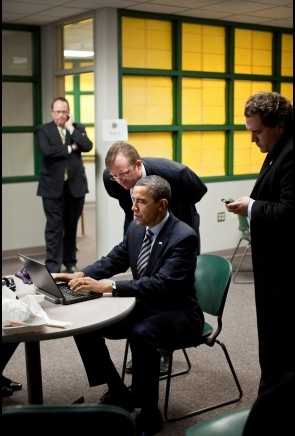
I was struck by this thought when I saw the following picture of Barack Obama editing his remarks on a laptop before addressing an audience at Northern Michigan University in February. Yes, even for the POTUS, despite his legions of speechwriters and aides, sometimes it's faster to sit down and just do it yourself.

Obamaspeec

#

The White House flickr stream is kind of fun to flip through. Here's a photo of Obama and crew watching Mubarak's speech on television. Yep, they're watching the same thing we're watching!

Asking About a Person’s Weaknesses

Austrian entrepreneur Hermann Hauser, in an interview in yesterday's FT, was asked about his three worst features. His answer: "I am impatient, I don't suffer fools gladly, and I am too demanding."

I've seen impatience cited as a weakness in several interviews with big-ego execs. What a cop-out. Though it's not as bad as when someone's self-critical moment comes via a line like, "I work too hard on the weekends."

When attemping to rely on a person's self-knowledge — a treacherous affair — stick to asking about the person's top strengths.

If, however, you're keen on asking a question that prompts a darker reflection, don't ask explicitly about weaknesses. Ask instead, "What keeps you up at 2 AM?"

You won't get an honest answer there, either, but, in my experience, you get a bit closer.