Mexico City Traffic

I've been to Mexico City two times. Both times the traffic has been insane. Remarkably, all the locals I spoke to always attributed bad traffic to "rush hour" — but personal experience indicates that rush hour is all day long.

Everyone I spoke to agreed traffic is a problem, but they all felt it was only a problem at certain times of the day.

Bottom line is 20+ million people in one city (largest in the world) is going to create massive transit challenges.

Most Natural “You” Emerges When Masks Collapse

When presenting ourselves to the world, we wear different masks depending on who's around. To our high school friends we'll act one way, to family we'll act a slightly different way, to our boss at work we'll act slightly different still.

Historically the most common distinction made between types of masks has been "personal" and "professional." It wasn't too long ago when once you left the office, work stopped. Now work follows you wherever you go. Telecommuting, etc. So knowledge workers find themselves wearing personal and professional hats at the same time, 24/7, from the office and from home.

In other words, technology is collapsing the masks we wear, making it harder to project different versions of our identity depending on the audience.

My theory: The most natural "you" is the version that gets presented when masks collapse. For example, host a dinner party with your mom, best friend from school, your boss from work, and a woman/man you're interested in dating. How do you act? What comes most naturally?

A public blog is another experiment in voice-synthesis and mask-collapse. I write one blog and all sorts of people read it, people with whom I would customize my presentation if we met in the real world. I slightly customize my vocabulary and personality if I meet a client versus my best friend from childhood. But I write only one blog, and even if I intend for it to be read by a particular constituency, I must remember that both my boss and friend can read it. Thus, the "you" that emerges on a personal blog represents a regression-to-the-mean synthesis, which may represent the most natural version of yourself.

(thanks to Stan James for helping generate this theory)

Infidelity and Trust: Boardroom vs. Basketball Court

In an earlier post I asked, Would you trust less a business partner who cheats on his/her spouse? Or do you completely separate personal and professional?

My answer is I would trust the person less in a business or corporate environment, but would still trust enough to maintain a relationship.

Here’s a question for people like myself, people who do not strictly separate bedroom character from boardroom character:

Suppose that you were on an NBA team and you knew one of your teammates was cheating on his wife. Would you trust him less on the court? Trust is vitally important in basketball, just as it is important in business.

My answer to this new scenario is no, I would not trust my point guard (who’s cheating on his wife) any less on the court.

Why do I answer the questions differently? Is the trust required on the basketball court different than the trust required in most other professional settings? Is it that not trusting a teammate on the court would result in failure easily observed by coaches and fans, whereas trusting a colleague a bit less in the office is not easily known by others? Or do I just hold two contradictory views?

For those who said you would trust your business partner less if you knew he or she were being unfaithful in the bedroom, what say you to the NBA teammate scenario?

(thanks to Tyler Cowen for raising these questions.)

An Egg vs. Hard, High Wall

The noteworthy author Haruki Murakami recently gave a short speech when he received the Jerusalem Prize for the Freedom of the Individual in Society. Here's my favorite part:

If there is a hard, high wall and an egg that breaks against it, no matter how right the wall or how wrong the egg, I will stand on the side of the egg.

Why? Because each of us is an egg, a unique soul enclosed in a fragile egg. Each of us is confronting a high wall. The high wall is the system which forces us to do the things we would not ordinarily see fit to do as individuals.

I have only one purpose in writing novels, that is to draw out the unique divinity of the individual. To gratify uniqueness. To keep the system from tangling us. So – I write stories of life, love. Make people laugh and cry.

(hat tip to the very smart John Lilly, CEO of Mozilla)

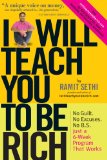
Book Review: I Will Teach You To Be Rich

Ramit Sethi’s new book titled I Will Teach You To Be Rich launches today. I highly recommend it to anyone under age 30 as a kick-ass crash course on personal finance, or to parents who want to teach their kids about money.

In fact, I like it so much that I’m offering you a deal. If you buy the book by 11:59 PM Pacific Time on Tuesday March 24th and forward your Amazon receipt to [email protected], you will be invited to participate in an hour-long special conference call with Ramit and me where you can ask us anything.

The book tells you everything you need to know about how to manage your money. From credit cards to saving for a wedding, from stocks and bonds to savings accounts, it’s all here. Unlike most books on money, I Will Teach You To Be Rich sings right along with the zest and humor you’ve come to expect from Ramit. The accompanying charts and boxes are helpful (and wonderfully rendered from a visual perspective) and the sprinkling of quotes (signed by real people, not “John D.”) are frequent reminders that other people are taking control of their finances — and so can you.

Amazon-book-small-image The book’s only weakness is that it doesn’t fully account for the global economic crisis. Ramit would argue that fundamentals are fundamentals when it comes to money. I largely agree, though it would have been lovely to have gotten a bit more on how the crisis came to be, why the S&P 500 hasn’t returned its usual “long-term” return over the past 10 years, whether bank bailouts should affect one’s selection of a bank, etc. But these are fast-changing and recent developments best followed in the blogosphere. For a foundational understanding of how a young person ought to think about personal finance both strategically and tactically, you need this book on your desk.

Of course, I’m a biased reviewer. I’m close to Ramit and have been talking to him about all aspects of this book for more than two years. But I don’t recommend stuff I don’t genuinely like. He’s taught me a lot about money, just like I’ve taught him a lot about working out, how to muster the courage to talk to women, and the rules of basketball.

Bottom Line: Buy the book by Tuesday night and forward your receipt to [email protected] and join Ramit and me for a private conference call on entrepreneurship, careers, and life!