I’m Scared to Death. But Supremely Confident.

"When I come out I have supreme confidence. But I'm scared to death. I'm afraid. I'm afraid of everything. I'm afraid of losing. I'm afraid of being humiliated. But I'm confident. The closer I get to the ring the more confident I get. The closer, the more confident. All during training I've been afraid of this man. I think this man might be capable of beating me. I've dreamed of him beating me. For that I've always stayed afraid of him. The closer I get to the ring the more confident I get. Once I'm in the ring I'm a god. No one could beat me. I walk around the ring but I never take my eyes off my opponent….During the fight I'm supremely confident. I'm making him miss and I'm countering. I'm hitting him to the body; I'm punching him real hard. And I'm punching him, and I'm punching him, and I know he's gonna take my punches. He goes down, he's out. I'm victorious. Mike Tyson, greatest fighter that ever lived."

        — Mike Tyson

I love this dual attitude: terrified of failure but also supremely confident of success.

It's too easy (and trendy) to just say "fear is the mind killer" or speak in glowing terms about how instructive failure is. If you aren't terrified of failing you probably don't care enough.

If an investor asks an entrepreneur, "Are you scared of your business failing?" and the answer is, "Not really," I'd be concerned. The best answer would be, "I'm fucking terrified that this will totally flop, and I'm doing whatever it takes to make sure that doesn't happen, and I'm confident it will not happen."Mike-tyson
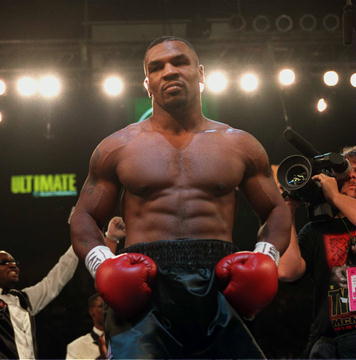
Too much fear can be crippling and preclude action. I think the optimal amount of fear is one notch before the "crippling" point.

I got nervous before high school and AAU basketball games.

I got nervous before big sales presentations in the early days of business career. So nervous, in fact, that I had a hard time getting business cards out of my suit jacket because my hands were shaking.

I get nervous before public speeches, difficult phone calls, or high-stakes emotional encounters.

I'm scared of failing, scared of letting people down, scared of embarrassing myself, scared of not one-upping what came before.

But the fear tends to be like cotton candy, it melts upon contact when the moment of truth comes — the tip-off of the basketball game, the start of the big sales meeting, or the first words of the crucial one-on-one conversation I'd prepared for. In the clutch moment, confidence must take over. When you come to the plate and crouch into your stance, you must believe that you are capable of hitting a home run.

As Tyson has also said, "Fear is your best friend or your worst enemy. It's like fire. If you can control it, it can cook for you; it can heat your house. If you can't control it, it will burn everything around you and destroy you. If you can control your fear, it makes you more alert, like a deer coming across the lawn."

###

Here's a compilation of other Tyson quotes. Here's my post on developing self-confidence. Here's my post on getting to the point of saying "I can do this!" Here's what elite athletes focus on in the clutch moments so they do not choke.

Quote of the Day

“SpongeBob is one of the greatest believers in the American dream in all of children’s entertainment. He’s courageous, he’s optimistic, he’s representing everything that Mickey Mouse should have represented but never did. There’s even something Jesus-like about him—a 9-year-old Jesus after 15 packets of Junior Mints.”

— Greg Rowland, a branding consultant on the moral influence of SpongeBob Square Pants, the children's toy and cartoon phenomenon in America.


I saw this quote in the latest issue of The Atlantic. The article from this issue that everyone is talking about is Joshua Shenk's piece on happiness. Because it is based on 70+ year study it is being treated more seriously than your garden variety self-help article on this topic. Here are two of the most interesting paragraphs:

But why, he asked, do people tell psychologists they’d cross the street to avoid someone who had given them a compliment the previous day?

In fact, Vaillant went on, positive emotions make us more vulnerable than negative ones. One reason is that they’re future-oriented. Fear and sadness have immediate payoffs—protecting us from attack or attracting resources at times of distress. Gratitude and joy, over time, will yield better health and deeper connections—but in the short term actually put us at risk. That’s because, while negative emotions tend to be insulating, positive emotions expose us to the common elements of rejection and heartbreak.

Here's Will Wilkinson's take. Yes, solid relationships are the key to happiness, but it's not so simple:

Vaillant points out that even the most “mature” strategies for adapting to disappointment, injury, or failure can strain our most intimate, sustaining relationships. And the reality of relationships over time tends to call for defenses that can threaten relationships. A positive, outgoing person may love freely and easily, but then become shattered by betrayal. Then what do you do? Steel yourself for the possibility of future pain by keeping some part of yourself private and out of the way? But then what have you done to your capacity to be nourished by intimacy and love? A lifetime of  rich relationships is not easy and therefore neither is the best kind of life.

Book Notes: Due Considerations by John Updike

John Updike’s 2007 anthology of essays and criticism Due Considerations brings together the late writer’s short-form contributions over the last 5-10 years. It’s a masterful collection that shows off his breathtaking range.

JohnUpdike_promostillbw I include the best quotes below (separated by line breaks) and the rest of the best below the fold. I recommend reading each for wisdom-content and/or gorgeousness of prose. Some of the sentences deserve to be savored. Can you beat the vividness of his late-night jazz club image below? Anything not in quotes is Updike; anything in quotes is the person cited.


His writing does what writing should do: it refreshes our sense of the world.

The novel, traditionally a mirror held up to the Western bourgeoisie, to teach them how to shave, dress, and behave, has focused on adult moral choices and their consequences. Newer novelists…see childhood as the place where one invents the baggage — totems, rituals, lessons to live by — of a solitary one-person tribe.

The prose at spots feels dry and crabbed, detail after detail set down with the obligatory tight fit of tile-setting.

“Clean gay” are not the adjectives with which I would now characterize the prose, though there is considerable gaiety in the narration’s swift onward flow, its sudden pools of rumination and opinionizing, its pleasure in its own inventions, the impish leaps in time that telegraph crucial plot developments so quickly we can scarcely believe our eyes, and the globe-spanning nimbleness and cosmic liftoff of it all.

So the novel becomes less an action than a disquisition, a wordy, wide-ranging array of voiced opinions, to which we settle like bleary customers in a late-night jazz club: the musicians are playing for themselves on the stand, there is a lot of excited, apparently hilarious talk at the surrounding tables, it is past time to go to bed, but, baby, it’s cold outside, and a stupefied kind of happiness comes with just being here.

“Love works backward in time, like all secrets. It colors memory and first impressions, dull evenings and late sleepless nights. It makes them glow with heat, like coals taken for dead.” – Andrew Sean Greer

Children assign too much importance to verbalization. Adults know more than they told. They know when they are loved.

“An imagined kiss is more easily controlled, more thoroughly enjoyed, and less cluttery than an actual kiss.” – E.B. White

“Love…ever unsatisfied, lives always in the moment that is about to come.” – Proust

Henry James recalled her cousin as “the very figure and image of a felt interest in life…the supreme case of a taste for life as life, as personal living, of an endlessly active and yet somehow a careless, an illusionless, a sublimely forewarned curiosity about it.” [One could spend hours analyzing what it means to have a “taste for life as life.”]

Continue reading “Book Notes: Due Considerations by John Updike”

Quotes of the Day

From three dead, wise men.

"Let us settle ourselves, and work and wedge our feet downward through the mud and slush of opinion, and prejudice, and tradition, and delusion, and appearance…till we come to a hard bottom and rocks in place, which we can call reality…. Be it life or death, we crave only reality. If we are really dying, let us hear the rattle in our throats and feel cold in the extremities; if we are alive, let us go about our business."

— Henry David Thoreau, on reality


"We dress our garden, eat our dinners, discuss the household with our wives, and these things make no impression, are forgotten next week; but in the solitude to which every man is always returning, he has a sanity and revelations, which in his passage into new worlds he will carry with him. Never mind the ridicule, never mind the defeat: up again, old heart!"

— Ralph Waldo Emerson, on solitude


"They stood there knowing each other well and each on the whole willing to accept the satisfaction of knowing as a compensation for the inconvenience — whatever it might be — of being known."

— Henry James, on two old lovers