“The Stale Tenement Air of Married Life”

Great opening paragraphs in this review of Joshua Ferris’s story collection:

It is late on a spring afternoon in Brooklyn. Sarah sits on her balcony, sipping a glass of wine, gazing down at the neighbors laughing on their brownstone stoops. A mystical sort of breeze arrives, one of “maybe a dozen in a lifetime,” tickling the undersides of leaves and Sarah, too, who now finds herself restless with longing for something new, for anything but the same old thing. Her husband comes home. “What should we do tonight?” she asks. “I don’t care,” Jay says. “What do you want to do?”

As most battered and seaworthy veterans of relationships eventually know, this is not the best response to a mate who feels herself to be in a sudden existential quandary, who, anointed by a breeze, is looking for something more than just another late-night superhero movie and familiar takeout sandwich. Bad though a spouse may be who dictates the marital laws, equally awful is the passive partner who simply goes along for every ride.

In that vexed, trembling fashion begins “The Breeze,” one of several standout stories in Joshua Ferris’s new collection, “The Dinner Party,” a magnificent black carnival of discord and delusion. Richard Yates once published a collection called “Eleven Kinds of Loneliness.” With 11 stories of its own, “The Dinner Party” might comparably have been titled “Eleven Kinds of Crazy.” Coupledom, in particular, is shown to be a nearly hallucinatory proposition, involving those alternative realities commonly known as husband and wife, who suffer veiled and separate lives side by side, breathing in squalid proximity “the stale tenement air of married life,” as Ferris puts it.

Book Review: The Intel Trinity

Steve Jobs, in a 1994 interview, said that once you discover that everything around you that we call “life” — rules, expectations, institutions, buildings, companies, theories, and so on — were made by people no smarter than you, everything changes. Because when you realize that most of what seems permanent and “the way things have always been” was, at one point, the proactive creation of a fallible human being, then you learn that if you poke at life you can actually change it. From then on, you take a much broader view of life’s possibilities.

It’s a powerful point that I agree with, except for the notion that the institutions and companies and norms and countries around us were built by people “no smarter than you.” In fact, the Founding Fathers of America were probably smarter than you or me. Same with Steve Jobs. Not all of us is smart enough or persistent enough to leave an enduring impact. But it’s true most of us are smarter than we know.

In any case, if you apply Jobs’ comment to Silicon Valley, it resonates. It’s uncommon to step back and ponder who created the norms and culture of modern tech entrepreneurship that we take for granted today. I locate the answer in (at least) two companies. HP, where Dave and Bill pioneered the idea of flexible work hours, employees owning equity in companies, casual attire, non-hierarchal decision making, and so much of the “west coast” aesthetic that is central to modern Silicon Valley identity. When HP introduced these policies, they were considered bold and groundbreaking. And then Intel, which, by growing from an idea to the world’s most important company, set a standard for execution that became the high water mark for other startups that aspired to global scale.

Intel also was one of the first companies to raise modern venture capital. How often do we stop and think about the original investors who decided to invest real money in a high risk, low liquidity tech company, and the entrepreneur who thought to sell equity in his company in exchange for enough risk capital to shoot for the stars?

I recently read Mike Malone’s The Intel Trinity, a wonderful guide to the history of Intel and the famous troika of Bob Noyce, Gordon Moore, and Andy Grove. These guys created Silicon Valley. The Intel Trinity explains the story of Intel well, and the tremendously intense and sometimes volatile relationship between them. Those of us too young to have lived through the rise of Intel are an especially relevant audience for this book, as is anyone who does not understand the historical meaning or importance of Moore’s Law. While there are a couple chapters in the book about Andy Grove’s personal history, for more color on that — his unbelievable personal life story as an immigrant from Hungary — I’d recommend Grove’s memoir Swimming Across.

John Stuart Mill’s Life, In a Sentence

“Mill’s [life story] is of a man out in the pure sun of reason and rational inquiry, lit at night by the romantic moonlight of a little bit of love and just enough madness.”

That’s from Adam Gopnik’s wonderful account of Mill’s life. The opening paragraph of the piece contains this: “Certainly no one has ever been so right about so many things so much of the time as John Stuart Mill.”

Mill made it onto my icons list of 2009.

Book Short: The Complacent Class by Tyler Cowen

Tyler Cowen’s latest book — The Complacent Class: The Self-Defeating Quest for the American Dream — follows up The Great Stagnation and Average is Over as the third in a trilogy about what’s gone wrong in America that has caused, in Tyler’s summation, wages to stagnate, infrastructure to decay, entrepreneurship to slow, and in general a large swath of Americans to fall behind in the modern economy.

Lengthier reviews already published elsewhere, so I’ll offer just three impressions of this provocative book written by a good friend.

First, reading it was reminder number 6,238 that I live in an exceptionally privileged life. I’m doing fine and almost everyone I know is doing just fine. The economy around me is booming. I travel almost exclusively to parts of the world where everyone is doing fine. That I find myself in this position is due almost entirely to luck and good fortune; what responsibilities I and my fellow lottery winners have to those handed a harder set of cards is one of the most important moral questions I grapple with.

Second, the habits of mind and action that Tyler says contribute to the complacency of so many Americans are the same habits we write about in The Start-up of You — except we extoll the positive version of them, of course! Tyler talks about risk aversion; we talk about how to take intelligent risk. If you want solutions, at the individual level, to some of the diagnoses in The Complacent Class…then read The Start-up of You!

Third, there’s an ambiguity in language on the topic of entrepreneurship that pops up in this book and other books and articles that study economic data. Tyler cites data — and points to this 538 piece summarizing the data — showing that fewer people are starting companies. Even the tech sector has fewer startups today! Entrepreneurship is slowing down, it seems? Well, maybe. Venture capital is pouring into startups. If there were fewer and fewer companies being started, why is there more and more venture capital being invested in startups? I think the issue here is the definition of “startup” and “high tech.” High level economic data tend to look at “new business formation” to draw conclusions about “entrepreneurship” and they define “startup” as any sort of new venture. Even “high tech” is broader than the specific niche that Silicon Valley is famous for and that venture capital chases: software and hardware startups financed and run in such a way as to one day achieve massive scale. This sort of entrepreneurship — the sort parodied on HBO’s Silicon Valley, glorified on Shark Tank, and written about in the popular press — is thriving, even if, in general, fewer Americans are starting “new businesses.” Of course, this doesn’t detract from the broader point that a lot of Americans are facing stagnant careers and a lot of once-stable industries are no longer reliable sources of prosperity.

Anyway, Marginal Revolution, Tyler’s blog, has long been a must-read. And don’t miss his podcast, which is still fairly new but really hitting its stride…

What I’ve Been Reading

Two very long books.

1. 1Q84 by Haruki Murakami. I really enjoyed working my way through this novel. If you’re new to Murakami, I wouldn’t start with this one. It’s dauntingly long (almost 1,000 pages), and I could see some readers getting lost — if you aren’t ready for it — amid the strangeness and sadness that permeate many scenes in the book. But if you’re in the right headspace, the hyper detailed descriptions, the plot, and strange sci-fi “weather” cast over Tokyo make a memorable reading experience.

Here’s just one quote that gives a sense of the vibe: “Once you pass a certain age, life is just a continuous process of losing one thing after another. One after another, things you value slip out of your hands the way a comb loses teeth. People you love fade away one after another. That sort of thing.”

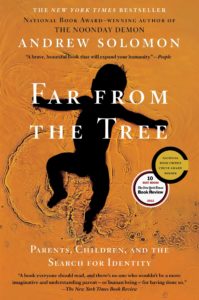
2. Far From the Tree: Parents, Children, and the Search for Identity by Andrew Solomon

This is another brick of a book but of a very different sort: non-fiction, organized into focused chapters, each on some element of a non-ordinary life experience and how parents and families adapt. There are chapters on deafness, dwarfism, transgender, homosexuality, prodigies, autism, and others. If you’re a parent of a child who falls into any of these categories, it’s a a must-read. I’m not, but I still found myself learning a ton about the life experience of those with certain types of disabilities. In many chapters there’s a spotlight given to the push and pull of advocacy groups, politicians, educators, and others who try to standardize a point of view on whether parents should buy cochlear implants for their deaf child, for example, or a 5 year old boy who tells his parents he wants to become a girl.

Solomon inclines to telling anecdotes over statistics, because “numbers imply trends and anecdotes imply chaos.” There’s a lot of messiness in the real family experiences profiled here. Internal debate. Changes of heart. I’m in awe at how Solomon shares stories about the families he spoke to. Genuine compassion and yet steel eyed honesty. He manages to assert his own opinion on topics where there’s true debate, but without simplifying the matter or selling short the diversity of views.