Rincon de Vieja – Part 2 – The Hike

In Rincon de Vieja National Park, there are a couple volcanos. To reach the craters, it’s advertised as a seven hour roundtrip hike from the entrance of the park and you have to sign a waiver before doing it releasing the national park and Costa Rica of any liability. Stan and I thought we could do it quicker. We’re both fit and Stan is an experienced mountain climber in Colorado.

We set off at around 9:30 AM and began the trek. The first hour and a half was an uphill but pleasant hike through some forest / jungle. Lots of trees and shrubs around us and a canopy overhead blocking the sun. We stopped a few times to get water, but overall, it wasn’t too hard. We saw only two other people in this section of the hike — they were older but determined to continue on, it seemed.

After we emerged from the canopy section, out in the open air, we stared up at the crater and were startled with how far away it was and moreover, how steep the trail seemed to the top. We walked on and up through, still feeling pretty good and confident with our pace.

We eventually reached a sign that had two arrows and messages: one pointed to the “difficult” path and said “Use caution” and the other pointed to the “easy” path. We couldn’t decide which one to follow, we flipped a coin, and it landed on the easy path. We set off in that direction and within a couple minutes had to decend a steep, poorly constructed path downhill toward a river. We were amazed this was labeled the less difficult of the two paths — even this brief downhill section was muddy and challenging and it’s hard to see people with big bags or wobbly legs doing it.

At the bottom of the hill we had to cross a river and then came upon a wall of solid dirt and rock with a rope hanging down. WTF? Would we have to use the rope to ascend this wall like a rock climbing wall? It appeared so, and we hauled ourself up. By this point we were stunned at how difficult the going had become. And it had just started.

For the next 40 minutes we gained elevation very quickly as the trail became a stairmaster with muddy footholes and narrow lanes winding through shrubs. No crossbacks, no zig zags, no flat land. Just straight uphill. Exhausting. Very very exhausting. The farther up we got we had to stop every couple minutes to catch our breath.

We felt some raindrops and this added to the stress. The day prior we had been rained on, hard, and we didn’t want to have a situation where it started raining Costa Rica-style and we were left on the side of a mountain with the paths would quickly disintegrate into a mudslide.

As we climbed and climbed I think stopping and turning back crossed our minds. There wasn’t another soul on the mountain and the prospect of rain was scary — not only for our clothes / comfort but for the safety of being able to come back down.

We ended up making it up the steep hill, barely, and the worst was over. We still had to hike up to the peak of the mountain and then walk around the edge, but the uphill was largley over. My quads were shaking.

The top of the crater was like nothing I’ve ever seen. Deserted. Moon-like. Rocks and nothing else. Then some green leaves here and there. We walked along the narrow path at the very top of the crater and finally reached active volcano. A sign said we couldn’t stay for more than 15 minutes b/c toxic gases emitting out of the steamy crater are dangerous. We checked it out, turned back, and found a wind-secluded area where we could have a bag lunch.

Truly one of the more exhausting, crazy, but worthwhile physical experiences I’ve had!
Monster Hike in Costa Rica and Resilience

As I mentioned in my last post, your loyal blogger is on the road, and isn’t sitting with his legs kicked up on a Costa Rican beach reading books under a tree (ok – well maybe a little of that). He also loves the outdoors and as such tries to be "active."

My friend Stan and I hiked up to the volcano crater of Rincon de la Vieja National Park (45 mins NE of Liberia, CR). It was one of the more challenging physical experiences I’ve endured. It wasn’t the time — it took seven hours round trip — but the immense steepness and poorly constructed trails that made it utterly grueling. Think stairmaster in mud.

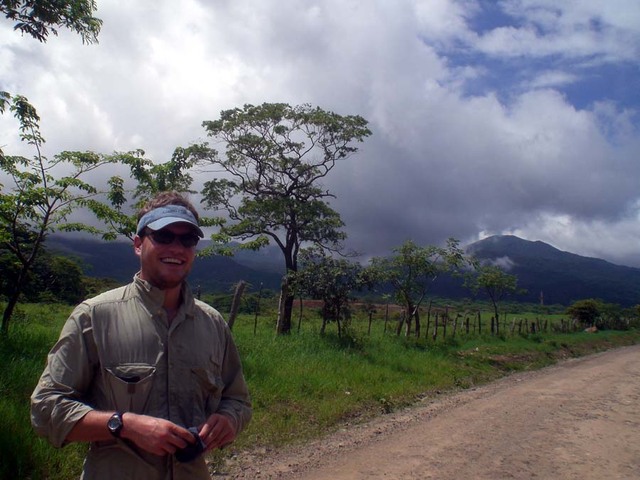
The three following pictures illuminate how the hike went. Here I am at the outset of our hike, smiling, happy, and ready to go. The volcano is that big mountain in the background. Fyi, my collar is only popped to protect against sun burn — wouldn’t want to be confused with an east coast prep school kid!

Cimg3186 Then after a grueling three hours up a muddy and mind-blowingly steep mountain, the picture looks much different:
Cimg3195

When we finally reached the crater area, we walked along trail leading to the huge pit of steam and sulfur. It must be a close sibling of the moon, because if this isn’t a moonscape, I don’t know what is:Cimg3198

Stan and I joked that we were both "deeply humbled" by Mother Nature. Our trek was worth it. I’m a big believer in the importance of resilience and believe one’s "Resilience Quotient" (RQ) is transferable. That is, the experience of enduring hardship but ultimately finishing the job can help in other parts of life. Stan and I didn’t turn back, we finished the hike, and now have a great story and photos.

OK – back to reading on the beach.

Rincon de Vieja Nat’l Park – Part 1

Rincon de Vieja National Park is not at the top of the tourist list in Costa Rica. But it’s still worth visiting for anyone in the country for more than a couple weeks. Only 45 mins northeast of Liberia airport, it’s easily accessible.

My friend Stan and I spent our first day in the national park hiking the shorter, two-hour path. It was mainly forest / jungle so lots of beautiful tree sights, a mini-volcano / hot spring thing, and a mini-waterfall. About an hour and a half into our hike, it started raining. Pouring. Pouring harder than either of us have experienced. We turned around and started backtracking out of the park.

I had an umbrella, Stan had a jacket, but neither was effective for the torrential rains. We hitched a ride back to our hotel with a Dutch couple (we had walked the 4 kilometers to the park) who we also had dinner with later that night.

The next day we walked to the waterfall near our hotel and swam / stood in the little pool area the waterfall created. Obviously, the nature around the waterfall was stunning — green and attractive and large, angled rocks. When our conversation started treading on "how to improve Twitter’s UI" we had to bring ourselves back to nature. 🙂

That night, in a heroic attempt, we tried to walk to a neighboring lodge in the national park area to have dinner. The closest hotel was 3.5 kilometers away — most people drive or pay the $5 roundtrip fare for a hotel van to take you. We were feeling adventurous, so we set out at night. We got lost, confused, scared (of some attack dogs at one house we passed, the sole house in the deserted park area), etc etc. Even though we had seen the sign for the other lodge during the day, by night, Stan’s little headlamp couldn’t illuminate stuff enough for us to find our way. So we turned around and began the long, 3.5 km walk back to the hotel. Exhausting.

At dinner, we bumped into yet another Dutch couple, who we chatted with. They wanted someone to talk to, and importantly, start complaining to! They ragged on the hospitality impulse in Costa Rica restaurants, which was pretty funny to listen to. ("The service here is non-existent, it’s a spectacle, it’s ridiculous.") It was true that waiting tables doesn’t seem to be a skill at the staff at this hotel or other restaurants. With the waiter standing in front of us, Stan even told me, "Maybe I’ll get the same thing as you, so they don’t screw up our orders." (The prior night they had brought all of us the wrong dish, forcing the Dutch guy to demand to re-see the menu and compare plates to orders.)

All in all, our first couple days in Rincon de Vieja were fun, filled with nature, rain, and one too-long night walk. Little did we know our real physical challenge would come the next day….

Best Paragraph I Read Today (on LA)

From Salman Rushdie in his novel Shalimar the Clown (review forthcoming). In poetic fashion it captures some essence of LA, and near the end of the graf speaks to why I think it’s a city better to live in than visit.

He praised the city, commended it precisely for the qualities that were commonly held to be its greatest faults. That the city had no focal point, he professed hugely to admire. The idea of the center was in his view outdated, oligarchic, an arrogant anachronism. To believe in such a thing was to consign most of life to the periphery, to marginalize and in doing so to devalue. The de-centered promiscuous sprawl of this giant invertebrate blog, this jellyfish of concrete and light, made it the true democratic city of the future. As India [name of daughter] navigated the hollow freeways her father lauded the city’s bizarre anatomy, which was fed and nourished by many such congealed and flowing arteries but needed no heart to drive its mighty flux. That it was a desert in disguise caused him to celebrate the genius of human beings, their ability to populate the earth with their imagings, to bring water to the wilderness and bustle to the void; that the desert had its revenge on the complexions of its conquerors, drying them, ingraining lines and furrows, provided these triumphant mortals with the salutary lesson that no victory was absolute, that the struggle between earthlings and the earth could never be decided in favor of either combatant, but swung back and forth through all eternity. That it was a hidden city, a city of strangers, appealed to him most of all. In the Forbidden City of the Chinese emperors, only royalty had the privilege of remaining occult. In this brilliant burg, however, secrecy was freely available to all comers. The modern obsession with intimacy, with the revelation of the self to the other, was not to Max’s taste. An open city was a naked whore, lying invitingly back and turning every trick; whereas this veiled and difficult place, this erotic capital of the obscure stratagem, knew precisely how to arouse and heighten our metropolitan desires.

Related Posts:

The Global Tongue of the World: Panglish

I’ve been in Costa Rica the past two weeks, so language (Spanish and English) is on my mind. Wired has an interesting, short piece on how Chinese is affecting the English spoken around the world. Here’s Slate’s helpful one paragraph summary:

The "likely consequence" of growing numbers of Chinese learning English without "enough quality spoken practice" means that "more and more spoken English will sound increasingly like Chinese." Already, nonnative speakers far outnumber native speakers, and in the next decade, native speakers will make up only 15 percent of those who use the language. English is "on a path toward a global tongue—what’s coming to be known as Panglish." And, "[s]oon, when Americans travel abroad, one of the languages they’ll have to learn may be their own."