The Right Mix of Independence and Interdependence for Group Decision Making

My Mom is a beekeeper so I've been reading articles on how bees live and work. Much about bee life is very interesting and relevant in other contexts: their teamwork, how they relate to their CEO (queen bee), division of labor, and more. Below's a fascinating excerpt from a recent academic paper on how honey bees select their nest. They employ a blend of individual, independent assessments of quality nest sites and consensus-driven deference around the most promising, emerging nest sites. With a right combination of independence and interdependence, they are able to make a decision that draws upon collective wisdom while also avoiding groupthink.

We have developed an agent-based model of nest-site choice among honeybees. The model not only explicitly represents the behaviour of each individual bee as a simple stochastic process, but it also allows us to simulate the bees' decision-making behaviour under a wide variety of empirically motivated as well as hypothetical assumptions. The model predicts that, consistently with empirical observations by Seeley & Buhrman (2001), the bees manage to reach a consensus on the best nest site for a large range of parameter conditions, under both more and less demanding criteria of consensus. Moreover, the model shows that the remarkable reliability of the bees' decision-making process stems from the particular interplay of independence and interdependence between them. The bees are independent in assessing the quality of different nest sites on their own, but interdependent in giving more attention to nest sites that are more strongly advertised by others.

Without interdependence, the rapid convergence of the bees' dances to a consensus would be undermined; there would not be a ‘snowballing’ of attention on the best nest site. Without independence, a consensus would still emerge, but it would no longer robustly be on the best nest site; instead, many bees would end up dancing for nest sites that accidentally receive some initial support through random fluctuations. It is only when independence and interdependence are combined in the right way that the bees achieve their remarkable collective reliability.

(hat tip Paul Kedrosky)

Email of the Day, Youth Sports Edition

A girls soccer coach in Massachusetts was recently forced to resign after emailing the parents of his 7 and 8 year-old players that he expects them to "kick ass." Here's the entire email. Below is an excerpt. When you read "kids" remember it's 7 and 8 year old girls.

Some say soccer at this age is about fun and I completely agree. However, I believe winning is fun and losing is for losers. Ergo, we will strive for the “W” in each game. While we may not win every game (excuse me, I just got a little nauseated) I expect us to fight for every loose ball and play every shift as if it were the finals of the World Cup. While I spent a good Saturday morning listening to the legal liability BS, which included a 30 minute dissertation on how we need to baby the kids and especially the refs, I was disgusted. The kids will run, they will fall, get bumps, bruises and even bleed a little. Big deal, it’s good for them (but I do hope the other team is the one bleeding). If the refs can’t handle a little criticism, then they should turn in their whistle. The sooner they figure out how to make a decision and live with the consequences the better. My heckling of the refs is actually helping them develop as people. The political correctness police are not welcome on my sidelines. America’s youth is becoming fat, lazy and non-competitive because competition is viewed as “bad”. I argue that competition is good and is important to the evolution of our species and our survival in what has become an increasingly competitive global economy and dangerous world. Second place trophies are nothing to be proud of as they serve only as a reminder that you missed your goal; their only useful purpose is as an inspiration to do that next set of reps. Do you go to a job interview and not care about winning? Don’t animals eat what they kill (and yes, someone actually kills the meat we eat too – it isn’t grown in plastic wrap)? And speaking of meat, I expect that the ladies be put on a diet of fish, undercooked red meat and lots of veggies. No junk food. Protein shakes are encouraged, and while blood doping and HGH use is frowned upon, there is no testing policy. And at the risk of stating the obvious, blue slushies are for winners.

These are my views and not necessarily the views of the league (but they should be). I recognize that my school of thought may be an ideological shift from conventional norms. But it is imperative that we all fight the good fight, get involved now and resist the urge to become sweat-xedo-wearing yuppies who sit on the sidelines in their LL Bean chairs sipping mocha-latte-half-caf-chinos while discussing reality TV and home decorating with other feeble-minded folks. I want to hear cheering, I want to hear encouragement, I want to get the team pumped up at each and every game and know they are playing for something.

Lastly, we are all cognizant of the soft bigotry that expects women and especially little girls, to be dainty and submissive; I wholeheartedly reject such drivel. My overarching goal is develop ladies who are confident and fearless, who will stand up for their beliefs and challenge the status quo. Girls who will kick ass and take names on the field, off the field and throughout their lives. I want these girls to be winners in the game of life. Who’s with me?

Go Green Death!

(hat tip to Andy McKenzie for the pointer)
Native English Speakers Don’t Say “Clever” Much

Always interesting to hear and analyze how non-natives speak the English language. What’s difficult? What do they mess up?

One random observation: the word “clever.” Most fluent English speakers I know don’t use the word “clever” very often, certainly not as a catch-all compliment for intelligence or savviness. If anything, “clever” can have a slightly negative connotation — like sneaky. Yet many folks in Latin America use “clever” very often and in broad contexts.

Second random observation: “this” and “that.” Neither is technically grammatically better than the other, but you can hear it when it doesn’t sound right.

Horseback Riding in the Countryside

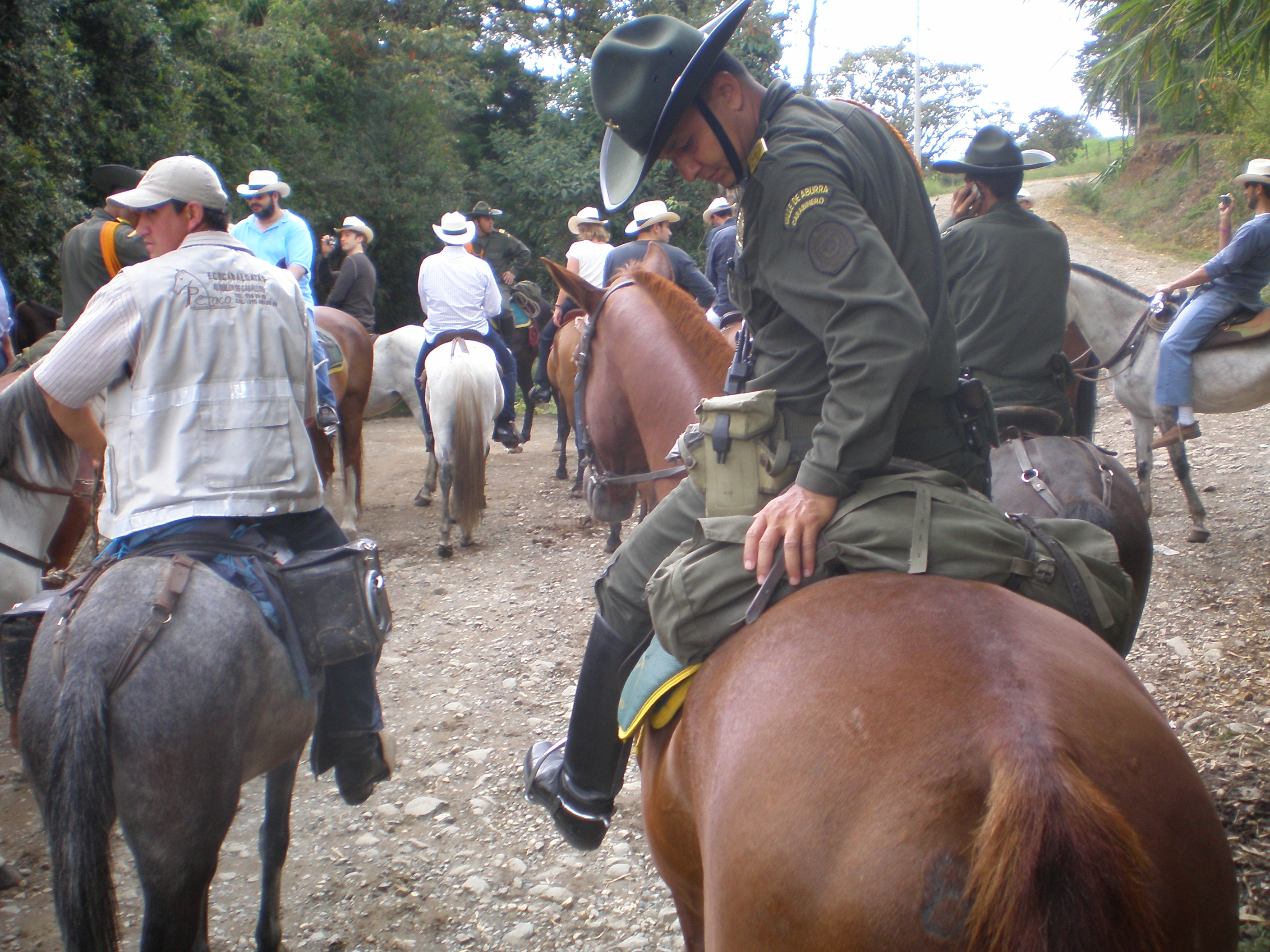
On Sunday the group went horseback riding for about an hour outside Medellín. We had a fantastic time.

There were about 20 of us on horses and about 15 police officers on horses as well, acting as our guides and escorts. One of the guides' horses was the "DJ" – two stereo speakers playing traditional cowboy Spanish music draped over each side of the horse.

The countryside was beautiful — lush green hills, lots of vegetation, trees, trails, etc.

Horseback

My horse got tired as the journey went on as he became gradually less responsive to my kicks which are supposed to jumpstart him. Or maybe he just realized his "driver" was a real amateur and that he could follow his own pace!

One of the most impressive aspects of the horses were how they always picked the best path to take on difficult, rocky downhills. That is, they would instinctively bob and weave on the path to avoid the sharpest rocks or least steady ground. Also, my horse had a penchant for grass, and stopped a few times to munch on grass on the side of the trail. Just like with walking dogs, the horse will eat grass forever unless you pull him away.

Hosreback2 All in all, a wonderfully authentic experience. Horseback riding is a traditional weekend activity in many countries in South America. I'll post pictures next week.

What I’ve Been Reading

1. Meditations by Marcus Aurelius. Some people swear by these Stoic teachings, but even me, a confessed lover of nuggets, could not fully engage with the long list of short aphoristic nugget-y blurbs. I’ll try again later. I do want to better understand Stoicism.

2. Paradox of Choice: Why More is Less by Barry Schwartz. There are many reviews and summaries of this book on the web (including an entire Ted talk) so I’m not sure I’d recommend reading the whole book itself. Schwartz’s argument — that too much choice robs us of satisfaction — is clearly presented and convincingly supported, even though it’s a “problem” only the very fortunate seem to have. I found much of the book familiar, but if you haven’t already dipped into happiness books or any of the recent slew of pop psychology books, Schwartz brings a lot of the research into one place.

3. The Black Swan: The Impact of the Highly Improbable by Nassim Taleb. Another book that’s been well reviewed and summarized. I read Fooled by Randomness and loved it. I didn’t love Black Swan, but this is probably because over-high expectations. It’s a good book with important points about statistics, randomness, planning, and human nature. With the onset of the financial crisis, I’m sure Taleb has been dancing a jig. The book’s weakness, to this reader who isn’t qualified to assess the statistical arguments, is stylistic. He proudly resisted any editorship, and it shows. Also, he seems to enjoy his reputation for brashness so much that he hurls bitchy, pointless insults toward people like Richard Posner. All this notwithstanding, you should still read this book.

2. The Knack: How Street Smart Entrepreneurs Learn to Handle Whatever Comes Up by Norm Brodsky and Bo Burlingham. Brodsky and Burlingham have sterling reputations in the business journalism world, but I found nothing new in this grab bag of entrepreneurship tips and tricks. Like most business and entrepreneurship books: pass.

The best book I’ve been reading recently is John Updike, but that review deserves a separate post.