I bused from Suzhou to Shanghai and had a learning moment: how many times during the day do you think we are annoying or hurting somebody without even knowing it? The inspiration for this thought was the person in front of me in the cramped, aging bus. My knees were pressed right into his cushion and he felt like leaning back and rocking his seat 5-6 times during the 1.5 hour trip, exerting painful pressure on my knee caps. And he didn’t even know it. I don’t blame him, but it struck me how oblivious he was to my pain, and how much pain I may cause others without a hair of a clue.
Once in Shanghai I made my way to a blog reader’s house. It was one of those somewhat nerveracking but in the end super rewarding moments of meeting someone in person who’s been reading my blog. I gave serious concern to not staying with this reader, because I just felt like I didn’t know enough about him, a Google search didn’t reveal much, and I didn’t want to be in an uncomfortable (or dangerous) position.
My fears were not only unfounded but, like every other blog reader I’ve met on the road, completely trumped by amazing gratitude for having Eisen, my Shanghai friend, now in my life.
I knocked on his door, heard running feet, the door flew open, “Ben!!!”. The first thought that crossed my mind was the Japanese game show host in the movie “Lost in Translation” whose exuberance overwhelms the poor Bill Murray.
After salutations Eisen led me to my own apartment. He owns a spare apartment that his sister stays in sometimes when visiting Shanghai. Completey furnished and spacious.
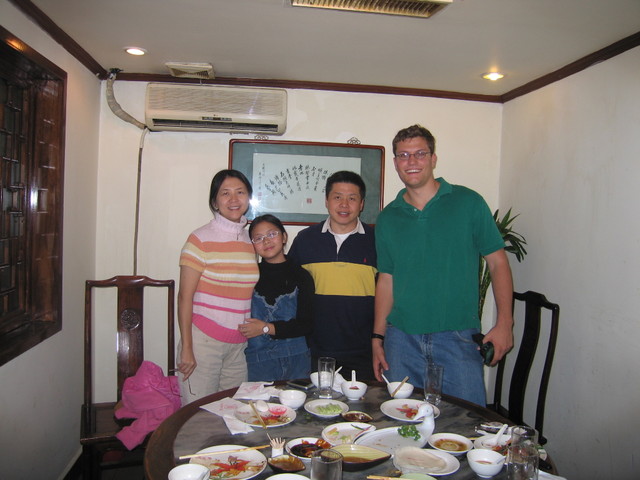
Another day, another city, another blog reader, another penthouse for myself. Come on, I’m telling myself, as I open the door to my new home for the week, this is crazy, this is too much. Eisen also hooked me up with a cell phone and helpful map and a couple good books on business and China, and then we headed to a restuarant across the street for a late lunch. He ordered some excellent dim sung and we chatted. A Singaporean who spent most of his adult life in Taiwean, Eisen and his family now live in Shanghai where he’s achieving loads of success producing music.
I spent the late afternon studying a Shanghai map, orienting myself (my Mom knows how important this is to me ;-), and setting up a few meetings with entrepreneurs and VCs. I then met Eisen and one of his music partners for dinner. We went to a Chinese place which serves traditional Chinese and seafood.
The setup was like that in the Dalian hotel: all the food is put out in glass cases and you walk around and point, they write down, and then bring out the food. J helped me decide what we’d eat — like every other Chiense restuarant, it was going to be family style again. He picked a fish and then he and the waitress lady had a long back and forth. Afterwards I asked J why they talked so long, and he said, “Communication difficiluties,” obviously perturbed. Amused, I asked, “What do you mean?” He said, “I told her I wanted that fish. She kept asking questions about how I wanted it cooked. Finally I told her, How should I know how to cook the fish? You’re the cook, right?”
We had a long dinner conversation on politics, Asia, languages, history. We concluded that there’s so much going on in the world in so many different places. The world IS a big place. Each country has its own issues and much as I try to remember the details, I know I’ll retain little. Both Eisen and his friend spent many years in Taiwan and neither is a Chinese citizen, so they have the good perspective of living in China and speaking the language iwth the dispassion of a foreigner.
The waiters and waitresses rolled around the resturant in roller blades! Hard cement floor so it worked well. Never seen that before. Apparently it’s a Thai thing.
Then we headed back to J’s place and he showed off his massive recording studio and he and Eisen played a couple of the mixes. Impressive stuff, even though it’s hard for me to judge musicial quality. Then we flipped on his TV whcih has many stations. We put on Al-Jazeera. First time I’d ever seen Al-Jazeera. Super interesting. The first show was a South Park-esque cartoon and, amazingly, was making fun of Middle Eastern traditions! The cartoon had two characters. One guy was dressed in a very western outfit wearing his turbon in ghetto style. He met another guy and they kissed, then exchanged words, then kissed again. Over and over, kiss after kiss. Hilarious. The next show was the news. Very formal. The only word I understood was “America”. America this and America that. I’m sure the words “evil” and “bomb” and “killing” were nearby. Interstingly, the entire news show had a sign language guy in a split screen. Eisen made the joke that that to sign “America” the guy put two fingers on his head like devil horns.