The Best Phone Conversations Happen When Both Are in a Similar Physical Environment

If you travel a lot you tend to:

  • Make a lot of phone calls while on the road / in airports / on-the-go.
  • Cherish any stationary time you do have at your desk as an opportunity to undergo some focused, uninterrupted work.

I’ve noticed a tension that arises when I’m traveling and call someone who’s at their desk, or vice-versa. The person driving tends to be more chatty realizing that there’s not much else he could be doing while on the road. Meanwhile, the other person, at his desk, gets anxious about spending precious desk time — when he can be most effective on his computer or talking to office mates — on a phone call.

To wit, my theory of the day: The best phone conversations between two people of equal status happen when both are in a similar physical environment with equal productivity potential.

Let European / Asian Airlines Fly U.S. Domestic Routes

Earlier this month, United Airlines spammed its customers and urged us to ask Congress to reign in oil speculators, whatever that means.

If Americans are going to get together to ask Congress to do something about the dismal state of domestic airlines, here’s a better plan: Urge Congress to take the EU-US Open Skies Agreement one step further. Let’s allow any European or Asian airline fly any U.S. domestic route.

The Open Skies Agreement, which just went into effect, allows any U.S. or European carrier to fly from any city in the U.S. to any city in Europe. This ended exclusive lockholds on lucrative routes to London Heathrow, among others. Right away Delta and US Air and Singapore Air among others started serving Heathrow, creating more competition (and thus lower prices).

Imagine what would happen if well-run European or Asian airlines with a younger fleet (such as the Lufthansa Group which includes their subsidiaries like Swiss Air) could start flying domestic U.S. flights. They would probably focus on longer haul domestic routes and could immediately attack the weak U.S. carriers and their hubs (US Air in Philly, United in Denver, and probably Delta’s secondary hub in LAX which has been a disaster).

I’m not optimistic the protectionist winds in Washington would allow for an open market in U.S. domestic routes, but certainly if American citizens are going to try to do something on the lobbying front to improve airline travel here at home railing against oil speculation isn’t the answer. Encouraging Congress to allow the better-run European and Asian airlines to compete probably is.

###

The one bright spot among U.S. carriers remains Southwest Airlines which announced a remarkable 15% increase in profit last quarter. Here’s an analysis of Southwest’s new boarding policy. To me it signals a renewed commitment to business travelers who are willing to pay to get a 1-15 boarding number. Consider this plus their re-modeling of all gate seating areas (each gate equipped with big fluffy chairs and more power outlets than you know what to do with) and it’s clear that Southwest will start winning over business travelers on longer routes, not just budget-conscious, short haul flyers.

###

I’ve now flown the new airline Virgin America several times between SF – NY, LA – NY, and SF – D.C., and have had a very pleasant experience. They offer low prices with professional staff and good in-flight amenities. But it’s hard for me to see how they’re going to maintain the low prices in the long run (I’m assuming now they’re loss leaders). I would expect Virgin America to follow the path of Jet Blue, though I’m not familiar with their oil / fuel hedge situation so maybe I’ll be proven wrong. Still, adding hip window dressing like JetBlue or the failed Ted or Song experiments of United and American without fundamentally changing the business model (VA operates a hub at SFO and competes on the cutthroat coastal routes) doesn’t strike me as a winning formula to an industry in need of innovation.

Does Travel Make You Happier?

Tyler Cowen via Gretchen Rubin:

Travel is an interesting issue. It makes people deeper, and makes their internal mental stream much richer, but I’m not sure it ever makes them *happier* per se. It can be a lot of hard work and also some frustration. Still it is worth doing as much as you can.

As I’ve said before, for me, all the cliches about travel are true. It really does broaden you.

Monster Hike in Costa Rica and Resilience

As I mentioned in my last post, your loyal blogger is on the road, and isn’t sitting with his legs kicked up on a Costa Rican beach reading books under a tree (ok – well maybe a little of that). He also loves the outdoors and as such tries to be "active."

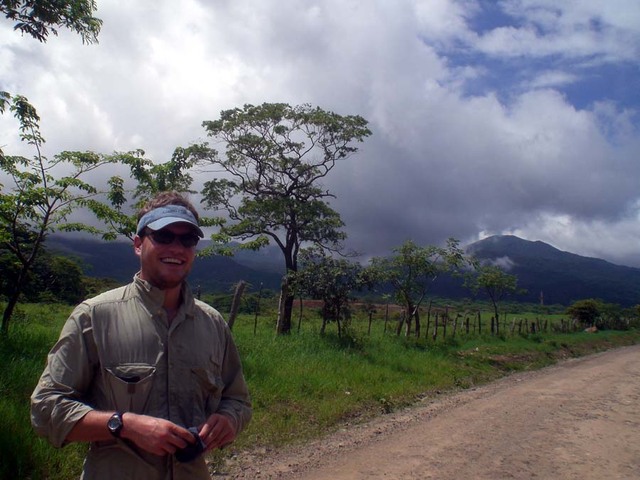
My friend Stan and I hiked up to the volcano crater of Rincon de la Vieja National Park (45 mins NE of Liberia, CR). It was one of the more challenging physical experiences I’ve endured. It wasn’t the time — it took seven hours round trip — but the immense steepness and poorly constructed trails that made it utterly grueling. Think stairmaster in mud.

The three following pictures illuminate how the hike went. Here I am at the outset of our hike, smiling, happy, and ready to go. The volcano is that big mountain in the background. Fyi, my collar is only popped to protect against sun burn — wouldn’t want to be confused with an east coast prep school kid!

Cimg3186 Then after a grueling three hours up a muddy and mind-blowingly steep mountain, the picture looks much different:
Cimg3195

When we finally reached the crater area, we walked along trail leading to the huge pit of steam and sulfur. It must be a close sibling of the moon, because if this isn’t a moonscape, I don’t know what is:Cimg3198

Stan and I joked that we were both "deeply humbled" by Mother Nature. Our trek was worth it. I’m a big believer in the importance of resilience and believe one’s "Resilience Quotient" (RQ) is transferable. That is, the experience of enduring hardship but ultimately finishing the job can help in other parts of life. Stan and I didn’t turn back, we finished the hike, and now have a great story and photos.

OK – back to reading on the beach.

Impressions of Prague, Czech Republic

Pragueatnight

(photo credit)

A friend and I spent a few nights the other week in Prague, Czech Republic.

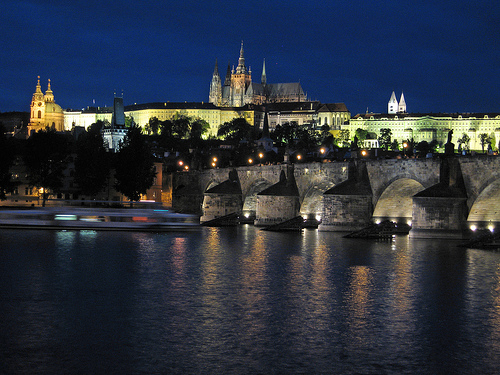
I’d heard endless good things about Prague. Truly, I don’t know a person who has not liked Prague, with the most common adjective being "dreamy." It’s clear why: the main old town square is a remarkable sight. Standing in the middle, to your right are enormous facades and old buildings; to your left is the Astronomical Clock. Leave the square, wind your way through cobble stone streets and you’re soon at the Charles Bridge. The bridge, especially at night as pictured above, is stunning. And the views of the city from the bridge are second-to-none. Walk across the bridge and continue up the hill and you see Prague Castle, a soaring, amazing architectural construction, with stone lions jumping out the windows.

We went to the Kafka museum after the Castle — it’s very well done. By reading some of Kafka’s diary entries it’s clear that he was absolutely obsessed with writing. He couldn’t do anything else. A sign of genius. (I read this set of Kafka stories beforehand to get oriented. A fine introduction to his work.)

Czech food is heavy (dark meat, yummy thick bread dumplings, beer) but good. Because my friend had a somewhat weak Italian stomach — sorry Massimo, couldn’t resist — we made a couple McDonald’s runs along the way, and stumbled upon the McWalk. The McWalk is like a drive-through window except it’s a walk-through. Why someone would use the McWalk instead of walking in the front door is beyond me. Apparently, there are only two McDonald’s McWalk windows in the world: Prague and Haifa, Israel. See my travel blog for more. Also – in McDonald’s they charge for ketchup!

The Soviet influence remains. I met a business professor in Prague who told me that many officials in the current government are there because of the old communist power structure. The communist ideology still has a grip on the national psyche, he told me, and this is problematic on many fronts including efforts to stimulate entrepreneurship.

We had bad weather for our visit, and weather always makes a difference. This probably contributes to why I feel like Prague is a little overrated. Its beauty is stunning, but many parts of Western Europe have beautiful old towns, churches which inspire, cute hole-in-the-wall shops, etc etc. I’m guessing that 10 years ago, Prague was a hidden gem for Western Europe tourists willing to venture a little more east. It’s changed big time. Charles Bridge teems with tourists every hour of every day. The whole old town is packed with foreigners, and the cheesy shops selling fake tourist trinkets line virtually every street. Sure, you can avoid the tourists and explore new town (which Massimo and I did and it was well worth it). But the fact remains: Prague is now a tier two tourist destination in Europe (if tier one is Rome, Paris, and London), drawing visitors from all over Europe, America, and Asia. To me, Kiev, Ukraine has more charm and is less crowded than Prague, and only slightly less beautiful.

The Bottom Line: Prague is well worth your time as something that has a bit more Eastern European vibe. But it’s no longer off the beaten path and therefore contains all the annoyances of other top European tourist destinations.