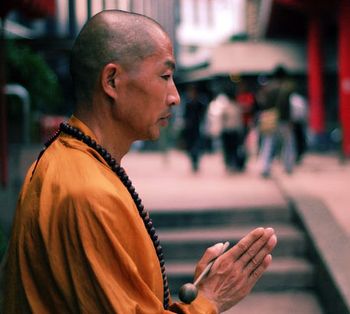
The Secular Church

After channeling Jonathan Haidt in a post titled "Why Moral People Vote Republican," Chris Yeh re-surfaces our idea of creating a secular church:

…Democrats appeal strictly to adherents of a Millian view, while leaving Durkheimians with the impression that they ignore the majority of what makes a society moral.

This ties in neatly with some of the thoughts Ben Casnocha and I have had about the secular church; specifically, that secular humanism needs a stronger foundation for expressions of self-control, duty, and loyalty than the small beer of lengthy philosophical discussion. Indeed, were the Democrats wise, they would try to create the equivalent of a secular church based on American patriotism, this providing themselves with both a moral foundation and the means to dispute the Republican monopoly on flag-waving.

Of course, the most important feature of our secular church will be adequate leg room in the pews.

Spiritual But Not Religious

Spirituality

"Spiritual but not religious" is an increasingly popular way to describe one's religious views.

What does it mean to be spiritual but not religious? Everyone seems to define the term differently. I do know that if you tell me you're spiritual I feel like I know more about you, even if I have a hard time pinpointing exactly what new knowledge I tote. I would probably peg you a person unusually self-analytical, interested in inner peace, health-conscious, and someone who thinks more than usual about emotions and relationships. But that's a pretty random list of characteristics, and that's part of the problem.

Another common definition: Spirituality is about reverence for nature. Spiritual people display a certain wonderment at the majesty of everything around us. This was the consensus in a recent roundtable discussion on religion that I facilitated. This amusing page of atheist motivational posters contains one emphasizing secular awe at natural beauty.

Me? I'm not affiliated with an organized religion and I do not believe in a higher power. I do not evangelize my atheism and am uncertain about the correctness of my view. Am I spiritual? By the above definitions, yes.

But I am reluctant to self-identify as spiritual.

For one, many people I know who wear this label and wear it proud are fuzzy thinkers and too enthusiastic about new-age texts. Second, I am suspicious that people who check the "spiritual but not religious" box are taking advantage of semantic ambiguity to absolve themselves of actually forming a belief about God.

Utilizing ambiguity in this way is similar to people who casually call themselves agnostic. Historically, agnosticism has meant that you believe that you cannot know whether or not there's a God (this is different than saying "I don't know"). Modern agnostics tend to be all over the place. "I don't know, I don't care" is the most common translation I discover when I probe. I also encounter many "agnostics" who are really atheists but don't want to say they are or do not understand that the absence of a positive belief in God is atheism.

In any event, I have no problem if someone's stance is, "I'm not sure where I stand on the God / religion question." For that matter, I respect any stance – believer or non-believer or confused. But a clear, understandable stance on religion is what I respect most, and I don't think "spiritual" counts as one. And as a supplementary label, absent additional explanation, it can be interpreted in too many ways to be useful.

One friend offered perhaps the cleverest answer to whether he is a spiritual man: "Other people consider me spiritual." Ha! He gets all the associative benefits with being spiritual, whatever those might be, and yet since he doesn't think of himself in this way he is relieved of the fuzziness charges.

Bottom Line: "Spiritual but not religious" is in vogue but fraught with ambiguity.

(thanks to DaveJ for helping explain the agnostic point and the absence of positive belief = atheism point.)

Me on Happiness

Gretchen Rubin of the excellent blog The Happiness Project interviews me on the topic:

Gretchen: What’s a simple activity that consistently makes you happier?
Ben: Stimulating, soulful, laughter-filled conversation.

Gretchen: Is there anything you find yourself doing repeatedly that gets in the way of your happiness?
Ben: Dwelling on a negative thought that seems to just cycle through my head. Wish I had better mind control so I could say to myself: "Accept thoughts on X, deny thoughts on Y." The passage of time, I've found, is the only reliable way a negative thought flushes out of my system.

Gretchen: Is there a happiness mantra or motto that you’ve find very helpful?
Ben: I collect tons of quotes and mantras. One I read yesterday I liked: "The world is not comprehensible, but it is embraceable." – Martin Buber. Not sure it's my ultimate mantra, but it's a good one. I spend most of my cycles trying to figure out why things work they way they do, and I need to remind myself that some things just *can't* be rationally, logically explained.

Gretchen: If you’re feeling blue, how do you give yourself a happiness boost?
Ben: Treadmill and push-ups. Talking to family and long-term friends. And trying to cheer other people up (in the process, I cheer up myself).

Gretchen: Have you always felt about the same level of happiness, or have you been through a period when you felt exceptionally happy or unhappy — if so, why? If you were unhappy, how did you become happier?
Ben: I'm more even keeled. I think I have a high set point. But, the past few months I've felt more funks than usual, and while it has been difficult I think hitting lower moments makes you appreciate the highs more. How am I dealing with it? Confronting the unhappiness directly and moving swiftly to eliminate what I see as the causes — the events, people, things, etc — from my life. And trying to be at peace with the fact that life is cyclical and some days / months / years will be better than others.

Gretchen: Do you work on being happier? If so, how?
Ben: I think about it / work on it. If you don't actively think about it, you outsource what it means to others, like the media, and they tend to promote a materialistic conception of the word. So I do think it's possible to pursue happiness without ever really knowing what it means, or without ever thinking you'll actually *arrive*.

Of course, one of the main ways I think about happiness is by reading the blog The Happiness Project. Have you heard of it? Some great stuff there. 🙂

You Just Have to Keep Breathing

Take a deep breath. Focus on your breath. Breath.

So have advised everyone from Eastern spiritual gurus to basketball coaches before the big game. Focusing on the breath, they say, grounds you in the present moment. Easier said than done, but I try to follow this wisdom as much as I can.

My brother pointed me to a scene from the 2000 movie Cast Away that articulates this spirit. For those who haven't seen it, Tom Hanks' character is the sole survivor of a plane crash that leaves him stranded on an island for four years. He survives thanks to some supplies in the plane and more importantly the memory of his girlfriend Kelly with whom he was in love. One day, the tide washes ashore the remnants of a portapody which Hanks uses to build a raft and ultimately get rescued.

He returns to Memphis to the shock of his friends and family who had held a funeral for him years ago. His girlfriend had mourned but then married another man and had children. In the below three minute clip Hanks talks about what he did, the sadness of losing Kelly all over again, and how he needs to just "keep breathing." Here's a shortened clip with only the end part.

There's elemental wisdom in those last words: "And I know what I have to do: I have to keep breathing. Because tomorrow the sun will rise, and who knows what the tide could bring?"

Pledging Abstinence Is Only Cool If I’m Alone

In Margaret Talbot's thoroughly interesting New Yorker piece on why so many evangelical teenagers are having sex, there's this nugget about teens who pledge abstinence:

…in some schools, if too many teens pledge, the effort basically collapses. Pledgers apparently gather strength from the sense that they are an embattled minority; once their numbers exceed thirty per cent, and proclaimed chastity becomes the norm, that special identity is lost.

Fascinating. Underdog status really does matter.