A Day With the U.S. Air Force

I’m accumulating new experiences left and right. Last week Aubrey Cattell from Cooley Godward took me to my first NHL hockey game at the Colorado Avalanche rink. It was lots of fun — you can’t beat $150 seats, cheap stadium food, and stock option conversation to the background of cross checks and other hockey maneuvers.

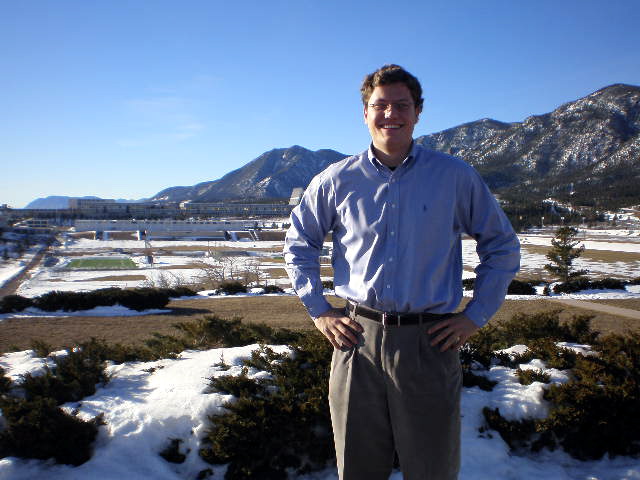
But Monday took the cake — I spent all day with Paul Berberian, an extremely successful entrepreneur here in Boulder, at the U.S. Air Force Academy in Colorado Springs. Paul is an alumnus and was visiting several business classes to talk about how to come up with the right business idea.
P2040005_1

It was my first time on a military base surrounded by 4,000+ people in uniform.Since Paul and I were escorted by staff, we could walk around and get up close. Initially I was intimidated — the freshmen who had to walk on certain lines in the courtyards and only turn at 90 degree angles, the memorial stones commentarting air force graduates killed in battle, the huge aircraft on display.  The highlight of our day — other than Paul’s speech, of course — was the lunch hour. All 4,000 cadets lined up by squadron and, to the background of the band, marched into the dining hall.P2040014

Serving lunch to 4,000 cadets is an excellent microcosm for the most awe inspiring feat of the U.S. military: logistics. I can’t begin to comprehend how hundreds of thousands of people and millions of dollars worth of equipment are moved around the world so efficiently.

Prior to visiting the student classes I didn’t think entrepreneurship would be part of the culture. When I think of military, I think of bureaucracy and authority, not creativity and thinking different. But, it does seem like an experimental subculture can exist within the boundaries of the formal education. The students had some interesting business ideas.

It’s not an easy place to walk around in if you’re a pacifist. In one of the dormitories, there was a quote which said something to the effect of, "Those who say there’s nothing worse than war are wrong." The military imagery is omnipresent.

But by the end of the day, I felt patriotic: the caliber of the students is very high and their dedication to the country is pure. It’s an outstanding institution. Thanks, Paul, for bringing me along!

Embracing Randomness in Your Product — Or Your Life

Kathy Sierra recently hit on one of the themes of this blog which is "randomness". She notes that adding randomness to your product or service can be a wonderful idea. Products should be neither fully predictable nor chaotic: just look at the iPod shuffle.

When the iPod Shuffle first came out, the ads were based on the theme, "Life is random." I thought it was one of the lamest marketing spins ever. I imagined the meetings, "Let’s spin the lack of display as a feature. Yeah, that’s it. We’ll sell the inability to choose your music as a benefit!"

But I was so so so wrong. Within a few weeks’ of the Shuffle’s release, the serendipity effect had kicked in. "OMG! That was the perfect song for this!"  "Seriously. It can’t be random. It’s putting songs together that just… work" The Shuffle was getting people out of their playlist ruts. Out of the music comfort zones we all fall into. Exposing them to songs they’d loaded onto their pre-Shuffle iPod but that never seemed to be one of The Chosen Ones. Think about it. Think about all the music on your (non-Shuffle) iPod, computer, or vintage CD rack. Now think about the subset you actually listen to regularly. For most of us, it’s a pathetically small set. By literally forcing people to listen to randomly-chosen songs, the Shuffle was constantly delighting, surprising, rewarding, stretching users. And users loved it.

Randomness is the story of my life. Nearly every good thing that’s happened to me is because of a random event or conversation. I think our default mode is to shut off randomness by being overly focused on some goal or plan. Specific plans and goals are useful until they blind your peripheral vision — and it’s in life’s periphery where some of the most interesting opportunities are. I’m absolutely committed to trying new things, talking to random people, and being open to changing my life path at any moment.

Randomness, for example, is a big reason why I decided to enroll in a four year traditional college: it maximizes the possibility of a lot of random shit happening in my life. My "Real Life University" conception – four years of self-directed education – was limited by the boundaries of my imagination.

So if you were to ask me what my 10 year life plan is, I’d tell you I have no such plan, and that I like wandering. After all, it’s easy in hindsight to connect the dots in your life logically. It’s stupid, in most cases, to try to draw out the dots as you’re living.

Can a Best Friend Be a Composite?

I have a diverse group of friends spanning all ages and backgrounds.* One thing I’ve realized is that given my range of activities and interests it’s hard for any single person to cover all my bases, to understand all the dimensions of my life.

Shared experiences is maybe the #1 factor of a successful relationship. And anyone who accumulates unique experiences, by definition, will have less overall shared experiences with any one person. So this presents a challenge for someone trekking on their own trail. My question is, does the construct of “best friend” even work in a situation where hardly anyone has direct overlap of experiences? After all, few people can fully appreciate an experience without enduring it themselves.

What percent of people do you think would say they have a true “best friend”? Do you have a best friend or is your best friend a composite of several relationships which serve different needs in your life? Is the mere notion of best friend a crumbling artifact?

(Hat tip to Kai Chang for helping think through this idea)


*To reinforce the diversity in my relationships, consider this. I just returned home from a three hour dinner with a 40 year old entrepreneur who’s smart, fun, and inspiring. Today I also got an email from a good teenage friend in college (also smart and funny) who said:

I am curious to know how corporate life is for a fledgling wannabe like yourself. Have you succumbed to financial greed just yet or are you still that innocent bastard who calculates what people and actions serve you most propitiously (you may want to consult dictionary.com for that one.) Have your co-workers taken to your sense of office humor, or have you found yourself at the mercy of some far advanced entrepreneurial jokes? In any case, try to make one less trip to the vending machine/water fountain from your cubicle and hit me back…Don’t forget where your black ass come from.

The Hero's Trail and the Journey of Life

I enjoyed this excerpt from T.A. Barron’s The Hero’s Trail, a thin book designed for younger readers. Barron gave me a signed copy so I read it on the stationary bike. A journey of a thousand miles begins with a single step…

[And] every journey begins with a single person. A hiker — and whatever inner qualities he or she brings to the trail.

That’s true whether the journey is long or short. It could be a full-blown expedition to traverse a whole continent, or a brief side trip to explore a slot canyon…Some embark on lifelong expeditions…others take strenuous side trips, ones that require great courage and determination to save someone else’s life. But in every case, it’s the inner qualities that define the hero — and the hero’s journey.

Just how are those inner qualities revealed? Through our choices. For every choice matters, whether it’s big or small, conscious or unconscious, repeated or rare. And every choice is an expression of who we are.

Our choices, then, are like footsteps. Each one takes us farther down the trail, affecting the route we take, the pace we set, and the deeds we do along the way. And each one is shaped by two primary forces: our own inner selves, and the trail itself — the landscape of life. So our inner qualities shape our choices; our choices become our footsteps; and our footsteps become our journey.

The Effect of Our Obsession With the Lifestyle of the Megawealthy

My friend Chris Yeh just did a sharply entertaining and dead-on post titled, "Money, Envy, and Why New Yorkers Are Crazy." In it, citing this sickening series of articles in New York Magazine on how New York’s super rich spend their money, he warns fair-minded entrepreneurs of the popular American hobby of "consumerist porn."

The feeling in your stomach after reading these kinds of insanely rich stories is probably similar to that of high school girls after they read People magazine — I never understood why my teenage girl friends looked at People, as surely only a self-loathing inferiority to the "norm" could emerge by umpteenth picture of Scarlett Johansson.

In our fascination with the lifestyles of the most wealthy (MTV Cribs, anyone?), Chris points out, it can be easy to confuse billionaire wealth with happiness. Time and time again research has found a correlation between money and happiness only to a point — I’ll pick a random number, and guess $75,000/yr income — with reported happiness levels being basically indistinguishable after that point (what the real cut-off is is up for debate).

I think it’s important, then, to not only avoid idolizing the lifestyles of the mega-wealthy (although, admittedly, I at times fantasize), but also to choose a physical environment that promotes better consumerist values. I know little about New York (I hope to spend meaningful time there at some point in my life), but based on this article and other anecdotal knowledge (Bonfire of the Vanities, for example, or recent college grads whose first job is on Wall Street), I have to guess that the high flying finance culture inculcates a set of unique values for young, smart professionals, and, if not questioned by the go-getter, are simply absorbed as right. And it’s 80 hour weeks, $500k salaries, mansions, and then private jets, several women, and endless gadgets.

The Bay Area, by contrast, lacks a similarly money-hungry culture. Chris ponders whether this is why the Bay Area has been successful as a high-tech hub: "The richest guy I know, a Google billionaire, still lives in the same rented apartment in Mountain View as when he was a grad student. And Priuses have largely replaced the Ferraris so common in the 1980s."

Here in Boulder, CO, my current locale, which according to one article is one of the top five wealthiest counties in America with a lot of "quiet wealth," living a glamorous lifestyle is second to skiing, hugging trees, and rioting in support of underage drinking — in other words, quality of life trumps all.

This doesn’t mean that you can’t live in New York (or London or Paris or Tokyo) without being sucked into a disheartening, make-money-and-spend-it-on-frivolous-bullshit scene, or that Silicon Valley or Boulder are immune from these traps, but it does mean that wherever we are living, there’s an elite, mega-wealthy culture, and before reading about its latest gossip in the local paper, we should think about what effects an obsession of their consumption has on our own values, life goals, and pursuit of happiness.

What do you think?