The Perceptions Of America From a "Populist" in the Pub and an "Elite" In a Restaurant

On my trip I am meeting a nice mix of highly educated businesspeople / writers / academics (through my network) as well as the more "comman man" (in bars, restaurants, on beaches, etc). There are consistent contrasts in how they respond to me, an American, and America more generally.

In Barcelona my friend and I went to an Irish Bar one night. We have both studied Irish writers and I had a successful stay in Ireland a few weeks ago. Unlike many Irish pubs, this one was Irish owned, showing Irish football on the TV, and we happened to sit down next to an Irishman comedy-club/music manager who immigrated to Barcelona a few years ago. He was a fun guy but "doesn’t want to visit America anytime soon". He has a kind of unacknowledged split in how he views my country. On the one hand he adores some of its cities (New York and San Francisco, he mentioned) and enjoys many of its cultural exports. On the other hand he deplores George W. Bush, the War in Iraq, etc. His opinions are more emotional than philosophical.

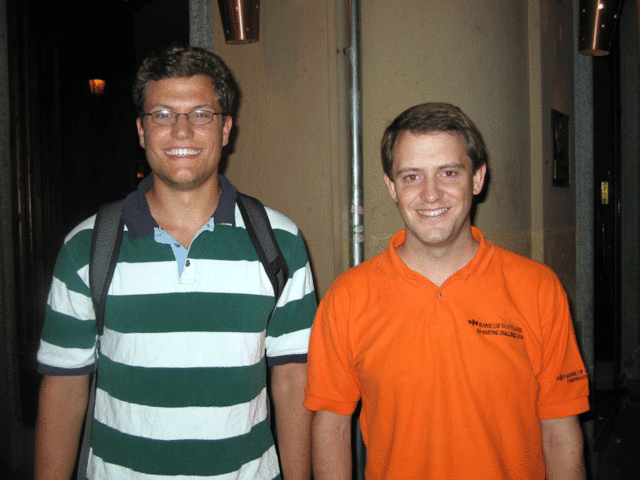
In Madrid we had dinner with a private equity business guy named Luis, who Chris Yeh introduced me to. Luis is a Madrid-based investor who attended Harvard Business School for a couple years and thus has acquired a honed "pro-market, pro-capitalist" outlook toward the world, making him seem like an alien to his Spanish business colleagues. We had a great time discussing Spanish politics, business, media, and life. Unlike the guy in the bar, Luis has a more favorable disposition toward America. It’s less charged and more nuanced: he admires the American model but qualifies his support saying what works for one country may not work in another.

Me_andluis_blog

These are just two examples. It’s been healthy to interact with all kinds of people on my trip — in train stations, over dinner, in a park, at a tourist office. I’m not necessarily surprised that the businesspeople, scientists, and academics I’ve met have a considerably more enthusiastic view of the U.S. because they personally experience the country’s contributions in all those arenas. The guy in the bar isn’t employed by an American multinational, doesn’t collaborate with America’s science labs, doesn’t sell to the American market, and thus only bases his anti-Americanism on the America government as reported by European media.

I’m not big on "populist" techniques to learn about the world. I don’t buy the idea that "media elites" or academics are out of touch with "regular Americans." Heck, maybe I’m an elitist myself (ok, I confess, I am). But this doesn’t mean I should avoid the "bar conversations" altogether. Indeed, I would argue it’s the aggregate of thousands of conversations in bars around the world which together constitute the "public opinion" of a nation, a statistic so often quoted in newspapers. It’s this aggregate, not the "chattering classes" of academia, which is measured and is where one must influence minds.

The New World Order: Cosmopolitan Liberals and Local Non-Liberals

I’m obsessive about globalization and cosmopolitanism. So I couldn’t help but read and re-read these last few paragraphs from Richard Shewder’s essay in Culture Matters (review forthcoming on this blog).

Such an emergent "new world order" might look like a post-modern Ottoman "millet system" on a global scale. I imagine this system would be two tiered and operating at two levels, global and local. I imagine its personnel will belong to two "castes." There will be the cosmopolitan liberals, who are trained to appreciate value neutrality and cultural diversity and who run the global institutions of the world system. And there will be the local non-liberals, who are dedicated to one form or another of thick ethnicity and are inclined to separate themselves from "others," thereby guaranteeing that there is another diversity in the world for cosmopolitan liberals to appreciate.

Right — if everyone is a cosmopolitan, there’s no local diversity to throw in the pot.

The global elite (those who are cosmopolitan and liberal) will, of course, come from all nationalities. In the new universal cosmopolitan culture of the global tier of the world system, your ancestry and skin color will be far less important than your education, your values, and your travel plans. It is already the case in the postmodern cosmopolitan world that you don’t have to grow up in the West to be Western any more than you have to grow up in the southern world to adopt an indigenous Third World point of view. Finally, I imagine that it would be possible in this "new world order" for individuals to switch tiers and castes in both directions, moving from global liberalism to local non-liberalism and back, within the course of a single life.

With regard to globalization, westernization, and economic growth, I would hazard this guess. If it should turn out as an empirical generalization that economic growth can be pulled off relying only on the shallow or thin aspects of Western society (e.g., weapons, information technology, Visa cards) then cultures won’t converge, even as they get rich. If economic growth is contingent on accepting the deep or thick aspects of Western culture (e.g. individualism, ideals of femininity, egalitarianism, the Bill of Rights), then cultures will not converge and will not develop economically because their sense of identity will supercede their desire for material wealth.

Which caste will you be part of?


Umbrella Repairman Losing Business; Blames Globalization

The Financial Times recently profiled Thierry Millet, a Paris-based umbrella repairman who "symbolizes France’s contempt for globalization" (I hope not!). Millet mends 8,000-10,000 umbrellas a year. His business is struggling because umbrellas are cheaper than ever (manufactured overseas) and people are choosing to throw them out and buy new ones instead of sending them in for repair. He’s quoted only once in the whole story. "That’s globalization," he says exasperatedly on his now-struggling business.

Precisely. How dare he have to deliver a product people need. Markets are so unfair. Who votes for a subsidy to keep this man in business?

Logistical and Cultural Challenges of Global Business: A Visit to Microsoft Dublin

A big goal for my trip this summer is to examine on-the-ground how globalization is impacting countries, businesses, and cultures. Yesterday afternoon I spent a little time at the Microsoft Dublin operation, the third largest employee-base location for Microsoft outside of North America and Tokyo (ahead of India and China!). Dublin attracts many U.S. multinationals because of their advantageous tax structure and English speaking and educated workforce. So, Dublin is a good sampling of how global organizations work with their major satellite offices overseas. Simply put, it’s a fascinating logistical and cultural challenge which raises several interesting questions which I will outline in this post (relevant to big business and start-ups alike).

My host here in Dublin, Frank Lynch of Microsoft, who I met through my blog and who’s made the start of my journey truly extraordinary, works with folks all over the world on operations IT support internally. It’s sometimes easy to forget how massive of an organization Microsoft is — operations support is an essential part of keeping the company going. Frank and his team operate out of three core time zones: Redmond, WA; Dublin, Ireland; and Asia (mostly Beijing, some India too). This enables a truly 24/7 operation. There are three conference calls a day on which two of three time zone groups participate: one at 9 AM, 5 PM, and 1 AM. At these times access to the development environment is passed over to the group just waking up. They review the progress made while the others were sleeping.

The logistical and cultural challenges associated with managing or participating in such a global, nonstop effort are daunting. Logistically, the sheer number of electronic communications require useful collaborative software and smart email protocol. Web 2.0 in the enterprise will be all about collaboration, says Peter Rip. Also, finding the overlap work time can put stress on employees since they can’t work on their own hours.

Culturally, each person brings national norms, some of which are antithetical to efficient business practices (at least as defined by Americans). In the West, if someone presents an idea, and there’s silence, it’s taken as implied agreement. In some Asian countries, speaking out is not always encouraged. In the West, if you ask if someone can commit to do something by Tuesday, and the person says yes, it should be done by Tuesday. In India, sometimes yes means no. You don’t want to ask yes or no questions (instead: “When do you think you can do this by?”). Western businesses usually involve rules-driven cultures — develop a system and process for evaluating things and making decisions. Other cultures believe relationships should be formed before doing business. Legal contracts and the like, then, can undermine trust and potentially harm relationships. Some commentators estimate that approximately 70% of the world’s population come from primarily relationship-based cultures. Another cultural difference is where status comes from: “Who you are” versus “what you do.” If the latter, it’s easier to challenge your boss. (See Global Integration for more on this stuff.) (NB: These observations are general, not related to my visit to Microsoft.)

These challenges raise an important, provocative question: Should firms look to decentralize their operations a la Southwest Airlines’ plane routes or centralize as much as possible around corporate headquarters and just ship out self-contained, niche projects to overseas facilities? SAP, while based in Germany, maintains a huge global presence with each facility of almost equal importance and scale. Their CEO, head of sales, and head of products are in Frankfurt, Paris, and Palo Alto respectively. Microsoft, on the other hand, continues to drive the bus from Redmond even though they have tons of offices overseas such as in Dublin, where there are 1000+ driven, competent employees. Within the satellite office at Microsoft, though, there is some decentralization as the employee mix at the Dublin office cuts across all domains, from XBox to Mac Office to internal ops, and the employees in each division may only have one or two project colleagues sitting next to them. Some quick strengths of each model:

Centralized model:

– more efficient (fewer logistical and cultural pitfalls)

– easier to project one corporate identity

Decentralized model:

– better talent since it’s spread all over the world

– immune to a natural disaster or the like taking down the guts of the organization

– can localize your products much better

The open-source movement definitely promotes the decentralized model. Check out this great Fortune article on mySQL called “Banish the Headquarters”. We have entire small companies plugging away even though their executive team has met at most a few times in-person. So, the need for entrepreneurial companies to understand and solve the logistical and cultural challenges of global business will only get more pressing. For most technology companies it starts with outsourcing, and more and more non-core business functions will be outsourced in the next several years, I’m sure.

One other note: Big corporations are often hammered by Valley folk and entrepreneur types for being boring dinosaurs. Some even say it’s riskier to work for a Microsoft than for a start-up. I generally agree, but it struck me while being a fly on the wall out here that despite Microsoft’s size it can actually be a dynamic, fun place to work. You’re part of a humongous community of people from each corner of the globe who embrace company core values and mission first (no matter what national culture says). You’re one of many working toward a huge shared goals (ah, to be one of 2000+ working on Windows). Some can see this has demotivating — you feel like you don’t have a real impact — but you can also look at it as the highest level of collaboration, where the collective wisdom and work of many make change no single person could do alone.

Book Review: Creative Destruction; Cosmopolitanism and Globalization

I talk about globalization a lot on this blog. I think it’s a critical force to understand. There are many facets to examine and one of the most fascinating to me is the cultural. How are the world’s cultures changing?

Tyler Cowen, a professor at George Mason and must-read blogger, is in many respects my intellectual hero on this front. He writes with persuasive eloquence. I suppose I’m breaking my own rule of "seek out opinions which differ from you own" when I read Cowen’s book Creative Destruction, but that doesn’t mean I won’t recommend it whole-heatedly to you! (I also recommend this new piece in the New York Review of Books on all these topics.)

You first must know that Cowen is a cultural sophisticate if there ever was one. He samples cuisine and art from all over the world and talks as fluidly about New Zealand cultural products as those of Canada.

Cowen is a cosmopolitan (in the tradition of Prof. Kwame Anthony Appiah) of a libertarian bent. What does this mean? Cowen believes markets and trade are friends of unique culture and aesthetic quality.

This is not a popular opinion. Many claim globalization is pulling producers away from niche production and instead appealing to a bland popular culture. Many charge "Americanization" as diluting the best of international flavor. Most of these critics use markets / trade / corporations as their method of bashing. I never like to see wrong-headed attacks on capitalism go unchecked. To defend markets in the context of culture is considerably more difficult than in other circumstances, though the case for markets, as Cowen shows, is as strong as ever.

Some Of His Basic Assertions

The concept of cultural diversity has multiple and sometimes divergent meanings.
Are you talking about diversity within a society or across societies? This makes a big difference. They move in opposite directions — when one society trades a piece of art to another, diversity within society goes up (more consumer choice) yet goes down across societies (they become more alike). Many Americans like to go to another country and complain that it’s not very different than our own. Alas, this is using the "naked eye" test with geographic spaces instead of wondering whether individuals within the society have more and better cultural choices.

Operative diversity differs from objective diversity

How effectively can we enjoy the diversity of the world? The world was diverse in 1450, but it was hard for individuals to benefit from it. Markets disseminate cultural products in ways we can enjoy.

Cultural homogenization and hetereogenization are not alternatives or substitutes; rather, they tend to come together.

Some parts of the market become more alike while other parts become more different. Partial homogenization creates the conditions necessary for heterogenization. "High and low food-culture have proven to be complements, not opposing forces. Paris and Hong Kong, both centers of haute cuisine, have the world’s busiest Pizza Hut outlets."

Cross-cultural exchange, while it will alter and disrupt each society it touches, will support innovation and creative human energies.

The creative destruction of the market creates a plethora of new artistic innovations that expand the menu of choice and provide more high-quality genres of output.

Cowen then discusses a range of local cultures and how they have adapted the exports of rich cultures to make their own special kinds. True, some unique niches of culture are lost during trade, but they are replaced by different outputs which can be better than the original.

Broad and Narrow Ethos
The spread of newspapers and magazines weakened American cultural regionalism such that when I visit Georgia they will seem so drastically different than my California brethren. "At the same time, the communication of information across space allowed for the mobilization of new constituencies — not geographically centered — with unique outlooks in niche areas of culture." I find this really exciting: people organizing themselves into diverse groups based on interests and values rather than geography.

The Paradox of Diversity
A growing menu of choice in a particular society may limit the menu of choice for the world as a whole.

Charges of dumbing down, "throw away culture," "commercial culture"
Some truth here, but what we are seeing is a diversity of consumption methods. Sure, one can have "bad taste," but it’s also easier than ever for someone who wants to sample a range of cultures intensively to do so. High quality taste has shown great resilience in today’s globalized world. Increasing variety and diversity raises all boats: high and low quality culture.

Should National Culture Matter?

With those points out of the way, let’s think about one of the most interesting aspects of this whole issue: should national culture matter? Should I value American culture and products higher than others? Should I first trade with my geographic neighbor? I strongly believe we should be treated as individuals, not as society’s cogs. And for individuals, globalization has greatly expanded choice and value. But as Cowen points out, most people don’t care as much about choice as much as identity. Here, some cultural sameness is essential for their sense of identity. Trade, then, bears diversity from this sameness because so many cultural producers emphasize difference (either for intrinsic — identity — purposes or for the extrinsic fruits of diversity).

What’s bizarre about many so-called national cultures, moreover, is that many are synthetic products. Few cultural identifications are truly national in their purity. "[People] would rather have a larger personal stake in something closer to them, rather than a smaller personal stake in something that is grander but also more distant."

The Main Conclusions

Cosmopolitan multiculturalism calls for the elevation of individual "free speech" — the voluntary exchange of goods that may transform cultures into a more synthetic variety as a whole but pave the way for more and better choices for that individual within his own society. Cowen doesn’t as strongly insist — as Appiah has done in his writing — that it’s condescending for rich Americans to shame the spread of global cultures. He still touches on it. Cowen says, "Poorer societies should not be required to serve as diversity slaves…Insofar as anyone feels the loss of diversity, it is the richer countries. Bringing a shopping mall to Papua New Guinea gives the Papuans more choice, but it may give the American collector of Papuan sculpture less choice, if it weakens the inspiration behind those sculptures by changing the underlying social ethos." For me, this is an acceptable trade-off — the Papuan gain is more important than our loss.

The twist Cowen lays out in the end is provocative: he says that cosmopolitanism cannot take center stage because in many ways an individual focus on the particular is the driver of the this larger theoretical framework. Cultural exchange is so effective because the producers don’t all hold strident cosmopolitan views. (Just like the stock market is so efficient because many investors believe it is inefficient and thus try to find bargains.) So, rather than advocate for the desirability of a universal cosmopolitan worldview for all, Cowen argues instead that cosmopolitanism is a useful metaperspective to understand contemporary culture.

So I say, we cannot enshrine cosmopolitanism in the fo refront of our consciousness, but we must not lose sight of it either: after all, leave the analysis to collectivist nostalgia and the great cultural successes we have experienced and we will continue to experience will be slowed by the timid ignorance which grips so much of the first world population.