Teaching Entrepreneurship via Business Plans

How do universities teach entrepreneurship?

The most popular way is to place the writing of a business plan at the center of the curriculum. Almost every school has a business plan competition at the end of the semester.

Yet most real-life entrepreneurs do not put much stock in business plans. They think they’re overrated. Recent studies show that VCs don’t care what is in a business plan; the content of plans has little to do with which businesses get funded.

So there’s a gap between how schools teach entrepreneurship and how entrepreneurship is being practiced in the real world. Students graduate with an entrepreneurship major and when they start their first business they think, “Step one is write a business plan!”

To be sure, business plans have their merits. Writing a business plan forces you to think about all the fundamentals of your business idea.

But even entrepreneurship professors would probably agree that the best way to learn about how to start a business is to start a business. If you’re a college sophomore interested in running your own company, start businesses while in school and learn by doing it. This is what they do at Babson and Bentley.

Alas not all students can get real businesses off the ground while tending to their studies. So what’s the next best thing?

Start micro-businesses. Start affiliate businesses. Sell stuff on eBay. Do web design. Write and sell e-books. Heck, write a blog and try to gain huge readership. A micro-business, which requires less than full-time work and could be operated out of a dorm room, probably would teach more than taking a class on entrepreneurship and writing a business plan.

Finally, you might just consider not studying entrepreneurship in school. Wait till you’re out of school and start your business then. Meanwhile, study topics (philosophy?) for which the classroom has a comparative advantage over self-education and real-world learning. Business and entrepreneurship are probably near the bottom of the list in terms of teachability in the classroom.

Farmers Didn’t Invent Tractors. They Were Busy Farming.

There's a cliche in innovation / entrepreneurship which says, "Scratch your own itch." That is, solve problems that you know really well. Choose markets you know really well.

But a lot of innovation doesn't come from the people who know the industry the best. That's because the closer you are to how something works now, the harder it is to imagine a new and better way of doing things.

In pondering why millions of dentists haven't been able to figure out that flaxseed oil helps your gums, Seth Roberts channels Jane Jacobs in this excellent observation:

For a long time, Jacobs says, farming was a low-yield profession. Then crop rotation schemes, tractors, cheap fertilizer, high-yield seeds, and dozens of other labor-saving yield-increasing inventions came along. Farmers didn’t invent tractors. They didn’t invent any of the improvements. They were busy farming. Just as dentists are busy doing dentistry and dental-school professors are busy studying conventional ways of improving gum health.

Jacobs also writes about the sterility of large organizations — their inability to come up with new goods and services. On the face of it, large organizations, such as large companies, are powerful. Yes, they can be efficient but they can’t be creative, due to what Jacobs calls “the infertility of captive divisions of labor.” In a large organization, you get paid for doing X. You can’t start doing X+Y, where Y is helpful to another part of the company, because you don’t get paid for doing Y. A nutrition professor might become aware of the anti-inflammatory effects of flaxseed oil but wouldn’t study its effects on gum health. That’s not what nutrition professors do. So neither dentists nor dental-school professors nor nutrition professors could discover the effects I discovered. They were trapped by organizational lines, by divisions of labor, that I was free of.

Bottom Line: Sometimes the big improvements come when you scratch someone else's itch.

Role of Side Projects in Innovation

Side
My 2,600 word article for The American, a publication of the American Enterprise Institute in Washington, came out today. It's on the role of side projects in innovation. It draws upon examples such as 3M, Google, Apple, the Founding Fathers, and music band Metallica. Here's the conclusion:

Figuring out innovation—how to come up with a killer new idea and then execute it—has long been an obsession of entrepreneurs and the academics and journalists who study them. One of the great myths of the innovation process, often reported in the popular press, involves a creative genius experiencing a “eureka moment,” refining the golden idea, and then pursuing it toward blockbuster status.

Successful side projects and the policies that nurture them somewhat deflate this myth. First, they highlight the random circumstances that can give rise to important inspiration. Second, they promote experimentation—not abstract brainstorming—because the “aha!” moment does not always happen at the outset, as mythologized, but somewhere in the middle of the process. Third, they underscore not the mad, brilliant scientist at the top but the collective brainpower of all employees, especially those close to the customer—Richard Drew at 3M, Paul Buchheit at Google. These people are critical to sustaining innovation over the long term.

Most of all, side project successes serve as a reminder that when you try more stuff than the next guy, up go the odds that you are going to do something right. It is the law of large numbers in entrepreneurship. Thomas Jefferson once wrote, "It is amazing how much may be done if we are always doing." And as Jefferson later learned, it is amazing what can come of some of the things we least expect, which is good reason to always keep that crackpot project bubbling on the side and to stay open-minded about what it might one day become.

Do read the whole thing.

When the Blinders Come Off…

Geez-magazine-find-the-eyes-to-see
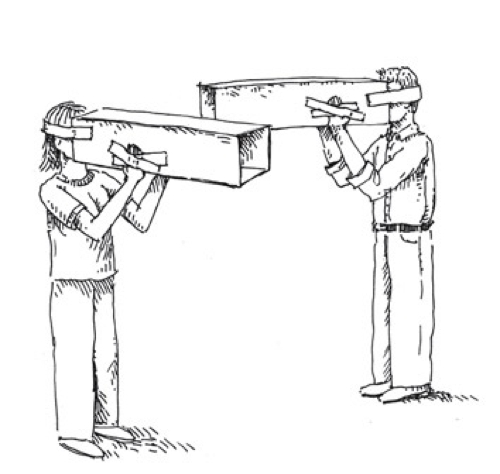
I could not respect how he functioned so completely immersed in the structures of his professional micro-universe. Yes, I too had previously derived comfort from my firm's exhortations to focus intensely on work, but now I saw in this constant striving to realize a financial future, no thought was given to the critical personal and political issues that affect one's emotional present. In other words, my blinders were coming off, and I was dazzled and rendered immobile by the sudden broadening of my arc of vision.

– Mohsin Hamid in his novel The Reluctant Fundamentalist, page 145, my review here

I read that paragraph slowly. It happens at a point in the novel where the main character is distracted at work by a brewing Pakistan-India war, and he notices his colleagues' total apathy to anything other than the company task immediately in front of them.

Most ambitious companies — certainly start-ups — require of their employees single-mindedness. They demand all-consuming focus, and to "give thought to the critical personal and political issues that affect one's emotional present" is seen a distraction. Some of the successful business executives I've met are absolutely immersed in their professional micro-universe. The politics of the world, their personal relationships, their personal philosophies: who cares? Whether they realize they're wearing blinders, I don't know. Whether blinders are necessary to achieve massive professional success, I also don't know.

I do know that most of the start-up folks I meet have a fairly narrow arc of vision (this is an observation not a criticism) and many cite this hyper-focus as key to their success. To me, if the narrow focus Hamid describes is necessary for professional success, and if such focus is especially necessary to start a start-up, and if you are a curious person, and if said focus requirement impinges on the flourishing of said curiosity, this represents one of the main downsides of the start-up entrepreneurship lifestyle.

Better to Start a B2B Company in a Recession

Sometimes, the best way to save money is to spend money.

You invest in education to improve your long-term earning potential. You invest in software to make your employees more efficient.

This is a basic concept that can get lost in the oh-fuck-we're-in-a-real-recession panic that is striking boardrooms and kitchen table conversations around the world.

But companies tend to remember it better than individual consumers. Companies tighten their belts more rationally. Consumers will blindly slash costs across the board. They hibernate and are unable to think about the long term benefits which can accrue from short term investments.

What does this mean to entrepreneurs? I think it's better to start a B2B business than a B2C.

Bottom Line: All else being equal (and this is a huge qualifier), if I were starting a new company in a recession or depression period, I'd prefer to sell to companies over consumers.