Fathoming People’s Emotions and Motives from Afar

Someone who works closely with Michelle Obama recently told me that Michelle is "a huge bitch."

In Lee Siegel's column about Elizabeth and John Edwards, which is stellar, he notes, "No matter how sophisticated we seem to get about social stereotypes, we fall right back into them as soon as their pleasure beckons. Elizabeth Edwards was a 'saint.' Now she’s a monstrous bitch. That’s how high-status women have been perceived for as long as anyone can remember."

Elizabeth Edwards is back in the headlines thanks to a new book about the 2008 presidential campaign where there's a chapter devoted to the Edwards' marriage. She comes off as…a monstrous bitch:

At one point during the 2004 presidential race, she “snarled” at the people who were scheduling her appearances: “Why the fuck do you think I’d want to go sit outside a Wal-Mart and hand out leaflets?”

To which Siegel offers the logical reply: Well, why the fuck would she?

Halperin and Heilemann [the authors] are veteran political reporters. Surely they know that such language and tantrums are as common in political campaigns as their opposite: sheer, calculated niceness.

Siegel says he doesn't defend Elizabeth's outbursts, but it's "appalling to tear her out of her context and turn on her now because we idealized her before."

What's more, deconstructing the dynamics of a relationship we have no part of is a fool's errand:

A friend of mine once said that the only two people who know what’s going on between a man and a woman are the man and the woman themselves. He was half right. The man and the woman—or man and man, woman and woman; it’s all the same—are the last to know. The idea that we can precisely fathom people’s emotions and motives is absurd. We can barely comprehend our own. Maybe pretending that we understand what makes our political figures tick is how we console ourselves for not understanding our politics at all.

California’s Governor Race: Idealism, Cynicism, and Tom Campbell

AllPH2009100701792

California is the largest and most diverse state in America. If it were its own country, California would be in the G8. It is also the most important state: for the last 20 years, California has been home to groundbreaking innovation in semiconductors, the internet, and military manufacturing, and it is even more dominant in present-day innovation around biotech and cleantech.

But California is in trouble.

Over the past several months I spent 40 hours learning about the fiscal disaster that is Sacramento. I also talked to experts about this year's governor's race. Arnold Schwarzenegger is being termed out of office, and there are three Republican candidates and one Democratic candidate vying to take office to implement policies that will put the State back on the road to fiscal recovery.

I wrote a 3,500 word analysis of the governor's race for the California Recorder. If you are a California voter or interested in California politics, please read the whole thing.

I begin the piece by comparing Arnold Schwarzenegger to Barack Obama: two charismatic leaders who promised transformational change.

After electing a would-be transformational governor and president since mugged by reality, will chastened California voters seek a more tactical administrator? Can a bland policy wonk defeat dynamic, self-funded outsiders who talk about "leadership" and conducting "top down reviews" of government? Can a commensurate insider who's first a realist beat optimistic outsiders who "reject false choices" and think they can re-make a culture?

Then I recount a panel I attended on California's future:

The CEOs alternated in sounding alarm over the Golden State's dimming star. Ed Colligan, the former CEO of Palm, roused the crowd when he declared the state health care program and failing K-12 schools unacceptable. He was quick to add, however, that Silicon Valley is the "greatest place in the world for entrepreneurs and innovation" and went on to praise the region's weather, culture, and people. It is the California way when talking about its politics: with despair acknowledge the depth of darkness the State finds itself in, but conclude with near-delusional self-confidence that, gosh darn it, we're California, of course things will work out. The California Dream is a highly potent dose of Americanism, and nothing stirs a local audience more than playing directly to the bi-polar hot points which make up this shared imagination.

Then I introduce Tom Campbell, the best candidate in the race, but one whose academic approach may not inspire audiences:

Tom Campbell was the last of the four to speak. He spoke softly and deliberately. He carefully offered three specific policy prescriptions on health care, stressing the benefits of inter-state competition of insurers, anti-trust reform, and litigation reform. (He asked the audience to download his 15 page policy paper.) On immigration, he described the argument for more H-1B visas, and the counterargument. On education, he proposed vouchers for the most disadvantaged and vowed to exempt community college grants from cuts.

It was an impressive breakdown of policy. Absent were emotional pyrotechnics. Campbell served up no red meat. He never once denounced the system in sweeping terms, nor did he anchor his ideas in appeals of hope and optimism. He garnered only polite applause.

I go on to review Campbell's background and policy views. He is a pro-choice, pro-gay marriage fiscal conservative who supports a tax increase who's running in the Republican primary:

Suffice to say, Campbell is an unorthodox Republican with immense political courage. And those are just his economic views. He also supports gay marriage, when 82% of Republicans in the state oppose it, and the right to have an abortion. He and Andrew Sullivan would make good bedmates. Sullivan is a conservative in the wilderness and subtitles his blog "Of No Party or Clique."

Lest Campbell's ideas seem too random, here's one way to cohere them: The Economist. It is Campbell's favorite magazine — which he reads, along with the state's major newspapers, each morning on his Kindle — and his views approximate almost perfectly with the British editors' in charge.

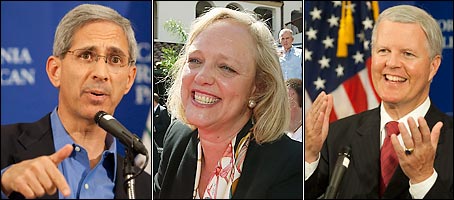
His two opponents in the GOP primary are self-funded outsiders who each have their own serious problems. From Steve Poizner's delusional fiscal proposals, to Meg Whitman's relentless opportunism.

But can Tom Campbell win?

What makes Campbell's campaign so improbable is not just that he lacks personal wealth — that barrier's been surmounted in the past — but that he is positioning himself as a truth teller when there's little evidence truth telling is successful in politics

Most savvy politicians hold an ends-justifies-the-means attitude toward campaigning. Economically literate Democrats say to themselves: I'll implement the right policies once in office, but first I need to get in office, and doing that requires appeasing unions with protectionist talk. When Obama the candidate dished populist rhetoric that worried America's trading partners, his economic advisor Austan Goolsbee notoriously quipped that Obama was playing domestic politics and that NAFTA was going to be fine. There wasn't a microphone around Goolsbee after that.

Campbell, by contrast, says exactly what he thinks on third rail issues. He's not hedging on politically risky positions. He's not obscuring the seriousness of the budget situation. Campbell's bet is that Californians will take the time to engage his ideas thoughtfully. They may not agree with him but at least they'll respect his courage, the thinking goes. If there were ever a time this strategy might work it would be now: a moment of a peril and one where 80% of Californians say the state is on the wrong track.

The bottom line:

The cold, hard bottom line is that California state government does not need "leadership" as it is often thought of. California does not need big personalities. We've seen how they fare. California does not need outsiders who think they can transform the most complex state in the union, transcend divisiveness, re-make a culture, and balance the budget by eradicating government waste. It needs, instead, someone who can negotiate among entrenched interest groups, a task with no analog in the private sector, and spend four years focused on cleaning up the State's balance sheet.
One of the Best Anti-Poverty Solutions: Immigration

Immigration
It is unfair that where you happen to be born matters so much to your potential success in life.

Warren Buffet has said that he won the "ovarian lottery" by being born in the United States — had he been born into a poor village in Peru, he says, his "talents" probably would have gotten him nowhere. "Lottery" is the right word: luck alone determined Buffet's place of birth.

The process of globalization has leveled the playing field a bit and reduced the relative advantage of being born in a rich country. Information and knowledge and physical goods now flow to the poorest corners of the earth. Over the last 50 years, with the rise of free trade and emergence of technologies like the internet, we've seen an extraordinary reduction of poverty. Hundreds of millions of people, mostly in Asia, now live above the poverty line.

But there is still work to be done, of course. Every night, in 2009, over a billion people in the world go to bed hungry. And just because someone isn't ultra-poor, doesn't mean he has the same opportunities or access as someone born in the United States.

So how do we make further progress toward the ideal of all people of the earth starting the race at the same point?

Here's an answer you won't hear from guys like Peter Singer or Jeffrey Sachs: immigration.

Or, to continue the globalization idea: more globalization, though a globalization that includes the free movement of people, not just goods and ideas. The champion of this cause is the economist Michael Clemens.

I recently met Michael at a conference in Miami and witnessed his presentation on migration issues. He began his talk with a moral question: why is it that a guy who happened to be born in the U.S. can do a certain job and get paid more than 300x that of a guy born in Haiti who's doing the exact same job, working equally hard, equally industrious. Why shouldn't the Haitian have the opportunity to move to the U.S. and receive the higher wage? We don't allow discrimination based on the choice-less facts of race or gender — why do we on place of birth?

He went on to debunk various myths: such as the idea that increased legal or illegal immigration depress U.S. worker wages or that the so-called "brain drain" hurts the countries exporting their people to richer places. In one jaw-dropping slide he showed a chart showing unemployment in the U.S. being inversely correlated with total immigration.

It's a complicated issue, to be sure. While I'm persuaded by the short and long run economic gains of immigration, I have lingering doubts about a country's ability to weave together floods of people from varied backgrounds. I wrote a long review of Samuel Huntington's arguments about the challenges of assimilating immigrants into the national fabric. Clemens, for his part, praises mongrelization and notes we've assimilated immigrants successfully in the past. (Not all agree with even this. Mark Krikorian bizarrely argues that our past experience with immigration is no longer relevant; he says we're a post-immigrant country.)

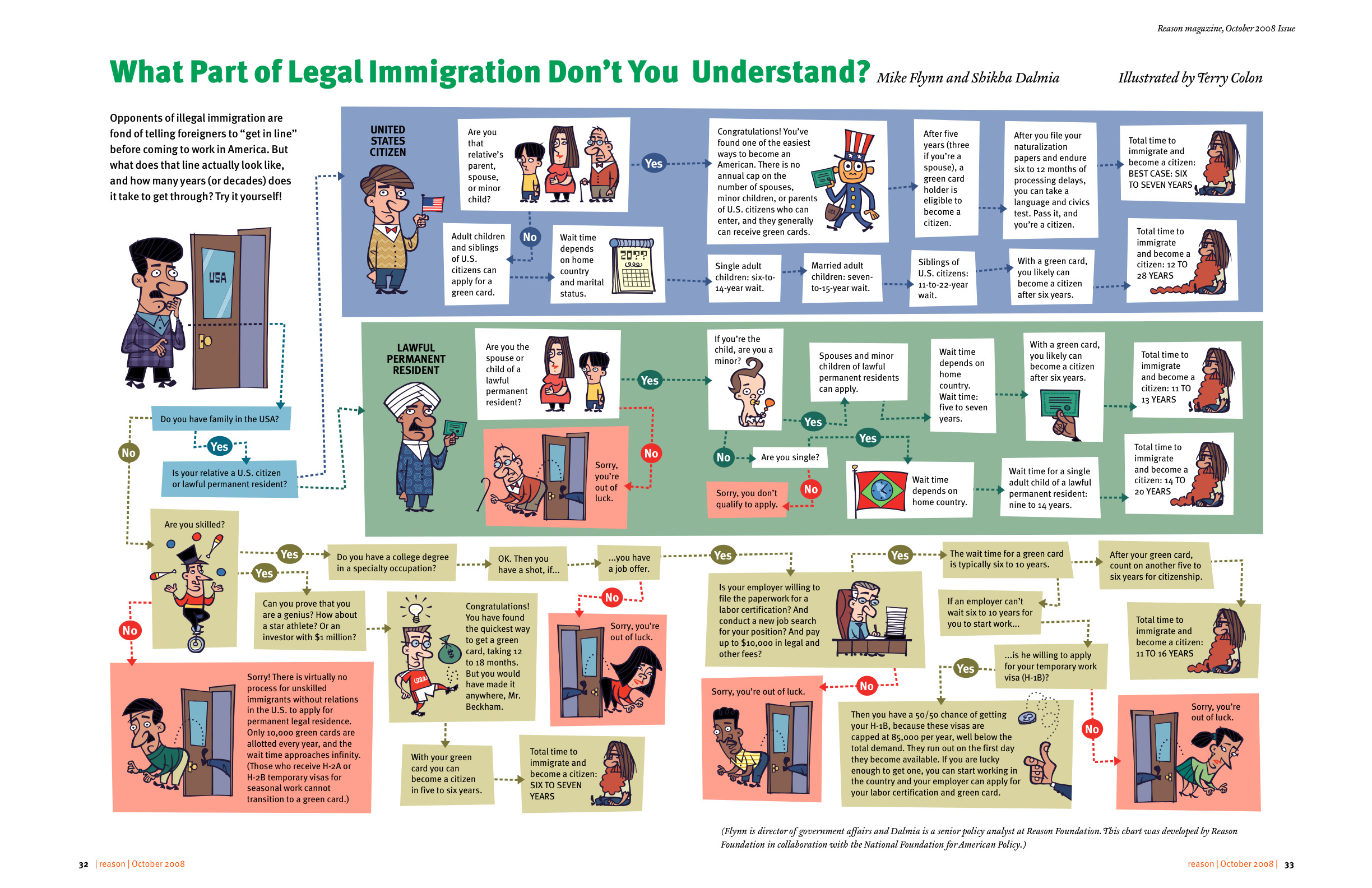
Here's Will Wilkinson in praise of the "intellectual rigor" of Clemens' work. Here's Jeff Jacoby on why conservatives have it wrong in their outrage over illegal immigration. Here's another Jacoby piece that Lou Dobbs should read. Here's an extremely simple, easy to understand chart that explains how the immigration system works in America. Here's a photo that should convince any foodie to think twice before protesting against immigration.

Bottom Line: Immigration is one of the best anti-poverty solutions. We need to reform immigration policy to make it easier for (non-terrorist, healthy) people to enter the U.S. Hail Michael Clemens' work on this topic.

Experts Who Predict the Future

This week I witnessed two presentations by New York University professor Bruce Bueno de Mesquita, a noted political scientist and futurist. His latest book is called The Predictioneer’s Game and claims to use complex game theory to predict political and economic events. He claims his predictions have been 90% accurate, which is why the CIA and others pay close attention to them. He never told us exactly how his models work, except to say several times that they are “very complex.”

As he spoke about the world and proffered future events — Iran will not develop a nuclear weapon, Colombia and Venezuela will not go to war — it was clear that Mesquita is a smart man who knows a great deal about international politics. He also is a talented public speaker.

Yet something bothered me. During his talk my buddy Justin Rockefeller (also in the room) texted me, “What do you think?” I replied, “Entertaining but I’m deeply skeptical. Nassim Taleb would have a field day.” He replied, “Yep.”

In Fooled by Randomness, Taleb talks about “why human beings are so prone to mistake dumb luck for consummate skill.” The idea of survivorship bias figures prominently in Taleb’s work. If I play the lottery 100 times, and I win every time, this doesn’t necessarily mean I’ve developed the skill to regularly win the lottery. Someone has to win. We ignore those who lose.

Mesquita wasted no breath acknowledging the improbability of developing a mathematical model that reliably predicts world events. He offered no qualifications on how much of his success might be due to luck and randomness. Instead, he dished predictions with breathtaking arrogance and certainty, returning again and again to his 90% success rate. He never once elucidated how this 90% number got calculated (I predict Hugo Chavez will die, eventually) despite it being the source of his credibility.

It took only a few minutes of Googling to find long, detailed criticisms of Mesquita. You’d think such a body of criticisms would temper his certitude. No sirree.

Surprisingly, people in the room seemed taken by Mesquita. He had spot-on observations, to be sure, about the selfishness of Mother Theresa or the self-interest of the Iranian regime. But why didn’t more people eye his prediction schemes with skepticism?

Charisma, for one. He was entertaining. We are so often bored by speakers that anyone who can dance a gig on stage gets a vote for “keeping us awake.” I hear that. But it is a dangerous heuristic — equating entertainment with substance.

He wasn’t just charismatic; he was an “expert.” In general, people are too deferential to experts who make predictions inasmuch as experts sometimes do no better than laypeople at predicting. In particular, people are too deferential to experts toting fancy credentials (such as a PhD), even if those credentials have little to do with the topic at hand. We should be especially skeptical of experts who feel a need to remind us again and again of their expertise, as Mequita did.

Look, Mequita is more than qualified to riff on current affairs and the state of the world. He has written a dozen plus books on international politics and economics and he is more knowledgeable than me on most of the issues he discussed. But it’s unimpressive to commentate under the vague guise of “complex game theory.” Do analysis and make assertions as an informed pundit, like everyone else, not some mathematically gifted prophet whose models only the CIA understands.

Bottom Line: Nassim Taleb’s popularity notwithstanding, there are still intellectuals who take their knowledge too seriously, confuse luck and randomness with skill and foresight, and pontificate with inappropriate levels of certainty in an uncertain, complex world.

###

Seth Roberts takes Elizabeth Kolbert to task for putting faith in scientists over science. Seth writes about “practically all science journalists”:

They take the consensus view too seriously. In case after case — so many that it’s hard not to draw sweeping conclusions — the consensus view about difficult topics is more fragile than an outsider would ever guess. It’s not necessarily wrong, just less certain.

We Like to be Shocked Because It Means We’re Innocent

The other day, sitting in a cafe here in Nicosia, Cyprus, I glanced at CNN International on the TV as the anchor ran through the headlines. Serious dispatches from Africa, from Europe, from Colombia, and then…from the leader of the free world…balloon boy!

Lee Siegel, on the incident that dominated the headlines, writes:

Along with the primal terror of a threatened child, there is something about the ordeal of innocence that strikes deep in the American soul. We are still shocked by everything, by sex scandals, by marital infidelity, by corruption, by violence, by public displays of anger—not an hour goes by when society is not rocked, briefly, by alarm, and then hysteria over Something That Happened Out There. We like to be shocked because we like to think of ourselves as innocent enough to be shocked. So in the spectacle of a child endangered and of all the country’s law-enforcement, and military, and technological resources used to try to save the child, we perhaps see our innocence put to the test, and our strengths and virtues fully on display in response.

It recalls Robin Hanson's interesting essay on Innocence vs. Insight. Why are we so taken with innocence, an apparently attractive form of ignorance?

###

I have yet to find a series of insults and defenses more impressive or hilarious than those that Lee Siegel-in-disguise hurled against his detractors.

###

Here's Robin Hanson on why people do not care about inequality of beauty (while we do care about inequalities related to genders or ethnicities). Should we compensate ugly people for their bad luck?

Here's Hanson, in response to David Letterman's forced admission that he slept with female producers on his show, in praise of blackmail.