Cultural Pessimism Remains Flip

In the July 8/9 weekend edition of the Financial Times (which is an outstanding newspaper, by the way, and I think I’ll have to start subscribing to it even though I’m already overloaded on intake) there’s a very typical “culture” column by a guy named Peter Aspden. In recalling a raunchy interview of no intellectual relevance on the BBC a few weeks ago, Aspden asks, “There’s nothing wrong with trivia, but why does it have to be invested with significance? …It’s no surprise that the cheeky bluster of the chat show host has come to dominate public discourse in a way that was inconceivable even 20 years ago.”

I like to categorize these moans — which usually appear every couple weeks in some reputable news outlet — as “now go suck the gas pipe.” In short, it’s a smart guy who’s fed up with the ridiculousness of pop culture. Hey — I don’t find many redeeming qualities in today’s pop culture exports, either, which could be generalized as largely hedonistic and self-destructive. But we have choices. I see the low quality of some types of pop culture as merely a symptom of the riches we can now enjoy. I believe it’s easier than it has ever been to lead a meaningful intellectual life. With the internet anyone can read scholarly articles, participate on intellectual blogs, and sample, for example, MIT courses online. The web makes it easier to find in-person intellectual gatherings, too, like the Silicon Valley Junto.

I choose not to watch TV. I don’t claim this as some moralistic triumph. I don’t even care if you watch TV or not, so long as you don’t restrict my choices.

Like Aspden I wish our culture and politics had more “respect,” yet the way I express this attitude is not by bashing the other side, but by sampling the parts of culture I enjoy.

Aspden doesn’t bring up the negative externalities of large parts of our population indulging in meaningless trivia, I suspect to avoid too elitist a voice. Even these, though, are arguable. Steven Johnson has demonstrated that video games and TV give the brain a good workout. And I’m still torn on whether easy access to pornography helps people sublimate their sex drive and thus make them less sexually aggressive in real life, or whether it’s a negative stimulant. In any event, these are difficult questions which require serious discussion, not personal gripes.

Alas, cultural pessimism is flip, and columnists need to fill word counts.
A Dinner With Libertarians in Rome and 9/11 Skepticism

The caliber and diversity of the people I am meeting on my trip continues to impress and humble me. Last night was no different.

In Rome I’m staying with a friend of a friend of a friend, Nicola Ianello. He’s a journalist and political theorist. After earning his PhD in Political Science, Nicola has done work at a libertarian think tank and was the first to translate Ayn Rand into Italian. He’s a great guy and his views and bookshelf are providing for some interesting discussions.

I’ve learned that the libertarian community in Italy (and Europe more generally) is active (conferences, programs for young people, translations) and close knit. Since it’s Europe — and not, say, Singapore — it’s easy to understand why like-minded people in a marginalized minority would connect with each other.

Last night I had dinner at a pizzeria (where else?) at 11 PM (it’s too hot) with Nicola and two of his younger 22 year-old friends / proteges who are finishing their degrees in political science with an emphasis on free market thinking. We had a great time.

We didn’t agree on everything. I, for example, like some libertarian ideas and generally advocate for a limited but energetic government. My friends in Rome are far more extreme — they question the role of any government. I probed a bit: “Is market competition preferable to the state in the delivery of emergency services like fire protection? How do you define property rights when it comes to the air above us and environmental issues?” At dinner we talked a little about Austrian Economics (more or less discredited among serious economists) and the Chicago School (seen as more legitimate I think). Hey – they’re even reading the Becker-Posner Blog!

It struck me afterwards that operating on an extreme end of any belief continuum means automatic exclusion from most mainstream discussion fora. I could tell that my friends were prepared to be written off as wackjobs whose views deserved to be ignored. I don’t believe that. I tried to listen and understand their arguments. This is important — it’s too easy for an extreme minority (of any color, in any intellectual discipline), if written off entirely, to resign to introversion, and thus write only for each other and not the general academy. The latter audience demands a higher standard.

Finally, one more interesting observation. Here and elsewhere I’ve talked to Europeans about 9/11. They sometimes wonder whether the U.S. government told the whole truth about the attacks. They wonder why there are no pictures of a plane hitting the Pentagon. They wonder whether the U.S. knew about the attacks and intentionally let them happen. They are insistent in avoiding the label “conspiracy theories.” So I’ll call it, “skepticism.” This strand of skepticism — if honest and if part of European public opinion — should be distressing to American policy makers and citizens. That smart, engaged people could harbor such fundamental distrust of American government means “anti-Americansim” is a far thornier issue than merely trying to be nicer to our allies on a policy level. The United States role in global security throughout history is immense. And yet this trust-building benevolence has all but been forgotten as the current foreign policy reigns. I don’t care if people disagree with policies; I support a vigorous press and skepticism about government’s motives and actions. But America needs foreigners and its own citizens to see the current national security strategy as a true policy — a real school of thought for how to act on the global stage, which it is — and not a secret oil mission run by W’s cronies. Until this is the case, we will continue to be distracted by cover-up theories or imperialism charges instead of the more urgent professional debate about the merits of different courses of action.

Thanks Nicola and friends for a stimulating dinner!

Tyler Cowen's Talk: Sponsoring of Culture in U.S. and Europe

Every day I am reminded of the role luck and randomness / serendipity play in my life.

Yesterday morning I was reading one of my top 10 blogs — Marginal Revolution, written by Professor Tyler Cowen of George Mason — and saw that Tyler was in Zurich for a day to give a speech. I emailed him saying I was in Zurich, too, and asked where he was giving his talk. He responded a couple hours later and by 6 PM I was at a fancy Zurich hotel where he was to give a talk titled "Sponsoring of Culture in the U.S. and Europe: Empirical Findings and Normative Reflections." What an amazing coincidence!

Loyal blog readers know Cowen has influenced my thinking in significant ways, especially on the areas of globalization and in particular its cultural effects. His article in Slate prompted the lengthy debate on this blog about independent book stores. His book Creative Destruction informs my admittedly minority viewpoint that commercialism and trade produce richer and more varied cultural options. And of course he writes prolifically on his blog, in the New York Times, and in various journals, providing near daily thought food.

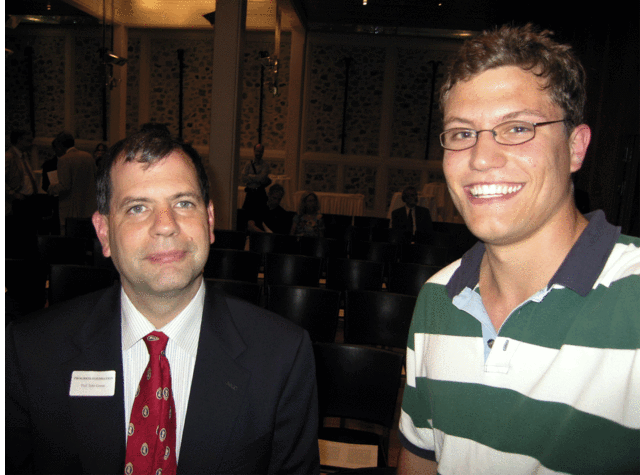
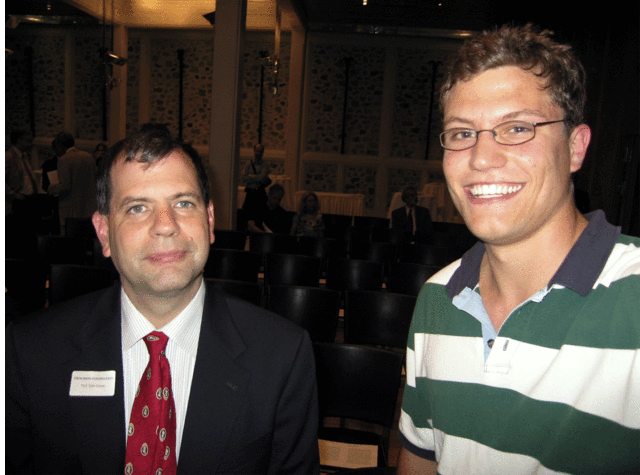
So, I was quite excited to meet Cowen in person. I did. We had a nice, brief chat beforehand, and I also met his wife.

Casnocha_and_cowenblog_1

His talk, not surprisingly, engaged me all the way through. His remarks touched on the U.S. funding and attitude toward the arts, compared and contrasted the U.S. to Switzerland in this respect, and then posed some general questions applicable to Europe and to the world. My notes are below.

The American system of sustaining the arts involves three prongs:

1. Low subsidies — The government provides some $120 M in arts funding nationally. This is a tiny figure. It’s important, but not that important. U.S. citizens give way more to charity per capita than any other country, though. Extremely philanthropic.

2. Strong incentives to give — Our tax system doesn’t discriminate how we give our money away, making it attractive to donate to the arts b/c of tax breaks.

3. Indirect influences — A strong science policy. Cowen made a big deal about this: strongly supporting the sciences leads to much creative blooming. He cited the computer, internet, and airplane as three major scientific inventions which have had a direct and positive impact on the arts. Other indirect influences include American universities, which house thousands of museums and the like.

Cowen made an interesting point about young people. He said America empowers youth as influencers — college students sit around and listen to music, start fads, build web sites, etc. They may not be "working" per se, but they are contributing enormously to American popular culture. Indeed, most of our popular culture is created by young people, and this is the culture that is exported abroad. If a country cares about the influence of its culture abroad, they should ask how much power is given to youth. He noted that Latin America and Asia have huge youth populations, making it prime for a lot of cultural influence in this next generation.

In comparing Switzerland to the U.S., Cowen said Switzerland has had great success within its own borders in creating arguably the richest culture scene per capita of any country in the world. This is because of their emphasis on local funding and direction (at the canton or "state" level). However, Swiss culture has not been very successful in its export. Why is this? Is this important?

When debating the funding of the arts, Cowen thinks too much time is spent on the size of government subsidies, when really some of these indirect causes are perhaps more important. A few questions to add to the debate: Will the internet remain neutral? Will broadband become ubiquitous? Cowen believes this may be the single most important question when thinking about the future of a vibrant cultural arts scene. Another: How can philanthropy work better and be more effective? Tax incentives are not enough. Somehow we need to encourage more and smarter philanthropy.

Sneaking Into an Academic Papers Conference In Dresden

I snuck into the ICA Communications Research Conference being held in Dresden, Germany on Friday. Ok, “sneak” is probably too emotive a word — there was little security, it was an academic conference, after all (unlike the WEF where I ran past a guard and then played dumb).

I found out about the conference since the program/agenda brochure was left in an ATM I used to withdraw some cash. At first I thought it had to do networking technologies and routers but in fact it was all about “communications” the academic discipline, an area loaded with interesting stuff. Grad students and professors from all over the world were presenting papers on a range of topics from pop culture to blogging to journalism to gender and ethics.

Just my luck — there was one day left in the conference! So Friday morning I walked the 15 minutes from where I stayed in Dresden to the huge conference center (dozens and dozens of sessions/panels).

The first session I attended was titled “From Asia to the World: Globalization within and through Popular Communication.” The most interesting presenter was Tabassum Kham from Ohio State University whose paper “Self as a Social Construct: The Emergent Self in Bollywood Cinema” explored the pressure on Indians to reconcile divergent forces on their sense of self. On the one hand, Indian culture essentially provides you an identity since it’s largely blood-based. On the other hand, global cultural exports through media provide a different view of identity, one embraced by “symbolic interactionists“. This view says your identity and sense of self evolves through interactions and re-invention. Kham showed a clip of a Bollywood film (if you haven’t seen a Bollywood movie before you should, it’s a trip — think half foreign film dialogue and half MTV music video) which shows a teenager travel to London, experience the Western culture of evolving and fluid identiy, and then return to India where he struggles to adjust back to his native culture. (Btw, issues of identity are fascinating and I will post more on this after I read Appiah’s Ethics of Identity which is waiting for me at home.)

The second session I attended was titled “Preparing for the Participation Age” which covered what most of us in blogland have been writing and reading about for awhile: the tables are turning, consumers are becoming producers, etc etc. I walked out halfway through this. This is a topic the blogosophere covers better than academia!

Next I checked out “Popular Media and U.S. Ideologies of Progress, Capitalism, and Imperialism.” I caught the tail end of Michigan researcher Rossie Hutchinson present the paper “National Identity Remodeled: Being American on ‘Extreme Makeover: Home Edition’“. Though I’ve never seen the show, Hutchinson presented a fascinating critique of the show and how it evangelizes American values implicitly. It was a convincing argument. As much as we may like to dismiss many of America’s less sophisticated cultural exports as cheap, we cannot dismiss their significance as ideological containers (for better or for worse).

One other observation: although mass media tends to quote professors and students at the top few dozen universities in the country, this conference reminded me that there are hundreds and hundreds of quality state and lesser known universities worldwide which produce tons of useful scholarly output about topics which matter.

Meeting PhD Students at the Laundrymat Doing Public Diplomacy Work

Ladies and gentlemen I introduce to you: randomness at work.

Sitting at the laundrymat in Dresden, Germany waiting for my clothes to be washed. Reading. Two young Americans walk in and begin to try to understand the German instructions for the washing machines. Confusion. Frustration. Since a German lady had just helped me, I felt obligated to extend the help to others, especially fellow Americans. I watched them struggle for a couple minutes, then called out, "You guys need some help?" A huge sigh of relief comes across their faces at the realization: a native speaker is in their presence!

We start talking and I learn they’re PhD students at the University of Southern California. They’re doing some fascinating work at USC’s new Center on Public Diplomacy and are here in Dresden for a conference. They’re traveling around Europe on grants and research money interviewing folks about the Danish cartoon scandal, presenting papers on wireless communication in Zimbabwe, and generally having a good time. It’s all really important work. I told them I want to contribute to a larger cause which targets: a) the Arab world around values of freedom and democracy, and b) China around values of free speech. I especially want to hit youth using technology.

If you’re interested in the USC Center on Public Diplomacy, check out their web site which is complete with a blog and RSS feeds. Here’s their definition of public diplomacy — every U.S. citizen can do his/her part (especially when Europeans surveyed think the U.S. is a greater threat to global security than Iran):

The USC Center on Public Diplomacy defines public diplomacy as "focusing on the ways in which a country (or multi-lateral organization such as the United Nations) communicates with citizens in other countries." Going a step further is the US Advisory Group on  Public Diplomacy for the Arab and Muslim World, which  calls public diplomacy outright "promotion of the national interest."

But public diplomacy has been found to be most effective, not by radiating messages to the masses by TV satellites, but through credible interlocutors who are locally regarded with great esteem, and whose views and opinions are accepted by the masses. As Sir James Fitzjames Stephen remarked in 1873, "The way in which the man of genius rules is by persuading an efficient minority to coerce an indifferent and self-indulgent majority."

Thank you God of Randomness!