Fun Fact of the Day: Sonic Bullets

The U.S. military has gotten serious:

The US military has acquired an arsenal of "sonic bullets" for use as non-lethal weapons. One plays backward the sound of a baby crying at 140 decibels, well above the threshold of pain.

From the FT’s review of the new book Manifesto for Silence, which says silence is a crucial and threatened commodity.

I wonder why it’s with a baby crying backward? In any event, I have a hard time keeping my sanity when just one baby cries at a normal level on an airplane.

Fighting Bad Information With Good

Fascinating article in the Washington Post about the difficulty of combating myths with accurate information:

The conventional response to myths and urban legends is to counter bad information with accurate information. But the new psychological studies show that denials and clarifications, for all their intuitive appeal, can paradoxically contribute to the resiliency of popular myths.

This phenomenon may help explain why large numbers of Americans incorrectly think that Saddam Hussein was directly involved in planning the Sept 11, 2001, terrorist attacks, and that most of the Sept. 11 hijackers were Iraqi. While these beliefs likely arose because Bush administration officials have repeatedly tried to connect Iraq with Sept. 11, the experiments suggest that intelligence reports and other efforts to debunk this account may in fact help keep it alive.

Similarly, many in the Arab world are convinced that the destruction of the World Trade Center on Sept. 11 was not the work of Arab terrorists but was a controlled demolition; that 4,000 Jews working there had been warned to stay home that day; and that the Pentagon was struck by a missile rather than a plane.

Those notions remain widespread even though the federal government now runs Web sites in seven languages to challenge them. Karen Hughes, who runs the Bush administration’s campaign to win hearts and minds in the fight against terrorism, recently painted a glowing report of the "digital outreach" teams working to counter misinformation and myths by challenging those ideas on Arabic blogs.

A report last year by the Pew Global Attitudes Project, however, found that the number of Muslims worldwide who do not believe that Arabs carried out the Sept. 11 attacks is soaring — to 59 percent of Turks and Egyptians, 65 percent of Indonesians, 53 percent of Jordanians, 41 percent of Pakistanis and even 56 percent of British Muslims.

Research on the difficulty of debunking myths has not been specifically tested on beliefs about Sept. 11 conspiracies or the Iraq war. But because the experiments illuminate basic properties of the human mind, psychologists such as Schwarz say the same phenomenon is probably implicated in the spread and persistence of a variety of political and social myths.

The research does not absolve those who are responsible for promoting myths in the first place. What the psychological studies highlight, however, is the potential paradox in trying to fight bad information with good information.

(hat tip RSizzle)

The Atlantic: Speechwriting, Rove, Quirkiness

The Atlantic is my favorite media brand. I say brand because they’re much more than a monthly ideas magazine. They have the best web site of its peer group (web-only content, interactive articles, etc), some of the most interesting writers blogging under its masthead (Jim Fallows, Andrew Sullivan, Ross Douthat), they produce the annual Ideas Festival, and much more. Here’s a recent Washington Post piece about their intense hunt for the top talent.

The September 2007 issue is outstanding. Links below are for subscribers only.

Matthew Scully, former speechwriter for President Bush, has a delicious tell-all piece about Michael Gerson‘s role in crafting Bush’s speeches. It’s apparently stirred quite the chatter in Washington. I’ve always been interested in the speechwriting world, and Scully’s first-person piece gives interesting insight into how it all works — and sometimes doesn’t.

Joshua Green has a terrific analysis and prediction of Karl Rove’s legacy. In a word: he had a huge opportunity to re-make American politics, and he failed.

Michael Hirschorn writes a piece on "quirk" in culture:

We’re drowning in quirk. It is the ruling sensibility of today’s Gen-X indie culture, defined territorially by the gentle ministrations of public radio’s This American Life; the strenuously odd (and now canceled) TV sitcom Arrested Development; the movies of Wes Anderson; Dave Eggers’s McSweeney’s Web site; the performance art, music, and writing of Miranda July; and the just-too-wacky-to-be-fully-believable memoirs of Augusten Burroughs.

Given that everybody and their kid brother seems to profess their deep love of "This American Life", it’s refreshing to hear someone complain about the show’s "unbearable lightness". I actually haven’t heard it much, but I’m all for the lone voice.

So…do you subscribe to The Atlantic? Do you read Atlantic bloggers? It’s some of the highest quality brain food around.
What the Russians and Chinese Have in Common

If your personal economic situation is improving you’re more tolerant of infractions on your social or political freedoms.

That’s a basic but central lesson I take away from my travel the past year to China and Russia. Both economies are growing, growing, growing, but at a cost to free press and political opposition, to name two.

When I’ve talked to 30 year-old or younger Russian or Chinese people, they say that they prefer stability and a fatter wallet than all the "freedoms" that America and Europe celebrates. After all, they say, history shows that the freedoms will come in time — but first people need to live above the poverty line.

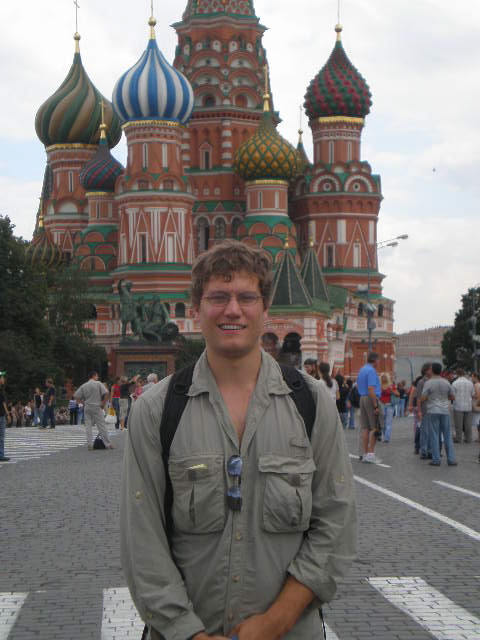
Here’s a good article in Dissent magazine titled The Russian Conundrum: Growing Economy, Failing Society. Here’s my post on lessons learned from China. Below is a picture of me from two days ago in front of Saint Basil’s Cathedral outside the Kremlin in Moscow. Stunning structures there.

Kremlin

Quotes of the Day from the News

"This isn’t the 15th century. You can’t go around the world and just plant flags and say ‘We’re claiming this territory.’ "  — Peter MacKay, Canada’s foreign minister, in response to Russia planting an underwater flag at the north pole and celebrating / publicizing a new claim to pieces of the Artic Ocean.

"The moderates and modernists are so frustrated. They’re putting their necks out, getting no support, and having fatwas issued against them."  — Jonathan Hayden, a young American from Alabama who recently toured the Islamic world with a Pakistani-born professor and a couple other American University classmates. The professor’s new book, Journey Into Islam, sounds interesting.