What I’ve Been Reading

Books, books, books.

1. Blitzscaling by Reid Hoffman and Chris Yeh. Not that I’m exactly unbiased given the authors and my entangled relationships here, but lots of good insights from Silicon Valley and China on how to build a huge, world-changing company. Reid and Chris worked super hard to distill the complicated and sometimes contradictory lessons of fast scaling companies into a book structure that’s digestable and practical.

2. The Girl Who Smiled Beads by Clemantine Wamariya and Elizabeth Weil. Beautifully written memoir about surviving genocide, becoming a refugee, and resettling in the United States. “It’s strange, how you go from being a person who is away from home to a person with no home at all. The place that is supposed to want you has pushed you out. No other place takes you in. You are unwanted, by everyone. You are a refugee.”

4. Dancing with Life: Buddhist Insights for Finding Meaning and Joy in the Face of Suffering by Phillip Moffitt. Phillip led the meditation retreat I went on earlier this year and this book summarizes the Buddha’s wisdoms, and Phillip’s experience with it, clearly and relatively concisely. Phillip was co-owner and editor in chief of Esquire magazine before leaving the material world and pursuing serious meditative and yoga practice. The book is divided into four sections corresponding with each of the Buddha’s Four Noble Truths:  1) There is suffering in the world, 2) there are known causes of suffering, 3) there are solutions to the causes of suffering, and  4) there are specific tactics that can be followed to put into practice these solutions.

3. Mastery by George Leonard. During one of my private interview sessions with Phillip Moffitt at the meditation retreat, I wondered aloud whether I had hit a plateau in my meditation practice. Without hesitating, Phillip recommended I read this book from George Leonard, which discusses the issue of plateaus in the journey toward mastery. Some good insights; nothing earth shattering. The premise: “Learning any new skill involves relatively brief spurts of progress, each of which is followed by a slight decline to a plateau somewhat higher in most cases than that which preceded it.”

Where in our upbringing, our schooling, our career are we explicitly taught to value, to enjoy, even to love the plateau, the long stretch of diligent effort with no seeming progress?”

Here’s my previous post on the sorts of skill building that results in quantum leaps versus continual iterations of improvement.

6. Tribe of Mentors and Tools of Titans by Tim Ferriss. Two gargantuan interview books from Tim; tons of life hack nuggets and solid book and gadget recommendations across the two.

7. Suicide of the West by Jonah Goldberg. I love Jonah’s writing and his speaking (on his podcast and on BloggingHeads.tv). In this book, he makes the following argument: “Capitalism is unnatural. Democracy is unnatural. Human rights are unnatural. The world we live in today is unnatural, and we stumbled into it more or less by accident. The natural state of mankind is grinding poverty punctuated by horrific violence terminating with an early death.” And as such, we should be utterly grateful for what we have, and utterly paranoid about not destroying the golden goose of modern civilization that’s laying such wonderful eggs.

More:

In later chapters, I spell out how liberalism and capitalism created the Miracle and how the United States of America is the fruit of the Miracle. But the key point to understand for the arc of this book is that both are unnatural. The idea that we should presume strangers are not only inherently trustworthy but also have innate dignity and rights does not come naturally to us. We have to be taught that—carefully taught. The free market is even more unnatural, because it doesn’t just encourage us to see strangers to be tolerated; it encourages us to see strangers as customers.

Other random highlights:

One of the most interesting taboos in American life is the taboo against discussing human nature.

Virtue requires denying one’s baser instincts—i.e., human nature—and doing what is right. This is why C. S. Lewis argued that “courage is not simply one of the virtues, but the form of every virtue at the testing point…”

Hypocrisy is often a terrible failing but it is more often a misunderstood one. Hypocrisy is the act of violating an ideal or principle you admonish others to follow. Too many people believe that hypocrisy is an indictment of the ideal as much as it is the hypocrite. This is folly. A world without hypocrisy is a world without ideals.

Friendships: Frequent Quick Hits vs. Infrequent Deep Dives

Consider the communication pattern between you and two hypothetical friends of yours.

With one, you email, text, and talk at least once a week. You’re continuously in touch. If you live in the same place, you may even see this friend pretty regularly for quick bursts. Maybe you grab coffee before work. Or get lunch in the middle of the workday. If you don’t live in the same place, you’ll hop on the phone for 5-10 min phone calls at least once a week, or sometimes a full hour if the stars align.

With the other friend, you’re not in touch all the time. You occasionally forward articles to each other and sometimes exchange a fun text message, but weeks and months often pass without meaningful interaction. When you do talk to or see the friend, it’s a deep dive. It’s a longer interaction. Maybe you see this friend in person once a year for a full day or even a whole weekend. Maybe you have a 90 min video chat catch-up twice a year.

In the busyness of my adult life, my friends increasingly fall into one of these categories. For example, I’m “in touch” with Chris Yeh on a very regular basis; we’ll talk a couple times a week by phone for 10-15 mins each time. By contrast, my interactions with Brad Feld are less frequent, but when we interact, it’s usually for 36-48 continuous hours in person. Interestingly, the one time I’ve had a very long continuous interaction with Chris was when we spent 24 hours together on the Burning Man playa (and slept in the same car). I learned things about Chris that I had not known, despite 10+ years of being in regular touch! I suspect if I ended up talking to Brad 2-3 times a week, I’d appreciate a different side to him, too.

Both are deep, positive relationships. Both types of friendship can be very rewarding. They’re just different cadence patterns.

Of course, there are downsides to each model of relationship. People whose friendships primarily consist of sporadic deep dives probably feel a higher degree of loneliness day-to-day during dry spells in-between the deep dive nourishment. (If you’re in an intimate romantic relationship, this can be okay because you tend to share minutia/quick hits with your spouse so don’t need to lean on friends as much for this.)

People whose friendships primarily consist of regular quick check-ins and texts and workday lunches probably feel some lack of depth with some of their so-called “close friends.” They realize that after years of “how was your day?” conversations and staying up to speed on the real time relationship drama or work battles that will someday be easily forgotten — they realize that they’ve never explored life’s deeper questions with their friend.

If you’re lucky enough to have a deep dive rhythm with someone, I think it’s comparatively easier to add some more day-to-day flavoring — and then perhaps you have the best of both! I was intrigued by how Gretchen Rubin described her approach on Tim Ferriss’s podcast: Every 4-5 days she sends email updates to her family recounting very minutia, day to day details of her life (“I’m getting my hair colored today”) with the explicit expectation that the update is “boring” and no one is supposed to reply. Its function is to simply keep friends in the loop on day to day happenings, like you would around a water cooler.

Finally, I wonder if women and men trend differently on this topic. The women I know tend to be better than men at staying in regular touch with their female friends. There’s a natural, continuous snacking dynamic between especially younger women I know: group text threads buzz a couple times a week, regular walks around the neighborhood, quick “Love you!” text messages, etc. Many of these women also have plenty of deep dives of course but the regular staying-in-touch with quick hits is what I notice most.

Male friendships can be characterized by months of non-communication, and then punctuated — if they’re lucky, and that’s a big if — by a deep dive. The issue is, men like to talk about the “guy I’d take a bullet for” or the “person I’d go pick up at a 4am” — but the deep dives that create  4am pickups rarely happen, at least in the post college years. Many men are deprived of both continuous quick hits and regular deep dives. White, adult, heterosexual men have the fewest friendships of anybody in America.

#

I’m reading Knausgaard’s My Struggle Book 6 right now. Yes, it’s another 1000+ page opus — the final installment — and yes, I’m enjoying almost every page of it. That’s for a different post. Anyway, I recently came upon this paragraph:

When we moved to Malmö I had been afraid Geir and I would lose touch. That’s what distance does; when the time between conversations gets longer, intimacy diminishes, the little things connected to one’s daily life lose their place, it seems odd to talk about a shirt you just bought or to mention you’re thinking of leaving the dishes until morning when you haven’t spoken to a person for two weeks or a month, that absence would seem instead to call for more important topics, and once they begin to determine the conversation there’s no turning back, because then it’s two diplomats exchanging information about their respective realms in a conversation that needs to be started up from scratch, in a sense, every time, which gradually becomes tedious, and eventually it’s easier not to bother phoning at all, in which case it’s even harder the next time, and then suddenly it’s been half a year of silence.

#

Some old posts of mine on friendship:

(Thanks to Steve Dodson and Chris Yeh for reading drafts of this post.)

The Wisdom of Eric Schmidt and Tyler Cowen

We are honored to have former Google CEO Eric Schmidt as one of our luminary LPs at Village Global. He recently participated in an event with our founders and Network Leaders in San Francisco. It was a delight to have my old friend Tyler Cowen, interviewer extraordinaire, conduct the chat with Eric. They had a wonderfully stimulating conversation about a range of topics. Perhaps my favorite part was near the end, when Eric and Tyler have a back-and-forth about GDP growth.

Here’s a video of their conversation. Here’s the post on the Village blog about the event. The audio of the conversation will also be published on Tyler’s must-listen podcast, Conversations with Tyler.

The Wisdom of Bob Iger

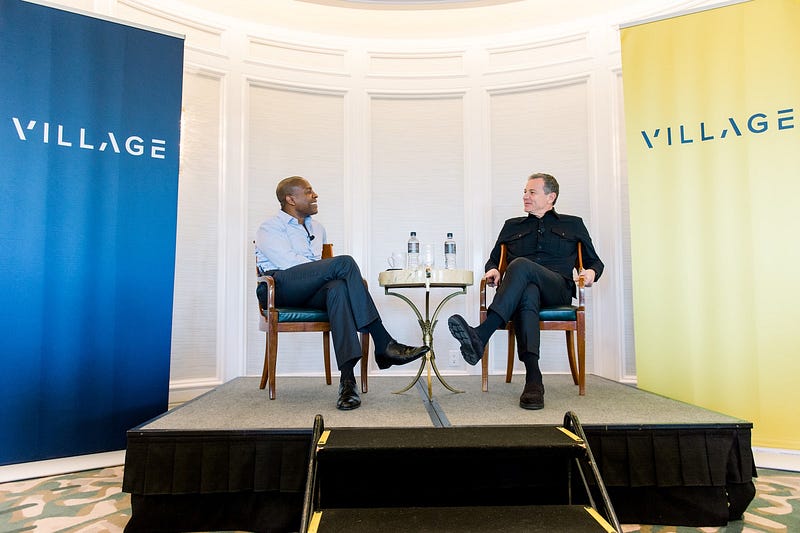
We’re honored to have Disney CEO Bob Iger as one of our LPs at Village Global. We recently hosted an event with Bob and about 100 of our portfolio companies, Network Leaders, and other friends of the firm at the iconic Beverly Hills Hotel.

Bob was in fine form on stage, and was terrific with a small group of our founders afterwards in a smaller session. As one of the world’s most successful CEOs, and one of the most important people in the entertainment industry, we were thrilled to be able to hear from him up close and personal.

Here are the photos from the event.

One of the more memorable things Bob said at the event was that he’s not “paranoid” about the future. He acknowledged the Andy Grove quip that “only the paranoid survive” but said that this particular framing (paranoia) doesn’t resonate with him. He’s more curious than he is paranoid. He’s relentless about trying to transform an iconic company into a new era. But it’s curiosity and optimism that drives him to do so. It was a refreshing, different sort of view than the common Silicon Valley line. It was a reminder that there are many ways to frame the challenge of disruption and innovation. And there are many ways to be an exceptional leader.

Remaining on Nodding Terms with Chile

Photo I took atop the Costanera Center

In 2010, I lived in Chile for 9 months. It was a memorable time in my life. I lived through one of the country’s worst earthquakes. I went through transitions professionally and romantically. I caught a glimpse at bilingualism in the distance.

There are many countries I have yet to visit, countries still on the bucket list. But I still prioritize visiting Chile to deepen an already deep experience.

In 2012, I returned and wrote a piece titled The Sweep of Nostalgia and quoted Joan Didion’s advice — remain on nodding terms with your past. I still believe in that advice — at least being able to nod at selective elements of your past. Staying in touch with Chile is part of that process.

I visited Chile again a couple weeks ago — a 2018 visit. Returning to a place you once knew well shakes loose old memories, like dusty old photo frames that tumble down off shelves if you open a cabinet door that’s been shut for some time. The memories are not necessarily significant. Random stores. Random streets. Random metro stops. “Oh yeah, that thing” is a routine thought during these occurrences. Not profound. Unless you consider it profound that our brains store a gazillion memories that are not bubbling at the surface and need active prompting to surface — and that is kind of profound if you think about it.

One of the more touching moments on my latest visit happened at my old apartment building. I went back to the building in the Providencia neighborhood. I told the doorman I used to live in the building some years ago, and asked if he’d let me enter to take the elevator to the roof and look out. After a bit of mental jogging, he said, “I remember you!” I stared at him and then remembered him as well. Same guy working the door after all these years. Some things really don’t change very much.

The subway is still excellent (and my transit card from 2010 that I’ve held onto still had value on it!). The andes mountains are still beautiful. The Chilean friends I made all still live in Santiago — no one has moved away.

Of course some things do change in a decade’s time. For example, everyone in Santiago has a smartphone now. I lived there pre-iPhone. Had I an iPhone and data plan in 2009, I would not have gotten lost nearly as often. I wonder how my experience would have been different had I nailed every turn-by-turn…

Mainly, the feeling I get when I think about my time in Chile is about how much time has passed in my life. I’m older now; I look much older in photos today versus my photos from then. So much has happened in my life since then. I do feel a tinge of sadness thinking about it. When I lived in Chile, I was in my early 20’s, living abroad, with so much possibility in front of me. So little constraint. I live a far more constrained life today. All by choice and I’m happy with my choices, but enough years have piled up now where I can look back and draw out multi-year detailed maps for how my life could have gone had I made different choices at different juncture points.

#

I should note a few practical things my partner and I did on the most recent trip to Chile. Agua de Ramon park is wonderful and just 20 mins from uptown Santiago. The new Costanera Center tower is cool — the tallest building in Latin America. A sunset drink atop the W Hotel offers remarkable views. And the Ritz Carlton Santiago is a wonderful hotel; the club lounge is very much worth upgrading for — 3 meals a day served there and they’re exceptional. I worked full time from the hotel so it was a good location to do that from.

#

I’ll repeat the ending from my previous post on Chile:

Some months ago, I watched saw the beautiful documentary Nostalgia for the Light. It’s about the astronomy done in the Atacama desert in the very north of Chile. Here’s the trailer. The Atacama desert is the driest in the world and the only place on earth with zero humidity year-round. Soon, 95% of the world’s astronomy will be done there. The film juxtaposes the work of scientists in the desert who look to the sky for answers, with old women just miles away who look to the ground for answers, searching for the bones of relatives assassinated by the Pinochet regime and buried in the desert. The film is about the connection between the past and the future, ground and sky. It’s also about memory.

In the film, director and narrator Patricio Guzman says, “Those who have a memory are able to live in the fragile present moment. Those who have none, don’t live anywhere.”