Book Review: The David Foster Wallace Reader

“A writer of virtuosic talents who can seemingly do anything.”
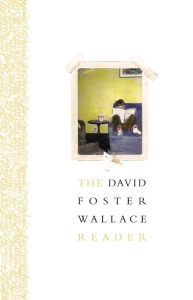
walacereaderThat’s what one critic once said of David Foster Wallace. Its ringing truth is on display in the recent anthology of Wallace’s writing, The David Foster Wallace Reader. The collection contains non-fiction essays, short stories, excerpts from his novels, class notes/syllabi from his time as a professor, and email exchanges with his mom.

It’s an essential addition to the library of any hardcore Wallace fan and a pretty decent introduction to his work for newbies, since it’s a curated and edited “greatest hits” collection. Buy the print edition not the e-book, as it’s the sort of thing you might want to flip through, not read every last word on every one of the 800+ pages.

One of my favorites in the collection, which I hadn’t read before, was “Little Expressionless Animals,” a story originally published in The Girl with Curious Hair. There’s a hilarious sequence about how one character was “reeling into Lesbiansism.”

I had also not read “Incarnations of Burned Children” before. It originally appeared in Esquire in year 2000. It’s three pages long, a single paragraph, and very powerful. A must read.

Some of my favorite excerpts from The Pale King are in here, including his extended riff urging the reader to ignore the disclaimer on the copyright page that what follows is fiction. Many other paragraphs to potentially quote in this post, such as:

The paradox of plagiarism is that it actually requires a lot of care and hard work to pull off successfully, since the original text’s style, substance, and logical sequences have to be modified enough so that the plagiarism isn’t totally, insultingly obvious to the professor who’s grading it.

Or this one, which I tweeted:

Many of the chapters have an afterword written by an academic or commentator. One of Kari Kunzru’s comments after one of the stories gave me pause:

If being expressionless is the result of trauma, as it is in this story, then self-expression must be healthy. But somehow, in the cities of the developed world, expressing yourself has started to feel like work. We’re constantly exhorted toward ever-greater feats of affect, to be that little bit more creative; to commit to our goals; to give service with a smile, feigning excitement like contestants on a game show. When life takes on this game-show quality — fake, regimented, spiritually exhausted — expressivity pulls in two directions, both toward and away from truthfulness. It can be another kind of mask, the kind that eats away at the face until you’re no longer sure what your off-camera reaction would be.

Book Review: The Unspeakable

daumbokI’ve been reading Meghan Daum’s columns for years. When I saw she had a new collection of essays out titled The Unspeakable — and that it received the high praise of Cheryl Strayed — I immediately bought it.

The theme running through most of the pieces is “sentimentality and its discontents.” In her words:

Collectively I hoped they’d add up to a larger discussion about the way human experiences too often come with preassigned emotional responses.

In other words: We’re supposed to feel crippling sadness when someone close to us dies but we don’t. We’re supposed to have newfound insight on life after a near-death experience but we don’t. She writes with utter clarity, energy, and honesty about these sorts of gaps in emotion. It’s a pleasure to read her and it’s easy to recommend this collection. (For excellent musings on sentimentality from two other wise souls, see these two essays in the New York Times book review.)

The opening essay of Daum’s collection is about her being at the bedside of her mother as the mother dies and instead of being overcome with grief she’s preoccupied by a range of practical concerns, like how she’s going to cancel her mother’s apartment lease. Right out of the gate you know she’s going to be as honest as can be, even about the people closest to her.

In an essay on the pleasures of not being a foodie (hear hear!), she argues that she strives for contentment, not the mushy concept of happiness. Contentment doesn’t mean settling or just a “fine” life; rather it means

…feeling like I’m in the right life. Living in a place where I feel like part of a community, doing work that feels reasonably meaningful, surrounding myself with people I enjoy, respect, and in some cases love. It would mean spending as little time as possible doing things I don’t want to do.

What I’m saying is that contentment is a tall order. Not impossible, but formidable enough to elude most of us most of the time. But there’s a trick to it, a master key to all the dead bolts that lock us out of our inner peace. The key to contentment is to live life to the fullest within the confines of your comfort zone. Stay in safe waters but plunge as deeply into them as possible. If you’re good at something, do it a lot. If you’re bad at something, just don’t do it. Celebrate it. Be the best noncook you can be…

Of course, for some people, being outside their comfort zone is itself the comfort zone. I’m talking about people who backpack around developing countries with hardly any money, journalists who become addicted to covering wars, and soldiers who become addicted to fighting them.

There’s a piece on nostalgia and youth. I loved this graf:

Now that I am almost never the youngest person in any room I realize that what I miss most about those times is the very thing that drove me so mad back when I was living in them. What I miss is the feeling that nothing has started yet, that the future towers over the past, that the present is merely a planning phase for the gleaming architecture that will make up the skyline of the rest of my life. But what I forget is the loneliness of all that. If everything is ahead then nothing is behind. You have no ballast. You have no tailwinds either. You hardly ever know what to do, because you’ve hardly done anything. I guess this is why wisdom is supposed to be the consolation prize of aging. It’s supposed to give us better things to do than stand around and watch in disbelief as the past casts long shadows over the future.

The problem, I now know, is that no one ever really feels wise, least of all those who actually have it in themselves to be so. The Older Self of our imagination never quite folds itself into the older self we actually become. Instead, it hovers in the perpetual distance like a highway mirage.

Here’s Meghan Daum’s interview on the Longform podcast, which was interesting.

What Makes America What It Is

I’m not particularly patriotic. Nonetheless, I was moved by the eloquence with which Barack Obama articulated the American creed at the march at Selma over the weekend. Likely one of the speeches that will highlight his presidency.

For the blow by blow analysis, see Fallows. (Always see Fallows for wisdom…)

Markets vs. Central Planners, An On-Going Series

A great little vignette from Don Boudreaux about humility and markets.

I remember back in the late 1970s or early 1980s when I first noticed that still water began to be offered for sale in single-sized bottles. I was convinced that this product would fail. “Who would pay for still water in single-sized bottles when still water can be gotten for free out of water fountains and water coolers or at zero marginal cost out of faucets at home?” I reasoned. Whether I reasoned rightly or wrongly, my prediction proved wrong. Reason, you see, is a wonderful and necessary tool, but also one of limited power. My reason could not reveal to me the preferences of millions of other people. My reason could not reveal to me the ambitions and the creativity of entrepreneurs. My reason could not reveal to me the details of an open-ended future in which people are free to spend their money—as consumers, as producers, and as investors—as they wish.

Had I been a government planner in the 1970s or early 1980s—a planner with the finest training, the highest integrity, and a most intense desire to serve my fellow citizens well—I would have counseled against directing society’s scarce resources into the production and distribution of single-sized bottled still water. My reason would have assured me of the prudence and correctness of my decision. And if I were such a government planner whose diktat would have been heeded, no one would ever have learned that my decision stunk.

That markets work better, in all their chaos, than smart, well-intentioned central planners, is in one sense quite counterintuitive.

Why You Need Network Intelligence in Your Company

You want your employees networking outside the company–even on the company dime and on company time.

This is a theme we explore in-depth in The Alliance. As a brief summary, we’ve prepared a new slide deck on why network intelligence matters, and how to set up programs to support it at your company. Check it out.