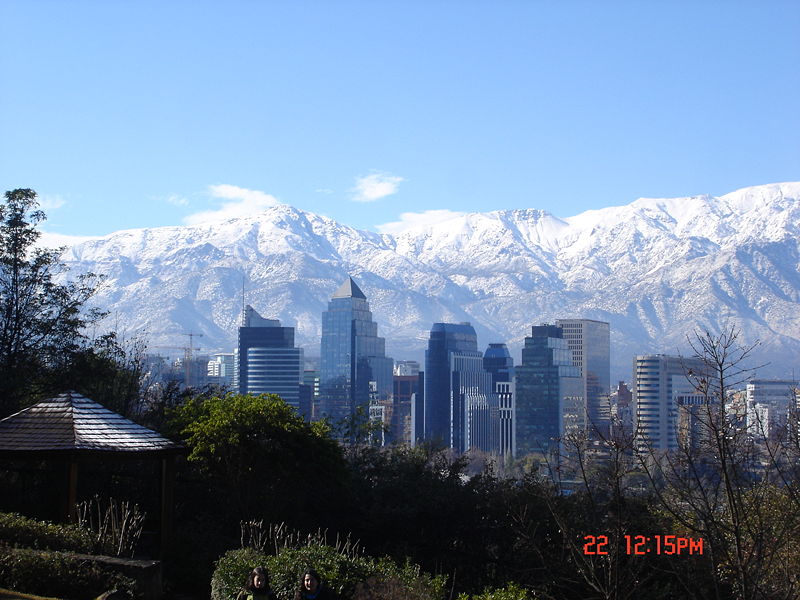
Chile is the Switzerland of Latin America. Chile is the Japan of the Southern Cone. Santiago is Zurich. Santiago is Tokyo. Valparaiso is St. Gallen. Valparaiso is Kyoto.
OK. This might be stretching it. Chile is still a developing country, with all that that entails. But it is striking to arrive in the country after time in Argentina and Uruguay — it feels like arriving in Hong Kong or Japan after time spent in China and India. (Granted the contrast is not as stark; but then, nothing compares in intensity to India.)
The Santiago airport is clean and well-signed, and the personnel are helpful and professional. I got in a taxi at the airport, and he looked at my address, conferred with a colleague about the best route, then called the office en route to double check directions. The highways were exceedingly well lit (it was night time) and all traffic laws were obeyed to the T.
I spent the night with a friend in Vitacura, a tony neighborhood in the north of Santiago. The next morning I went for a run in this Atherton-style hood. The air was crisp and cool and the Andes mountains served as an unmatchable backdrop. (Think: Boulder Flatirons, except grander.) Again I noted how everyone obeyed crosswalk signs and how well marked everything was.
The next night L, D, and I shared a couple bottles of Chilean wine and several plates of tapas at a hip, loud wine bar (that turns into a dance club at midnight). Spanish was the common denominator, so I got plenty of practice. Wine always loosens the tongue as well, especially when it’s a foreign language.
Vitacura is not the real Santiago, so I spent the next six nights in an apartment in Barrio Brasil, a neighborhood near the center of town that’s full of students and nightlife and restaurants. It was an ideal location and the apartment set-up worked well as it allowed me to buy some groceries/food.
I took the same approach to Santiago as I did in Buenos Aires: walk around, more or less randomly. There was plenty to see, including ample mullets (the fashion choice of most Chilean young men), spontaneous dance protests in streets, school children, and more. I walked to the zoo and metropolitan park and to get there I had to walk through the Palestinian neighborhood. I know this because a guy came up and asked if I needed help (it’s happened three times so far in Chile; didn’t happen in Argentina or Uruguay) and he told me there are 70,000 Palestinians living in Santiago.
Food in Santiago is still heavily meat-based but not as much as in Argentina and Uruguay. Churrascos are the go-to. “Completos” are just hot dogs but with loads of sauces on top. The produce and fish are tasty, thanks to Chile’s coastal location.
The Santiago metro is the best I’ve ever used, anywhere (Japan is probably better, but again, Japan is a separate category). The trains come every two minutes or so; there are a million people standing around to help you through every stage; queues are formed and respected; the trains are trash-free and well-signed; and the coverage of the subway/metro is vast. You can get anywhere on the subway, it seemed cheap, and very user-friendly.
Pollution in the city? Yes, it’s there, and the smog and so forth is as advertised. But it wasn’t as oppressive as I expected. Some told me it would be impossible to run outside due to smog. Not so.
The city is segregated by class and in the nicer neighborhoods there isn’t much poverty to see or deal with. The wealthier suburbs are incredibly American-looking. Similar looking homes, trimmed grass lawns in front, etc. I was told that American ex-pats can live in one of these suburbs and feel right at home.
Bottom Line on Santiago: I love it.