10 Easily Implementable Life Problem-Solving Strategies

I'm a big fan of litmus tests, heuristics, rules of thumb (here's my wiki with hundreds of rules), and anything else that can help me make a quick decision when there's too little time or too much indecisiveness.

Colin Marshall posted 10 "easily memorable and implementable life problem-solving strategies" that are really stellar. I've excerpted all the heuristics below. Read each one.

  • "Would I respect me?" I supposedly ask myself this about either my life in general, as a tool for broader self-assessment, or about a specific action I'm contemplating taking. Pro: straight to the point. Con: too much wiggle room — where's the line between what's respectable and what isn't?
  • "What benefits my future self?" I've found no better way to battle the bad habit of foisting tasks and undesirabilities onto the Colin of a few days from now than to identify what I could do next and automatically choose whatever benefits my future self most — or harms him the least, anyway. Pro: eases the dealing-with of future unforeseen developments, both positive and negative. Con: what if present Colin gets hit by a bus, leaving nobody to collect my future-self benefits?
  • "Find the thin end of the wedge." This is stuff of folk aphorisms about thousand-mile journeys begun by single steps, camel noses poking inside tents and what have you. Meaning: daunting tasks are made more doable than they seem by isolation of the small ones that precede or collectively constitute them. Werner Herzog, discussing the task of assembling an entire cast of little people for Even Dwarfs Started Small, put it eloquently: "One dwarf would tend to know another." Pro: makes hardish stuff not so hard, at least perceptually, which is half the battle anyway. Con: could potentially get me under more onerous obligations than I can foresee.

  • "Barf it out, then clean it up." A friend quoted her journalism teacher as saying this, and I've since adopted it as a pithy reflection of the broader phenomenon that the sole path to non-suckage winds through the treacherous woods of suckage. I must therefore make peace with producing something sucky and then iterate that initial product until it achieves decency. The trick is avoiding discouragement by that first piece of suckiness. As a writing principle, everyone knows this — you pound out the rough draft, then do the real writing, which is rewriting — but I submit that it's applicable across all pursuits. Pro: it's the only way to create good things, I suspect. Con: risks incentivizing producing crappier than I have to, at least to start. A worse initial effort might make fruitful iteration tougher.
  • "Can I fail at this?" It's like Raymond Chandler said: there is no success without the possibility of failure. Therefore, something I can't fail at is also something I can't succeed at. I can fail at conducting an interview, writing an essay or making a video. I can't fail at meandering around the internet in search of "neat stuff to read." In a recent tweet, I defined procrastination "the temporary displacement of tasks at which it is possible to fail with tasks at which it is not possible to fail." I suspect I'm less far off the mark than ever, especially regarding why procrastination is not a productive tendency.
  • "Always produce." Hat tip, of course, to Paul Graham. Operating under the mandate of always producing something, no matter if it sucks, isn't fully formed or doesn't match my vision, drives away the seductive demons of fantasization whose mission is to keep me thinking about doing stuff but never actually doing it. Thinking about doing something doesn't help, and in fact probably un-helps. You might have noticed Nike's successful employment of their own version of this heuristic. Pro: easy motivator, addresses a hugely common issue. Con: could lead to a life-threatening miscalculation or two.

  • "What's the deadline?" Even when solidly in the actually-doing-stuff phase, I find my stuff rarely reaches actual doneness in the absence of a hard end date. Because how do I identify "doneness," anyway? I can always keep noodling away on a project, telling myself it's incomplete, if I never need to hand it in. This has the ancillary effect of preserving the precious mythologies of B.S. one builds about one's own brilliance. ("Oh, but it would've been awesome if I'd had more time!") Hence the importance I've come to grant the skill of adhering to self-imposed, sharp-edged rules. I have set a deadline of 11:30am on this post, for example, because I otherwise risk spending all day on squirrely retoolings. It's happened before. Pro: prevents life from being overtaken by unending boondoggles. Con: how to know exactly where to set the deadline?
  • "What are the rules?" Though this is perhaps my interest in conceptualism talking, it seems to me that nothing interesting ever gets done or made without rules, whether imposed by the creator or by the creator's circumstances. I find "drive across country without using a freeway" more interesting than "drive across country," "write a novel without using the letter e" more interesting that "write a novel," "make a movie for ten grand" more interesting than "make a movie." Crude examples, but you get my meaning. This has all been said before, but more in terms of creativity being truly sparked by limitations, necessity being the mother of invention, things opened up by way of closing them off, etc. I like to think of it as arbitrarily setting down the first element and taking it as given, using it as a structure on which to build the rest of the work. (Then, if you like, remove the structure.) Pro: makes the first steps easier. Con: encourages stunts, though stunts aren't necessarily worthless.
  • "What am I doing now?" I often fall victim to the delusion that circumstances will be somehow be more advantageous in the future, so that's when I'll really bear down on my work. Of course, conditions are never so much more suitable when the time actually comes, or at least they're not as perfect as I'd perhaps assumed they'd be. So if I want do something or be a certain way, I try to cut off any line of thought that terminates in my having convinced myself that I'll act on my intentions in the future. If I'm serious about it, it'll be reflected in what's going on right now, at the present moment. There's no such thing as ideal conditions. Pro: prevents excessive pipe-dreaming. Con: sounds superficially like a mindset some flake on Oprah would peddle.
  • "What's the hardest thing I can do?" Again, my hat tips to Paul Graham: "This is a good plan for life in general. If you have two choices, choose the harder. If you're trying to decide whether to go out running or sit home and watch TV, go running. Probably the reason this trick works so well is that when you have two choices and one is harder, the only reason you're even considering the other is laziness. You know in the back of your mind what's the right thing to do, and this trick merely forces you to acknowledge it." What more could I add? Pro: helpful when choosing between defined options. Con: the usual problems about the very act of option definition, plus, how do you define "hardest"? Also, it might lead into pointless exercises in frustration.
The Selfishness of Public School Teacher Unions

Troy Senik writes about California’s problems and talks in passing about how the public school teachers’ unions have the state by the neck. Read it and weep:

Perhaps the most vexing labor organizations are the teachers’ unions. These groups were the driving force behind Proposition 98, locking in mandatory spending on public education without regard to any other fiscal considerations. But that’s only where their transgressions begin. In 1992, the California Teachers’ Association — by far the most powerful teachers’ union in the state — blocked a ballot initiative to promote school choice in the Golden State by physically intimidating petition-signers and allegedly placing false names on the petitions. When asked about his union’s opposition to the measure, the CTA president responded: “There are some proposals that are so evil that they should never even be presented to the voters.” And in 2000, when testing results revealed that two-thirds of Los Angeles public schools were ranked as failures, the president of the United Teachers of Los Angeles announced that his union would accept a proposal for merit pay only on “a cold day in hell.”

The result of the teachers’ flight from responsibility has been unadulterated dysfunction. In Los Angeles schools, one out of every three students drops out before graduation. And a research team from the University of California, Riverside, recently concluded that by 2014 — the year all students are required to be proficient in math and English under No Child Left Behind — nearly every elementary school in the state will fail to meet proficiency standards. Yet despite the atrocious performance of California educators, it is nearly impossible to fire an incompetent teacher (the percentage of California teachers terminated after three or more years in the classroom is just 0.03%). For example, in a May exposé on the Los Angeles Unified School District, Los Angeles Times reporter Jason Song revealed: “The district wanted to fire a high school teacher who kept a stash of pornography, marijuana and vials with cocaine residue at school, but a commission balked, suggesting that firing was too harsh. L.A. Unified officials were also unsuccessful in firing a male middle school teacher spotted lying on top of a female colleague in the metal shop, saying the district did not prove that the two were having sex.”

But no matter how egregious their misconduct, California’s public-school teachers can always skirt the consequences. With 340,000 members statewide, the California Teachers’ Association is perhaps the most powerful interest group in state politics. In 2005, for instance, the organization spent nearly $60 million to defeat ballot measures aimed at bringing more accountability to California schools. And when budget agreements get hashed out in meetings of the state’s notorious “big five” (the governor and the four legislative party leaders), the CTA is treated like an unnamed sixth party to the talks. It’s no wonder, then, that despite having some of America’s lowest-performing schools, California’s teachers are the highest paid in the nation.

Trenik doesn’t even touch the idiocy of tenure.

It’s unfortunate that public school teachers are often portrayed as selfless martyrs, the guard-bearers of our children, when in fact they are selfish economic actors who look out for their own interests. Sure, the prison guards are similarly spoiled. But they make no bones about being anything other than self-interested prison guards.

###

Here’s the in-depth L.A. Times piece on how it’s basically impossible to fire teachers in LAUSD. Here’s the New Yorker just a few months ago on New York City’s battles with unions, where some teachers are being paid more than $100,000 to sit in a room and do nothing.

Reason is the Steering Wheel. Emotion is the Gas Pedal.

Good decisions require a mix of dispassionate, rational analysis and emotion.

Though we often hear of emotion and passion clouding the decision making process, research shows that feelings help us make better decisions. Specifically, emotions aid decisiveness. Humans who have suffered damage to the part of their brain responsible for emotions are prone to crippling indecisiveness.

Here's a metaphor I came up with that conveys the mix: reason is the steering wheel, emotion is the gas and brake pedal.

When you get in a car, you first need to decide where to go. You need to think clearly and objectively about the best route. Once you've decided on a route, you need to press the gas pedal at different intervals to move forward, to go faster, or to slow down and come to a stop.

Suppose you brainstorm a new business idea. You want to think about the idea clearly and assess honestly the pros and cons, market size, competitive landscape, etc. You don't necessarily want your emotional side to dominate this assessment process. Once you've decided you want to pursue an idea, dreams of success and emotional excitement enable you to press the gas pedal and put in 12 hour days.

If the business is headed for the gutter, and you need to take immediate action to right the ship, emotions such as fear of failure and embarrassment will accelerate the actions prescribed by a rational cost-benefit analysis.

###

I frequently have to remind myself that good decisions can have bad outcomes. Also, I'm still unsure of the role of intuition in good decision making, but I agree with Auren that it's better to trust your gut when it tells you not to do something.

Quotes of the Day

"Just a few centuries ago, the smartest humans alive were dead wrong about damn near everything. They were wrong about gods. Wrong about astronomy. Wrong about disease. Wrong about heredity. Wrong about physics. Wrong about racism, sexism, nationalism, governance, and many other moral issues. Wrong about geology. Wrong about cosmology. Wrong about chemistry. Wrong about evolution. Wrong about nearly every subject imaginable."

Luke Muehlhauser

(via Eliezer Yudkowsky)

#

"The public's conception of new ideas: Crazy. Crazy. Crazy. Obvious." – Lant Pritchett.

Things I See in Chile

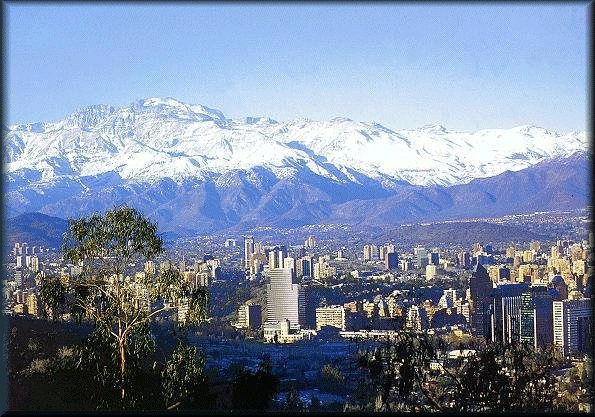
Santiago19ki
I'll be living in Santiago, Chile for a little while. I'm here to learn Spanish, explore a new culture and country (as a resident more than a tourist, a longtime goal), and pursue some professional projects.

Why Chile? As Spanish-speaking countries go, if you value security, political stability, and a professional/modern business culture, your options are Spain, Costa Rica, Uruguay, or Chile. I liked Chile the best. I'll explain why later.

I've been here for two weeks so far and intend to semi-regularly post observations, lessons, and stories from Chile. I hope they will help improve my (and your) understanding of what's going on in Latin America today and offer insight on the experience of living abroad. Thanks for bearing with me through the miles and months ahead.

#

Six random observations / lessons so far:

1. An entrepreneurial culture? Economically speaking Chile has been a success in Latin America. At current trajectories it will be the first LatAm country to join the club of first world nations. But for the next stage it needs to rely less on natural resources and more on knowledge-based industries. The government is offering an incredible set of incentives for tech entrepreneurs to locate in Chile. Yet incentives are not enough. To spur entrepreneurship and attract knowledge workers there needs to be an entrepreneurial culture. How the heck do you develop an entrepreneurial culture?

2. The Election. The first round of presidential elections are in a couple weeks. It's striking that the issues being debated are generally high on on Maslow's Hierarchy. When people start complaining about the hours the park is open, you know a country has taken care of the basics. In other words, people are starting to debate intangible social issues since the basic functions of government work correctly. For example, the country has finally gotten around to discussing rights for homosexuals. Remarkably, it's about whether gays deserve civil union rights, not marriage. The Catholic church influences this conservative agenda, of course. (For the same reason, abortion is illegal regardless of circumstances (such as rape) and divorce only recently became legal.) The candidates are also debating how to deal with economic inequality — I will address this in a future post.

Bottom line: The Presidential election in Chile is important inasmuch as the president has a lot of power in the political system. Congress doesn't have much say on the budget, for example. However, it's not an important election in the sense that none of the candidates proposes changing the successful status quo very much.

3. No Hablan Inglés. Chileans speak little English, say both the studies and my experience to-date. Sparse is signage in English and it's basically impossible to acquire English-language print media. I almost never hear English spoken on the street. The government is apparently trying to remedy this. A population that doesn't speak English is a population disadvantaged in the global economy.

4. I'm Learning Spanish.

  • You don't go to Chile if your only goal is to learn Spanish. First, Chilean Spanish is arguably the fastest spoken on the continent. Second, Chileans use higher-than-average slang and colloquialisms. Third, they rarely pronounce the endings of their words. Some ex-pats have told me that they can barely talk with Chileans in Spanish but they have almost no problem in a place like Costa Rica or Guatemala or even Mexico.
  • Fortunately, because there's so little English spoken, I get plenty of opportunities to mess up my Spanish when speaking with locals. When I do speak English here, it is usually with other gringos learning the lingo in Santiago. I've discovered that when I talk to another American in Spanish, it's always an interesting conversation. Every sentence a challenge! To find that right word or translation! It's been funny switching to English with someone and thinking, "Gosh, this person is actually quite boring." When learning a new language, everyone speaking your target language becomes interesting.
  • I've noticed myself be more aware of my body and body language. When words are difficult to come by, body language must be used to express ideas.
  • Speaking Spanish for awhile and then switching to English feels like picking up a light bat in baseball after warming up in the on-deck circle with the heavy bat. It's so light and easy!
  • The feeling of learning a word and then later hearing it used by locals. I like this feeling.

5. We Love American Pop Culture (Even if We Don't Like America). Latin Americans harbor some of the fiercest anti-Americanism I've encountered. (I haven't noticed this one way or another in Chile; I suspect Chileans are average in this respect.) Some of it is justified: the U.S. foreign policy record in Latin America is pretty terrible, recent projects in Colombia and elsewhere notwithstanding. Yet, as ever, American pop culture continues to dominate the air waves. In the metro stations, there are always music videos from American artists singing English-language songs. Last night, Miley Cyrus' "Party in the USA" was playing — most of the video is her dancing provocatively in front of an American flag. The Chileans around me watched the TV in the subway station, entranced. At the restaurant I went to tonight for dinner nobody spoke a lick of English, and yet the TV was playing a "Greatest Hits from the 80s" compilation of American music videos. At the gym, American movies are always shown on the TV.

6. Chile Needs Green-Tech Entrepreneurs. Locals are obsessed with conserving energy, turning off lights, etc. I've never seen so many green-friendly lightbulbs. Apparently they've been popular in Chile for years; only recently have they infiltrated the U.S. Chile has very little natural energy itself and it hates having to import it from Argentina. If you're an energy entrepreneur, consider doing business here.

#

When I arrive in Santiago, I first note the sanity of the airport. There is no illegal taxi operation to speak of. You can tell a lot about a country by the sprawl of taxi touts.

My first day I spend at Plaza de Armas. It is a grand old square with stunning architecture and offers world-class people watching opportunities. The sun gently baths my back as I people-watch. People watching is not just entertainment. I learn so much. 20 minutes of sitting and observing a pack of teenagers brings the ideas of peer pressure and groupthink to life: the teen girls are constantly mirroring each other in the way the walk, flick their hand, or get excited. They are all dressed the same, too.

I find a gym near my house. ¿Habla ingles? I ask the woman working the front-desk. A momentary lapse of self-confidence in my Spanish. No. Hablame. she replies. She knows the routine. So I ask her in Gringo Spanish about the gym and prices. It is a successful conversation, and when I walk to the next gym that I had researched online I first ask the front desk lady, ¿Hola, cóma está? and the conversation proceeds apace. Day by day, by day by day.

#

I see couples making out everywhere. On the subway. In parks. On the street. Everywhere: lips touching. A culture where kids live with their parents until marriage pushes sexual activity out into the public. I see men in plazas yelling religious enunciations until their throats literally give out, as everyone sits around half-listening. I see every person who walks past me as a potential pick-pocketer even though most everyone in this country is sweet and hospitable. I do not see anyone taller than me, ever.