Happy Days: The Pursuit of What Matters in Troubled Times

The new New York Times group blog Happy Days: The Pursuit of What Matters in Troubled Times is off to a good start.

Four people sent me Tim Kreider's post The Referendum, which he defines thusly:

The Referendum is a phenomenon typical of (but not limited to) midlife, whereby people, increasingly aware of the finiteness of their time in the world, the limitations placed on them by their choices so far, and the narrowing options remaining to them, start judging their peers’ differing choices with reactions ranging from envy to contempt.

The whole post is worth reading, which touches on the topic of regret and how making choices destroys alternative paths. Here's the final graf:

One of the hardest things to look at in this life is the lives we didn’t lead, the path not taken, potential left unfulfilled. In stories, those who look back — Lot’s wife, Orpheus and Eurydice — are lost. Looking to the side instead, to gauge how our companions are faring, is a way of glancing at a safer reflection of what we cannot directly bear, like Perseus seeing the Gorgon safely mirrored in his shield.

My other favorite post on the blog is from Robert Wright, talking about going on a silent meditation retreat. Hardheaded as he is, he returns with new compassion for weeds, among other things. I've heard other transformational tales from other very sane people, which is why doing a silent retreat is on my long term to-do list.

“Minor” Word Choices That Are Revealing

Seemingly minor word choices can reveal a great deal about a person’s state of mind. Here are three examples:

1. Say you hire a woman to come in and run your company. At first, she will refer to the company and team in the second or third person. “You guys should think about this.” When she starts saying “we” and “us” — her use of personal pronouns — you know she feels committed. Also check use of personal pronouns when listening to consultants talk about a client to assess how close to the client they consider themselves.

2. I recently met a serial entrepreneur friend who is starting a new company. I asked him, “What’s the business?” He replied, “Well, the day one idea is….” The phrase day one idea is telling: he knows how often the idea for a business changes over time, and he’s ready for it.

3. In this radio dialogue with Eliot Spitzer and Tyler Cowen on the financial crisis, Spitzer at one point jumps in after Cowen and says, “You’re right, Tyler.” He then moves on to make his point. The implication here is that Spitzer is the arbiter of right and wrong on a complex topic; a more modest response would have been “I agree” or “I think you’re right.” What’s being revealed is arrogance.

These examples are not “slips of tongue” — or Freudian slips — but rather subtle, intentional choices of language.

###

There was a meme circulating around the blogosphere a few months back around “superpowers.” The idea is that everyone has a superpower — or some unique skill. Brad Feld’s is being able to sleep on any seat in an airplane, the whole flight.

Mine? Here’s one: after a couple hours of talking to someone I can tell you their favorite phrases and words. Favorite = most commonly used. For maybe my closest 20 friends I can tell you off the top of my head their favorite words. After reading a long book, I can tell you the author’s two or three favorite words. Memory related to language doesn’t, alas, afford superpower reading comprehension or writing abilities. But it does make it easier to connect with someone, inasmuch as I can subtly mirror their vernacular.

The Nationalism of Liberals vs. Conservatives

Compare American liberal and conservative attitudes toward nationalism. (Pardon the generalizations.)

Conservatives tend to be proud nationalists. They poll higher on questions that ask, “Are you proud to be an American?” There’s the image of conservatives with their big American flags and trucks. Conservatives’ nationalism, at its strongest, tends to manifest in hawkish foreign policy.

Liberals tend to be unaware nationalists. They reject excessive displays of national pride. Flag waving makes them uncomfortable. They will proactively apologize for America when traveling abroad. Yet at the same time, they believe strongly in American jobs and workers. Narratives around the “little guy” being screwed by big bad multinational corporations is very much part of the liberal imagination. So liberals’ nationalism, at its strongest, tends to manifest in economic nationalism. In particular, protectionism.

Both forms of nationalism, when extreme, are dangerous.

But liberals’ economic nationalism I would say is less understood, especially by those who hold it. Most Americans, liberals and conservatives alike, do not understand economics and trade. So when liberals promote economic nationalism they get trapped in contradictions. We need to increase aid to Africa and poor people, for example, but we should also “Eat Local” and protect American tire factories. Those two goals pull in opposite directions: free trade and open markets is the best thing we can do for the poor in Asia and Africa. We need to help the little guy, for example, but not all those little guys overseas, even if they happen to be 10x poorer than a poor person in America.

Bottom Line: Liberals make fun of conservatives’ patriotism, but in fact liberals’ preferred economic policies are more dangerously nationalistic, and full of contradictions.

Links from Around the Web

  1. Penn and Teller in praise of GMO food.
  2. The weirdest questions asked on Yahoo Answers. At once hilarious and depressing.
  3. Kaizen and baby steps to achieve goals.
  4. David Grann's 16,000 word piece in the New Yorker about the Texas execution of an almost-surly innocent man is just outstanding. I've been thinking about it for days. It has the power to change your view of capital punishment.
  5. My friend Steve Silberman in Wired gives one of the best analyses of the placebo effect I've read, and breaks some interesting news about how Big Pharma is reacting.
  6. Why (current) web statistics don't mean shit. Jeff Nolan reminds us that it's not how many people who visit your site that matters — it's what they do when they get there.
  7. Josh Kaufman outlines the 12 core human skills.
  8. The making of a secret service agent.
  9. Interesting interview with author Rebecca Solnit. At one point she implores writers to reject the easy path of being "apolitical," excerpt below.

    we tend to think of politics as a tiny fenced-off arena of unpleasantness, which most Americans avoid—except for the horse race of a primary season or fun moral questions often centered in irrelevant individual crimes and acts. But politics is pervasive. Everything is political and the choice to be “apolitical” is usually just an endorsement of the status quo and the unexamined life….

    Apolitical is a political position, yes, and a dreary one. The choice by a lot of young writers to hide out among dinky, dainty, and even trivial topics—I see it as, at its best, an attempt by young white guys to be anti-hegemonic, unimposing. It relinquishes power—but it also relinquishes the possibility of being engaged with the really interesting and urgent affairs of our time, at least as a writer. The challenge is how can you not be the moralizing, grandstanding beast of the baby boomers but not render yourself totally ineffectual and—the word that comes to mind is miniature. How can you write about the obscure things that give you pleasure with a style flexible enough to come round to look at more urgent matters? Humor matters here, and self-awareness, and the language of persuasion and inclusion rather than hectoring and sermonizing. You don’t have to be a preacher to talk about what matters, and you don’t have to drop the pleasures of style. If you can be passionate about, say, Russian dictionary entries from the early nineteenth century, can you work your way up to the reconstruction of New Orleans? And can you retain some of the elegance and some of the pleasure when you look at big, pressing topics? I think you can. It’s what I’ve tried to do. I still think the revolution is to make the world safe for poetry, meandering, for the frail and vulnerable, the rare and obscure, the impractical and local and small, and I feel that we’ve lost if we don’t practice and celebrate them now, instead of waiting for some ’60s never-neverland of after-the-revolution. And we’ve lost the revolution if we relinquish our full possibilities and powers.

My Icons

When I mourned the death of a hero last year, my friend Eliezer Yudkowsky left a comment:

Don't overlook that being able to be awed in someone else's presence is one of life's joys. Some people never get to experience that.

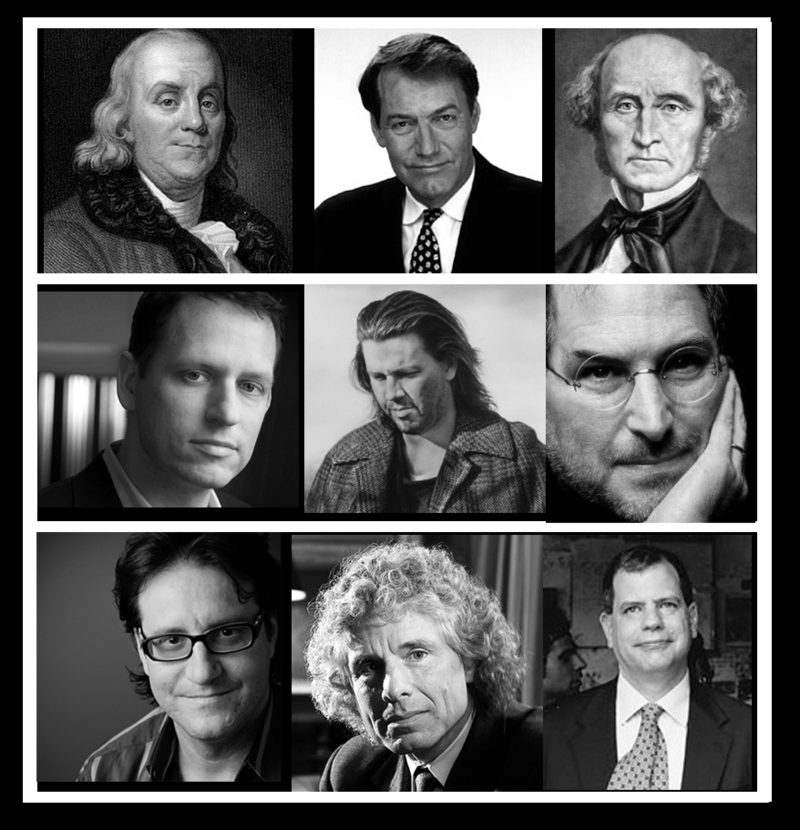
It got me thinking. Who else leaves me awed? Who are my icons? To shamelessly copy my friend Colin Marshall, I made a black-and-white portrait of nine people whose ideas or life-paths loom large in my own life, even if I don't know them personally or they are no longer alive. Click to enlarge the portrait.

Casnocha_icons2
 

"The people who are crazy enough to think they can change the world are the ones who do."

        – Steve Jobs

***

"The really important kind of freedom involves attention and awareness and discipline, and being able truly to care about other people and to sacrifice for them over and over in myriad petty, unsexy ways every day. That is real freedom. That is being educated, and understanding how to think. The alternative is unconsciousness, the default setting, the rat race, the constant gnawing sense of having had, and lost, some infinite thing…It is unimaginably hard to do this, to stay conscious and alive in the adult world day in and day out."

        – David Foster Wallace

***

"It's the ride that counts."

        – Brad Feld

***

"Precisely because the tyranny of opinion is such as to make eccentricity a reproach, it is desirable, in order to break through that tyranny, that people should be eccentric. Eccentricity has always abounded when and where strength of character has abounded; and the amount of eccentricity in a society has generally been proportional to the amount of genius, mental vigor, and moral courage which it contained. That so few now dare to be eccentric, marks the chief danger of the time."

        – John Stuart Mill

***

"Men want the same thing from their underwear that they want from women: a little bit of support, and a little bit of freedom."

        – Jerry Seinfeld

***

"Neuroscience is showing that all aspects of mental life — every emotion, every thought pattern, every memory — can be tied to the physiological activity or structure of the brain. Cognitive science has shown that feats that were formerly thought to be doable by mental stuff alone can be duplicated by machines, that motives and goals can be understood in terms of feedback and cybernetic mechanisms, and that thinking can be understood as a kind of computation."

        – Steven Pinker

***

"I suppose the basic intuition that I have about it is very simply, this is a world in which there is a possibility of things going extraordinarily well or extraordinarily badly, where both the good things and the bad things are bigger than people think."

        – Peter Thiel

***

"When we look up into the stars, we can choose among different feelings. On the sadder side, we can see emptiness and feel destruction and loss. But when I look up at the sky and gaze at the stars, I am joyful. I see a happy ending. I see interiority."

        – Tyler Cowen

***

"If you would not be forgotten
As soon as you are dead and rotten,
Either write things worthy reading,
Or do things worth the writing." 

        – Benjamin Franklin