A Grab Bag of Intellectual Goodies

A variety of goodies in the world of ideas in today’s New York Times. Here’s a grab bag:

Jim Holt has a well-written, punchy take on the new trend of "state sponsored soft paternalism". Informed, competent people still make choices not in their best interest. Should the state get involved? His example is gambling addicts.

The old “hard” paternalism says, We know what’s best for you, and we’ll force you to do it. By contrast, soft paternalism says, You know what’s best for you, and we’ll help you to do it…

What bothers [Libertarians] is the way soft paternalism relies for its justification on the notion that each of us contains multiple selves — and that one of those selves is worth more than the others. You might naïvely imagine that you are one person, the same entity from day to day. To the 18th-century philosopher David Hume, however, the idea of a permanent “I” was a fiction. Our mind, Hume wrote, “is nothing but a bundle or collection of different perceptions, which succeed each other with an inconceivable rapidity, and are in a perpetual flux and movement.” According to this way of thinking, the self that inhabits your body today is only similar to, not identical with, the self that is going to inhabit your body tomorrow. And the self that will inhabit your body decades hence? A virtual stranger. The idea of multiple selves may seem like a stoner’s fantasy, but economists who study human decision-making have found it surprisingly useful…

The general problem you face (as put by the political theorist Jon Elster) is this: For a given uphill goal and a given strength of will, does there exist a path, however circuitous, that will get you to the top of the hill? By adding a new path here and there, state soft paternalism makes it more likely that the answer will be yes.

•••

In his piece on plagiarism and how a sentence-level obsession might go too far, Charles Ishwerood writes this interesting graf:

With the rise of so-called reality-based entertainment and the surging popularity of the memoir as a literary form, it now seems that everybody’s life is a yet-to-be-developed television property or a memoir waiting to spring from the laptop, uncontaminated by the greedy depredations of the artist. The rush for self-fulfillment and self-expression that characterized the “Me” decade of the 1970s has evolved into a desire for maximum self-exploitation and self-commercialization in these early years of the 21st century, which might be dubbed the “Buy Me” decade. We’d be fools to let someone make a profit off our own backs, and so as a culture we become exercised at the idea of a writer making money by making use of experience or words not entirely his own.

•••

In his column on religion, Nick Kristof touches ($) on a new breed of "evangelical atheists". I do not believe in a higher power and I do not affiliate with any organized religion. In one sense, I’m an atheist, but I’m still "spiritual" (whatever that means). I always get a little uncomfortable with the intensity of hard core atheists, as if for them religion is the root of every possible evil in the world…ignoring how religion and religious institutions help a great many people:

The tone of this Charge of the Atheist Brigade is often just as intolerant — and mean. It’s contemptuous and even … a bit fundamentalist.

“These writers share a few things with the zealous religionists they oppose, such as a high degree of dogmatism and an aggressive rhetorical style,” says John Green of the Pew Forum on Religion and Public Life. “Indeed, one could speak of a secular fundamentalism that resembles religious fundamentalism. This may be one of those cases where opposites converge.”

•••

Riffing off Paul Tough’s education piece last Sunday, David Brooks notes ($):

But now, thanks to bitter experience and scientific research, we know that the best environments don’t liberate students. We know, or have rediscovered, that the most nurturing environments are highly structured. Children flourish in homes that are organized, in families where attachments are stable, among people who plan for the future and within cultures that celebrate work.

Many of today’s most effective antipoverty institutions are incredibly intrusive, even authoritarian.
Movie Review: Rushmore (Or How to Dominate High School While Pulling C's)

Rushmore is about a brilliant high school school student, Max, who runs every club conceivable on campus, edits the student newspaper, and produces stellar theater productions….all while nearly failing his classes. He ends up being expelled from school amidst his efforts to hit on a teacher at his school.

A few people recommend this movie to me awhile ago and now I know why. It’s basically my story (except for the "brilliant" and "hit on a teacher" parts).

Let there be no mistake: I barely passed through high school. In perhaps the most extraordinary moment in secondary school history, I went into my final science exam sophomore year with a C-, failed the final, and still came away with a C-, the lowest possible passing grade. I was put on an academic watch list. My parents got phone calls home about my poor performance. But I passed.

In the meantime, I was amassing a tremendously rewarding stranglehold on inter-school communications. At one point in time I was concurrently editing the school paper (print), running a mythical radio station (radio), co-running the all-school-meeting current affairs announcements (in-person), and blogging (web). In the winters, with my friend Jason junior year and Howard/Andy senior year, I was captaining the varsity basketball team, which provided important credibility in the jock world, too.

Like Max in Rushmore, there were dark times. There were times when I thought to myself, "What in God’s name am I doing?" I remember doing Comcate sales phone calls in the yoga room of the YMCA (where it was quiet) and thinking, "Why the hell won’t I just lift some weights and go home and study?"

But as my friend Chris has said, "For better or worse, entrepreneurship is like heroin. It’s risky, it’s dangerous, and you may end up in the street, but it’s almost impossible to kick the habit."

Max Ficher in Rushmore, a true life entrepreneur, understands this. In one of the best lines of the movie, Max is told that notwithstanding his incredible extracurricular contributions he has to get his grades up or else he’ll be expelled. When his friend asks him what he’s going to do about it, he replies, "There’s only one thing I can do, and that is petition the administration not to kick me out."

Atta baby. While some may consider his reaction unreasonable — or unwise, as he did get kicked out in the end — it wasn’t for lack of enthusiasm. Max Ficher tried to adapt his school to himself. As the British playwright George Bernard Shaw once observed, "Reasonable people adapt themselves to the world. Unreasonable people attempt to adapt the world to themselves. All progress, therefore, depends on unreasonable people." And progress, I should add, can still happen even if the individual fails in the attempt.

A great movie.

Is Original Thinking Orthogonal to Cognitive Speed?

While locked in a hotel room in Delhi I had an interesting email exchange with Chris Yeh and another partner-in-crime who prefers to stay anonymous.

Chris posed the provocative question, “Is processing power / having things come easily detrimental to original thinking?” In other words, is original thinking orthogonal to cognitive speed?

Say there are four kinds of thinking as far as creativity is concerned:

  • Original and swift
  • Original and slow
  • Derivative and swift
  • Derivative and slow

The best is original and swift (but rare!) and worst is derivative and slow. Of the remaining two boxes, which is a higher form of intelligence? Chris tells me he thinks I’m original and slow while he is derivative and fast, and that original/slow is the higher form. I don’t know if I agree!

Our partner noted that in some technical disciplines thinking “fast” helps you think creatively. For example, if you can’t do calculus and algebra in your head really quickly, it will be hard to generate original thinking about physics, and therefore original/slow may not be a workable style. In school, too, derivative/fast gets you much farther than original/slow.

What kind of thinking is more valuable in everyday business? Would you rather be a really fast thinker who refines the inputs of others, or a slower thinker but one who thinks new thoughts? What kinds of professions value original/slow versus derivative/fast?

Finished the Manuscript — Reflections on the Writing Process

Nearly two years ago I was sitting in a hotel room in Reno, Nevada with my basketball team at a tournament. I was focused on two things: dominating the boards on the court and dominating the buffet line in the restaurants. But I also had another side activity: my book. While my dear friends played poker, Austin reminded me I was parked on my bed banging away on the keyboard.

Yesterday, I turned in my manuscript (MS) for my book My Start-Up Life: What a (Very) Young CEO Learned on His Journey Through Silicon Valley. Since I am sitting here with just one of my nearly 200 excellent Christmas songs on iTunes humming from the speakers, I thought I’d reflect on the writing process.

First, some stats.

# Words in Final MS: 60,000

# Words Written But Not in Final MS: 30-40,000

# Pages in Microsoft Word: 260

# of Full Iterations / Drafts: At least 25

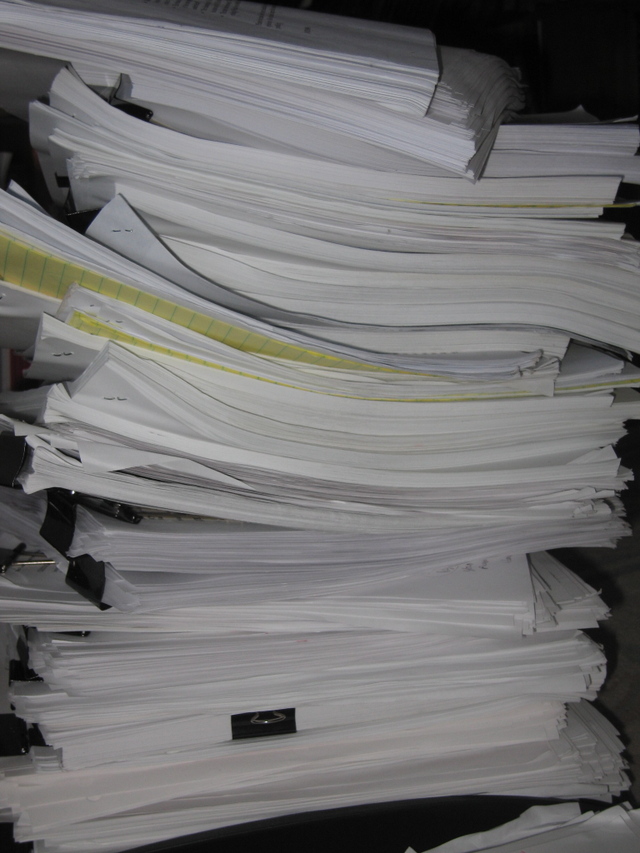
# of Hard copy pages printed for editing: ~8,000

First Line of the Book: It didn’t start with a dream.

Now, the process. My writing process was unconventional as far as non-fiction goes. I started writing a long time ago in quasi journal-entry form. I wrote an entire manuscript and then did a proposal and ultimately signed with a publisher (late September). Then I significantly re-worked the manuscript, with the help of my editor, to fit the new vision agreed to by the publisher and me. The new vision called for a more traditional "business book" rather than strict memoir. The book is my story written in a way that can aid and inspire other entrepreneurs.

Here are a grab bag of thoughts:Writingpost_1

Romanticization of Writing — For some reason I had this idea that writers stay up late at night with tea steaming on the side and write, write, write, and write…unable to stop. Maybe this is true for fiction, as you can get lost in the story. For my book there were times when I spent a couple hours doing solid writing, but the vast majority of time is writing a little and then editing, editing, editing. Changing words, re-organizing paragraphs, adding a better last line, etc. This is not nearly as romantic! It’s hard work.

Writing about Yourself — I believe it’s an order of magnitude more difficult to write about yourself than something / someone else. My book is not all about me, but I’m the central character and I write in the first-person voice. It is difficult to develop an authentic "voice," for one, and two, there’s the constant battle to project a tone that’s not arrogant but not too soft, either. Fortunately this blog gave me good practice.

Writing about Others — As a true story with real, living characters, I had to strike a balance between honesty and consideration for someone’s professional and personal reputation. In some cases I simply could not be as honest I would like. There are several pseudonyms used in the book.

Big Picture vs. Granular Edits — The easiest kind of editing to do is suggest word changes, fix grammar, and remove sentences. The hardest kind of editing to do is big picture ideas — does this paragraph fit in the big picture? Does this chapter work? What about this big issue that’s unaddressed? I found that most of the people who reviewed the MS focused on the granular stuff, which is super helpful in its own way. But now I know why the first time you read anything you’re supposed to read without a pen in hand because it can get distracting to start editing on the sentence level.

Feedback from Others — I received feedback from about 15 outside people. The core group included my editor, a secondary editor, my Dad who reviewed many drafts, Jesse Berrett who reviewed very early drafts, and then a half dozen business people who looked at a draft in early November. The outsiders who gave feedback had different profiles — ie young and old and different kinds of jobs. Since I was constantly making edits and updates, I knew they’d be reading an out-of-date manuscript. The quality of the feedback I got from reviewers varied. I mailed my business friends the MS on October 14. I turned in MS December 1. In that period of time I think it got 50% better.

I’m a huge proponent on getting feedback from others on your work. I recommend all writers distribute their work far and wide as often as they can. Be prepared to get contradictory suggestions. Also be firm about obtaining "candid feedback" — when you ask for opinions of friends, they might sugarcoat.

Obsession — During the last week of writing / editing I became totally obsessed with the MS. I had no idea it’d be this intense. I started canceling meetings and during the few dinners / lunches I kept scheduled I felt jittery and anxious to get back to my Word document. During the last two days I spent basically all light-hours working. I didn’t sleep very well through it all. The good news is I felt like by the end of this all-consuming period the MS improved quite a bit, the bad news is I felt like it could be even better! (Although, really, you could edit something for 10 years. At some point you must stop. 🙂

Plagiarism — Given my age, this was of heightened concern for me (and the Publisher). I’m happy to say I used no ghostwriter and did not, to my knowledge, plagiarize anywhere in the text. But I know there will be suspicions. I tried to be extra judicious in the Sources section to give proper credit for others’ ideas….at least those ideas I can clearly attribute to someone else. I’m sure I’ve internalized other people’s ideas and writing style without even knowing it.

Coordinating Actions — To reiterate the unromantic nature of the craft, I spent a huge chunk of time not writing but "coordinating actions". I had to get "braintrust" entries from friends who are contributing to the book, organize and collate edits, sign papers and fill out forms, and generally work with the Publisher on a variety of non-writing tasks such as legal agreements, copyright stuff, images, and so forth. If you’re not interested in organizing / communicating / facilitating, and solely want to be a "writer," you need to find someone to help you navigate the details.

Remembering the Reader — The best non-fiction remembers the reader on every page. A non-fiction book is a product a customer will pay money for. You’re always trying to serve the reader.

Tools — I used Tadalists to manage editorial tasks, marketing ideas, and a host of other random to-dos relating to the book. I wrote in Word in one big document which I backed up almost daily. I also had an "editing floor" document, "chapters in progress" document, "writing ideas" document, and a variety of other containers on my computer. I used del.icio.us to track things on the web that I wanted to use in my book.

Actually Doing It81% of the U.S. population feels like they have a book in them. This has been me for many years. Now I can say I’m a published author. I’m excited that I actually did it! I will probably write more books in the future.

So, what’s next? The book comes out in May. There’s a lot of marketing legwork to be done before then. In one sense, the work has only just begun…

Thanks to everyone who helped make this manuscript a reality. In particular: Neal Maille t, Peter Economy, and David Casnocha, among the dozens of others.

Flawed but Likable Characters

The recent Wall Street Journal profile of business book author Pat Lencioni contained this graf about why his business fables have done so well:

In a pattern he has since followed, Mr. Lencioni used tips from screenwriting, creating "likable but flawed" characters, building tension and dialogue, and changing scenes quickly.

Bingo. Not only is this key to good fiction writing, it’s also key, I think, when you construct and present your own identity to the outside world. We’re all flawed in some way. Likable people are open about it.

Being open about your flaws can be a form of self-deprecation. As Mark Katz says in Clinton & Me, "Self-depreciation is one of the most effective tools for leaders who want people to like and trust them, it communicates strength and grounding. Most people’s public personae are made up of 2-12 simple, widely known facts. If you concede the obvious you’re conceding nothing, but you gain back credibility. That’s a trade you should make every time."