Youthful Freedom from Status Worries and Societal Expectations

Young people are afforded more freedom to develop a cultural identity because they’re free from the "what will the neighbors think" status worries that belittle adults, Herbert Gans says, below, in Pop and High Culture. Granted, young people have status worries in their own worlds — school — and the question is probably "what will the cool kids think?". Still, there is a certain luxury to being able to wear sweatpants around the neighborhood and know that people will just accept it because you’re young, whereas if an adult wanders around in sweatpants there may be a suspicion that he has no taste of fashion, that he can’t afford nicer pants, or that he’s counter-signaling to show wealth.

As people become older — and worry about protecting their property values and status levels as well as discouraging their children from finding mates from inappropriate class backgrounds — cultural choice may be one area in which limits are now set. No one knows whether and at what point in today’s life concern about "what will the neighbors — that is, those of equal or higher status — think" begins, or when people begin to feel that they are too old to enjoy rap music.

In addition to being free from status worries, a young person is also free of most every expectation of society because you are always "learning" and "finding yourself." As you get older you are expected to become more predictable, to fit in a certain box. This affords a virtually risk-free playhouse for a young person. If you try a new job and it doesn’t work out, quit. If you marry someone and it doesn’t work out, divorce. If move to a new city and it doesn’t fit, move again. The consequences of failure in each example are greater by an order of magnitude if you wait 10 years. For now, you’re "learning."

That’s why I think it’s insane for people to spend their 20’s doing something that has a low cost of failure.

American Chinese Food vs. Chinese Food and Globalization of Cuisine

American crepes are not like French crepes.

American Japanese food is like Japanese food, in my brief experience.

American Chinese food is a mixed bag. If you go to Chinatown I think you can find a lot of similarities between what’s actually eaten in China and what’s eaten in an American Chinatown.

But for most of us who order take-out or eat at that cheap place down the street, it’s more different than alike. Here in China I’ve seen more meat sans sauces. It’s more spicy here, too. At the Chinese place I eat from in SF you can order soft tortilla wraps and stuff it with “musho pork” – a mix of lettuce and meat. In Beijing, you are supposed to dip Peking Duck into the dark sauce and then wrap the tortilla around the duck. Much different. I’ve also seen no sweet and sour chicken and no chow mein. Just one example of a tactical difference.

China is also a HUGE country and the food varies from region to region. Americans probably only eat from one region or the most popular flavors from each region.

While I’ve liked the Chinese food I’ve eaten, I probably like Japanese better.

My opinion on globalization and cuisine is that the very best Chinese food in San Francisco is probably as good as the very best Chinese food in Beijing. A five-star French restaurant in San Francisco is probably as good as a five star French restaurant in Paris. But, you’ll find many more “very best” French restaurants in Paris than in San Francisco. What you get in the native land is more quantity of the five star. Also, a “pretty good” French restaurant in Paris will likely be better than a “pretty good” French restaurant in San Francisco. The equality only exists at the top tier.

The Beijing Duck

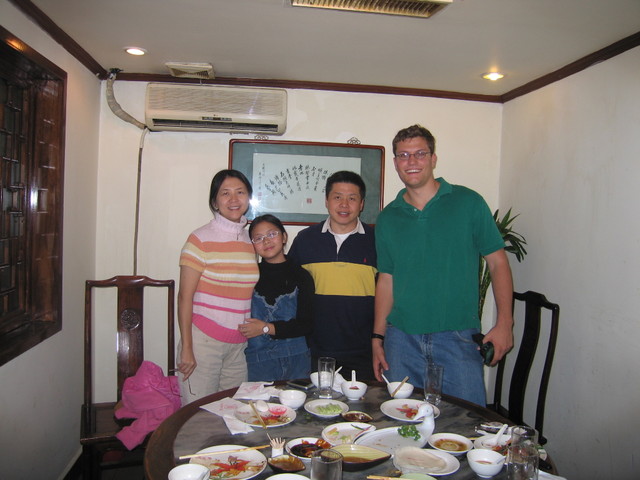
I had a fantastic lunch on Saturday with Catherine Cao of the China Environmental Fund, a VC firm that invests in green tech and businesses with an environmental/social conscious, and her husband Peter, who formerly was involved in IBM’s public sector CRM in China and now runs a software company.

When they asked what my preference for food was I replied as I always do, "Take me some place where locals eat, some place that I wouldn’t otherwise go in to." They took me a popular and high end restuarant that serves Beijing style Chinese food. Fantastic food! And I have to say: the Beijing duck is world famous for good reason.

The locals dip the duck into two kinds of sauces and then wrap it in a tortilla. I did that and also ate it raw. The crust of the duck — which is suppose to be the least healthy for you — was so sweet and tender. You must try it.Catherinepeter

Our conversation was fun too. Given the terrible pollution in China, I’m stoked someone as smart as Catherine is trying to make a difference (and take advantage of a huge opportunity) through the VC model, and both she and Peter had good insights on the current business and political scene in China.

Thanks guys for a great Beijing lunch!

The Morality of 5-Star Visits in the Developing World

I got a private email from a friend who expressed sympathy about my malaria medicine / Dalian disaster but also suggested “Some attitude adjustment may go a long way to making you realize how fortunate you are to see the world from this perspective and how enriched your life will be from doing so.”

His email and my response made me think of a larger point I wanted to raise, which is the supposed correlation between the difficulty of adventure and the resulting cultural experience.

When Nicholas Kristof of the New York Times gave a ringing endorsement ($) of gap years he said:

A student might, for example, start off teaching English and studying Latin American history in Ecuador, then learn Chinese intensively in Chengdu, then work at an AIDS clinic in Botswana while reading African literature on the side, and finish up by studying Islamic history in Istanbul. In each place, the students would live with local families.

Since the best way to learn about public health challenges is to endure them, I would also suggest offering extra credit for any student who gets malaria…

As a student backpacker myself in India two decades ago, I once lined up with the beggars and lepers of Amritsar to get free gruel from a Sikh temple — but that embarrassed even me.

In any case, all this suffering builds character…

Over a year or so, the kids would figure out how to catch rides with trucks north over the Sahara, then hitchhike through the Middle East and across Central Asia. After a temporary job in Calcutta to earn a few rupees, they could migrate through East Asia and then make enough money as tutors teaching English in China to buy cheap air tickets home.

I agree international travel builds perspective and character. Hell, that’s why I’m here in Asia. But I want to hone in on Kristof’s assertion that suffering builds character. So if I went to a really shitty 3rd world country and hung out with beggars would my character be strengthed more than if I stayed at a four star hotel in Beijing? Would bouncing my way through an African war zone provide more culture and perspective than walking through the backroads of a safe, quiet Italian village? Would riding a shitty five hour bus in Ecuador provide something “more” than a guided tour of Hawaii’s volcanoes?

It’s clear to me that these are all very different experiences, but I’m not sure you could argue that one is better than the other, or that somebody who roughs it is more moral or cultured, or is to be held in higher esteem than someone who “plays it safe.”

My attitude is: do it. Travel. Go somewhere. Explore. Grow because of it. But don’t feel bad if you can afford the loveliness of Zurich and that strikes your fancy. It’s not an AIDS clinic in India, but it’s not home, either. I feel the same about philanthropy: do it. Giving to needy causes is better than giving to the opera, but giving at all is good in itself.

Unfortunately, I think many young people hesitate when pondering an international adventure, because they feel like if they’re not sleeping with lamas they are somehow letting down Kristof and the rest of society’s adventurers.

I was born in arguably the richest region (Silicon Valley) in the richest state (California) in the richest country (US) in the world. Each day at school we were reminded how privileged we were and often presented with a picture of a starving baby in Africa. This creates an enormous sense of guilt — the intentions are pure, but the effect is often counterproductive. This guilt can mean we don’t take certain actions for fear of exacerbating our uncomfortable feelings of first-world privilege.

When I was in Florence over the summer I got hooked up through an organization with a host who lived in a dump, was dirt poor, and told me to sleep on a mosquito infested futon. The next morning I left his shack and checked into a hotel which served a warm breakfast, offered a comfy bed, and had wireless internet. Guilty as charged: I like modern accouterments. I like internet and warm showers and warm beds. I’m lucky enough to afford to check into a low cost hotel in Florence. And yet why did I not qualify as a “student backpacker” in Europe? Because I wasn’t sleeping in parks, wasn’t wearing shirts 4 days old, wasn’t sharing meals with a beggar.

Which brings us, after some rumination, back to my Dalian adventure. The food I ate there was terrible. I suppose I could have reacted, “This is the local food, learn to enjoy it, appreciate it.” I didn’t. My reaction was, “This is the most processed, vile lamb I’ve ever sunk my teeth into.” Am I selling myself short with this response?

To anyone from a first-world country pondering an international adventure into the developing world, I say, “Do it” and don’t feel bad if you’re not as courageous as the next guy to live and eat just as the middle class locals do. You’ll get a different experience, but it will still be mind expanding in many ways.