The Art of the Interview – How to Ask Good Questions

The American Journalism Review has an article in their October issue on John Sawatsky, a Canadian journalist who’s become a leading authority on the art of the interview. "His conclusion: too often we’re asking all the wrong questions."

The art of asking good questions is a skill useful in so many areas: journalism, of course, but also on sales calls, in focus groups, or simply during a chat with a personal friend who’s gone to you for help. Money grafs:

Resist the temptation to converse, sympathize, and add value or meaning to questions, he says; use short, neutral questions that repeat the source’s own words. If the source makes a value-laden statement–for example, "Brian can be excessive at times"–follow up with: "What do you mean, excessive?" …

Ask a closed-ended question and sources "will confirm or deny 98 percent of the time. That’s the science." The unpredictable part is what happens next. "Socially, people are taught to add a postscript to a confirmation or a denial. As journalists, we hope the P.S. will describe or explain the issue we’ve raised. That’s interviewing by accident. If you get somebody who doesn’t want to play, you’re in trouble." …

Instead of asking Sarah Ferguson, for example, "Is it hard being a duchess?" ask: "What’s it like being a duchess?" Instead of asking Ronald Reagan, "Were you scared when you were shot?" ask: "What’s it like to be shot?" …

The best questions, argues Sawatsky, are like clean windows. "A clean window gives a perfect view. When we ask a question, we want to get a window into the source. When you put values in your questions, it’s like putting dirt on the window. It obscures the view of the lake beyond. People shouldn’t notice the question in an interview, just like they shouldn’t notice the window. They should be looking at the lake."
"I get it," says a voice from the back of the room. "Mike Wallace is like a stained-glass window."
"That’s right," Sawatsky says. "Stained-glass windows are beautiful to look at, but it’s all about the window, not about the view."

Life at the Border is Most Interesting Because Contrasts Are Illuminated

Life at the border is the most interesting.

All conflicts in the real world happen at the borders of countries. Once as a kid I had two feet and two hands in four different U.S. states at one time (UT, NM, CO, and AZ) and I felt more alive. Cross a border in Europe, as I have done many times the past two months, and you experience a whole new language, sense of style, and dinner time.

The border is most interesting because it’s where contrasts are illuminated. Contrast drives everything. Contrast is important for good decision making — you need to know what your alternatives are.

Physically traveling puts you at the borders of the world and literally provides cultural contrasts. But I wonder if we could extend this idea to thinking. We all need to have a “home” somewhere — that is, a few core strengths, an industry we understand, a customer segment that’s familiar — but increasingly leaving home and thinking at the border is necessary. Spend time in new industries. Take new kinds of risks. Most important, expose yourself to new kinds of people.

I spoke with an executive the other day who hired artists — painters, sculptors — to live in the office of a services company. The artists were asked to do what they did everyday: make art. It had no apparent relevance to the services company at all. But something interesting happened. At lunchtime the artists would sit and talk with the company’s employees. They’d hang their art in the offices of the company. They’d mingle and mix at company social events. In short, this company served as a patron to random artists because they bet the artists’ presence and way of thinking would have a positive, indirect impact. It did indeed. That company placed itself at the border of their industry and the world of modern art.

How can you get closer to the border in your world?

(Hat tip: Pierre Claus for the conversation sparking this post)

Funny Business: Using Humor to Thrive in the Professional World

Each quarter the Silicon Valley Junto, a discussion forum for business and technology executives that Chris Yeh and I run, gathers to discuss an intellectual topic that’s not directly related to business or technology. It’s an invitation-only lunch held on the peninsula and in San Francisco.

Our topic this quarter was: Funny Business: Using Humor to Thrive in the Professional World.

At the Trinity Ventures office in Menlo Park about a dozen super interesting people gathered to analyze this very serious issue. In San Francisco, at the North American headquarters of Comcate, Inc., a dozen people from slightly different backgrounds (more women, more non-profit heads) tackled the same topic.

Check out the notes from the meeting for the insights we collectively gathered. If you want them in more organized fashion you’ll have to wait for the e-book on humor Chris and I are writing. Here’s Tim Taylor’s useful post about the meeting, and Jackie Danicki’s post.

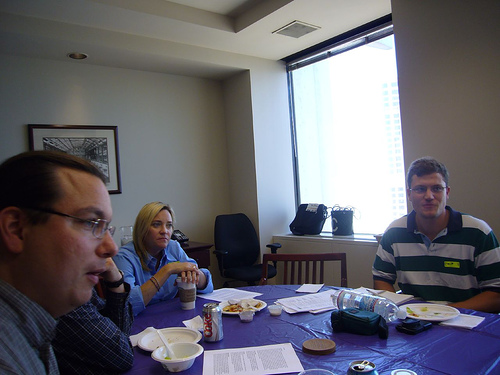
Here are photos from the two meetings on Flickr.

214287951_61194fa64f 212845974_b996860b4f

Each Day, Go Through a Recruiting Motion

I asked my friend Mike Bateman recently how he helps the companies he’s on the board of. He said the #1 way he helps is with recruiting new people. A+ people are really hard to find. Recruiting should be something companies do everyday even if they’re not hiring so that when they do need someone there’s a developed contact base of local candidates. Staying in touch with candidates — either jobless or employed elsewhere that you’d want to poach — also makes it easier to fire underperforming people.

I agree with Mike that finding good people is perhaps the hardest part of a growing start-up, and that each morning on the way to work the CEO should “go through a recruiting motion” — i.e. think about connecting with possible future employees of his/her company.

Those Profound Words of Advice People Get From Mentors

When successful people are interviewed they are often asked, “What was the best piece of advice someone gave to you or you would give others?” Their answers are usually cliches or things we all hear.

“Take risks and make mistakes.”

“Be thankful for adversity.”

“Hire above yourself.”

“Hold high ethical standards.”

Most good life truisms are all written down and simply rearranged in fancy sentence structures. So why do successful people always cite these as super important in their lives? Couldn’t they just have read a book of wisdom nuggets early on?

My theory is that “wisdom nuggets” and all self-help books have little to do with their content or actual message, and more about the person consuming the nugget. It depends on where you are in your life or what mood you’re in. It depends on the context of the recipient.

When I was grappling with an ethical issue once a couple years ago that involved my company, my first and close mentor Mike Patterson told me, “Ben, you can rationalize your behavior to do anything you want.” Hey, I’ve read some psychology, I know we’re able to rationalize anything, those words aren’t particularly novel. But given the time and place and situation, they were profound, and I won’t forget them. In addition, the most influential self-help book I’ve read, The Power of Full Engagement, may not be influential in your life.

So anytime somebody tells me a book or a quote or a person changed their life, I always ask: Was it the book, or was it you?